
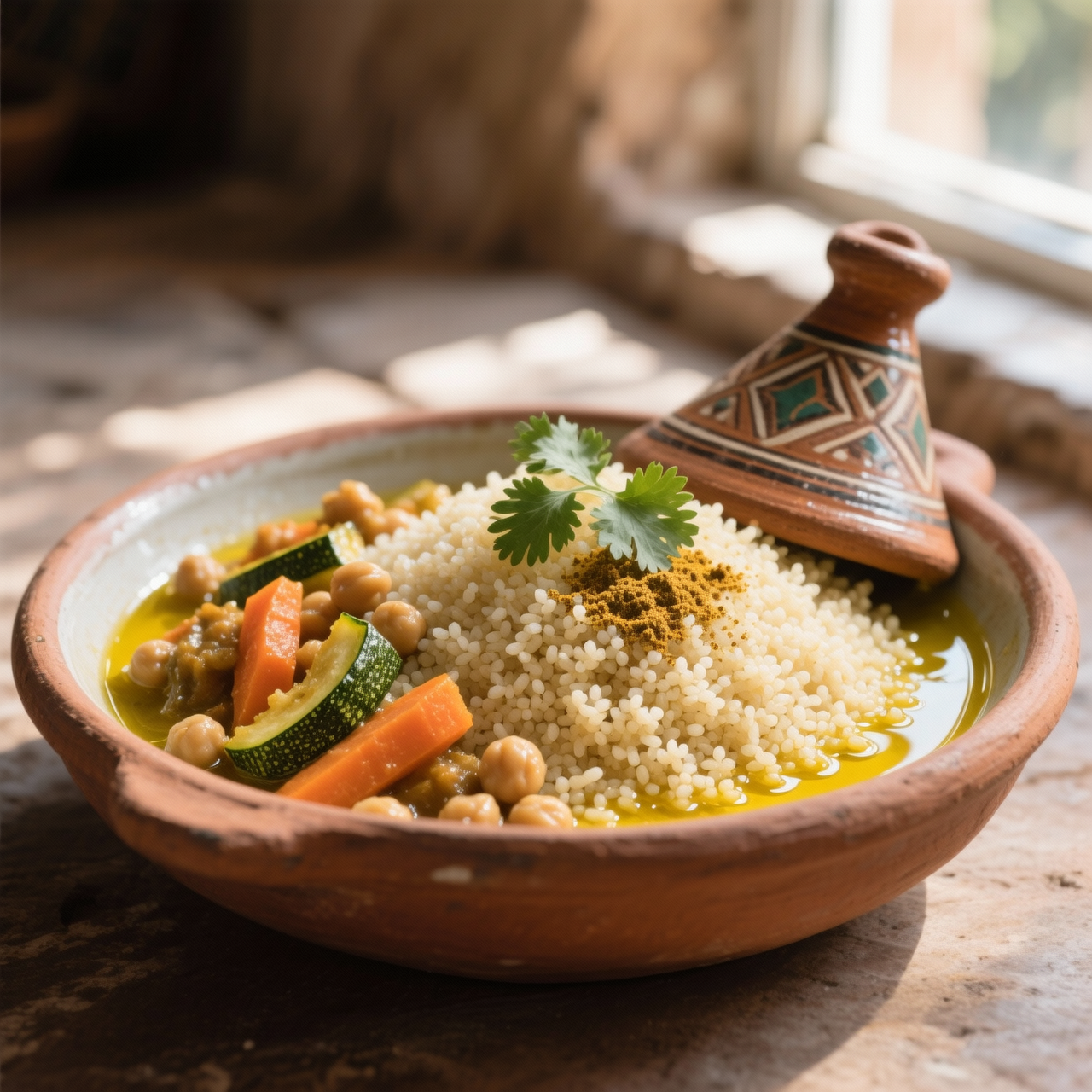
Hand-rolled couscous
When I first learned to coax coarse semolina into perfect granules, I was in a sunlit courtyard in Marrakech, watching a grandmother’s hands move with a steady rhythm that felt almost like breathing. Hand-rolled couscous is the quiet architectural foundation of Moroccan cooking, a side dish that carries generations of patience in every single sphere. Today, most cooks simply tear open a plastic-wrapped box of instant couscous for roughly three dollars, tossing the pre-gelatinized pellets into boiling water and hoping for the best. That factory shortcut is fundamentally flawed; the grains are mechanically extruded, precooked, and dried until they turn uniformly soft and gummy, completely sacrificing the delicate bite that defines the real thing. Making it by hand matters because you reclaim the very texture of the grain. You begin with just fine durum semolina, a pinch of sea salt, and measured splashes of water, gently working them together until the flour begins to clump, then rolling the damp mixture across a wide tray until the granules separate into even pearls. The most common pitfall is drowning the semolina with too much water at once, which instantly creates a heavy paste instead of discrete grains. Another frequent misstep is skipping the repeated sifting and drying phases, leaving behind dense clumps that steam unevenly. When you properly air-dry the finished batch on a linen cloth, it stores beautifully and yields a light, fluffy side that absorbs broths without collapsing. The from-scratch method costs pennies per portion, delivers a clean, nutty flavor, and elevates a simple pantry staple into something deeply restorative. Once you feel the exact moment the grains roll cleanly between your palms, you will never reach for a cardboard box again.
Nutrition
| Per serving | Calories | Protein | Carbs | Fat | Sat fat | Fibre | Sugar | Sodium |
|---|---|---|---|---|---|---|---|---|
| beginner | 265kcal | 8g | 46g | 5g | 1g | 3g | 0g | 290mg |
| intermediate | 195kcal | 6g | 38g | 2g | 0g | 2g | 0g | 150mg |
| expert | 340kcal | 12g | 68g | 2g | 0g | 4g | 0g | 8mg |
Per serving · Ava-estimated — a guide, not a clinical figure.
- 500 gSemolina flour— Fine or medium grind works best for traditional texture
- 150 mlWater— Add gradually to control moisture absorption
- 30 mlOlive oil— Coats granules to prevent clumping during rolling
- 5 gSea salt— Fine grain ensures even seasoning throughout
This beginner-friendly approach strips away the intimidation of traditional couscous rolling while strictly avoiding any processed packet mixes or instant shortcuts. Store-bought instant couscous costs roughly two to three dollars per box but relies on highly refined, pre-gelatinized semolina that turns mushy when reheated and lacks the distinct, separate granule texture that defines authentic Moroccan sides. By making it from scratch, you pay pennies per portion and gain a fluffy, resilient grain that holds sauces beautifully. The technique here focuses on a forgiving wet-sand hydration ratio and a simplified rubbing motion using your fingertips rather than a traditional wide wooden tray. Watch for the critical moment when the mixture stops sticking to your hands and begins to crumble naturally, which signals perfect hydration. We skip the laborious multi-stage sifting and multiple steamings used by professionals, opting instead for a single, gentle steam in a standard colander lined with a clean cloth. The result is a reliable, restaurant-quality base you can batch-cook, air-dry, and store in an airtight jar for months, ready to fluff into hot water whenever needed.
Equipment
- Large wide mixing bowl— ceramic or stainless steel works best
- Fine-mesh sieve— for uniform granule size
- Steamer basket or colander— must fit over a pot with a lid
- Clean cotton kitchen towel— cheesecloth is an acceptable substitute
Method
- 1
Combine coarse semolina, fine salt, and olive oil in a large mixing bowl.
Use coarse semolina for the best granule structure.
mixing~ 2 min - 2
Sprinkle lukewarm water over the semolina while vigorously rubbing the mixture between your palms.
Add water gradually until it resembles damp beach sand.
hydration~ 5 minTricky bit - 3
Cover the bowl and let the granules absorb the moisture for ten minutes.
This resting period ensures even hydration without clumping.
resting~ 10 min - 4
Rub any remaining lumps between your fingers and pass the couscous through a fine-mesh sieve.
Reserve oversized clumps for soup thickeners or discard them.
sifting~ 3 min - 5
Spread the granules over a cotton cloth inside a steamer basket and steam over gently boiling water.
Keep the grains loose to ensure proper airflow.
steaming~ 15 minTricky bit - 6
Transfer the hot couscous back to the bowl and gently toss with a fork to separate the grains.
The grains should be light, fluffy, and completely distinct.
fluffing~ 2 min
Cooking from frozen
Thaw overnight in the fridge, then re-steam gently with a splash of water and fluff with a fork.
Storage times are a guide — always use your judgement and store food safely.