
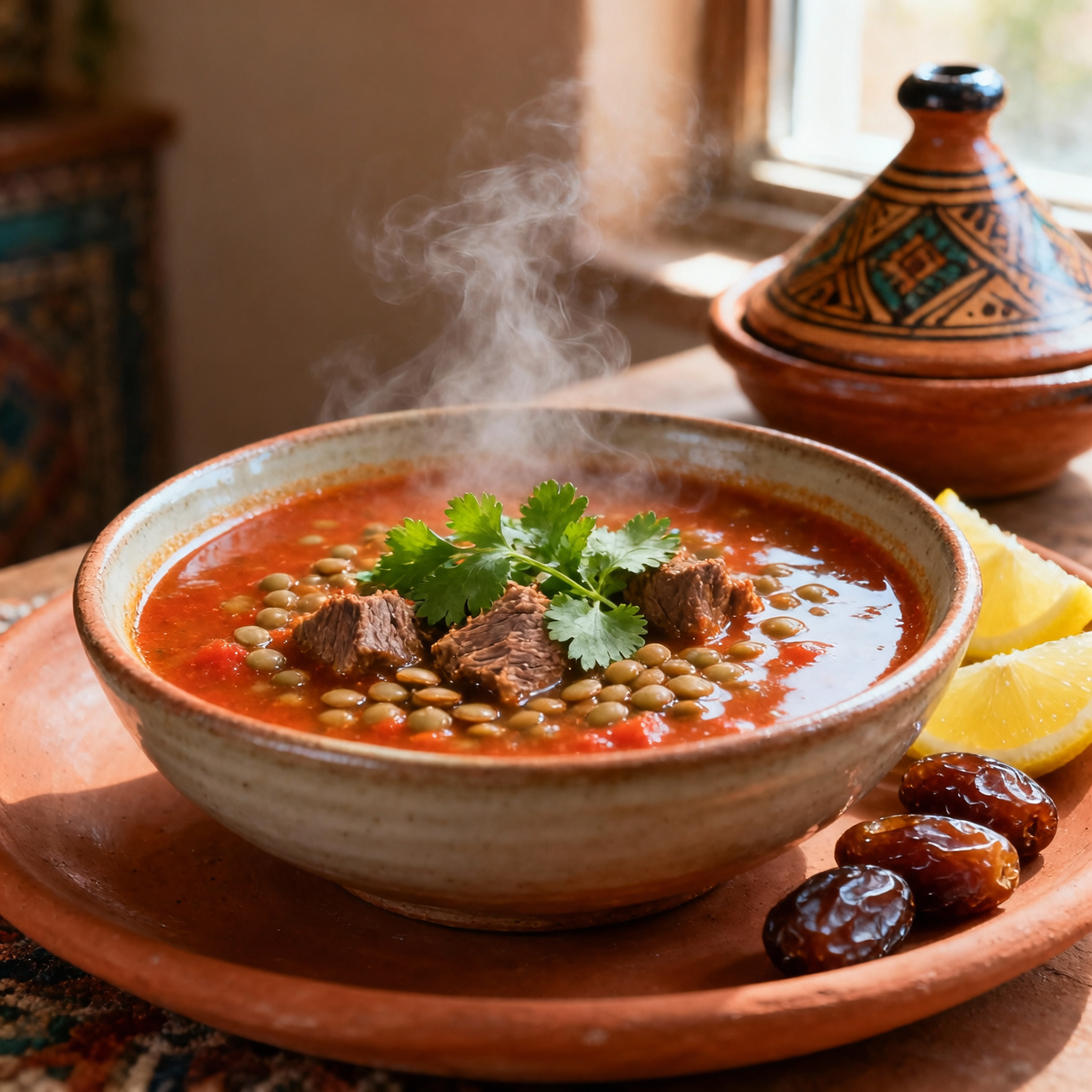
Harira
When I first learned to coax the deep, earthy warmth of harira from a simmering pot, I quickly realized this is not merely a soup. It is a living chronicle of Moroccan hospitality. Born from the bustling medinas of Fez and Marrakech, this traditional starter emerged centuries ago as a nourishing way to break the Ramadan fast, though its roots stretch back to Berber agricultural traditions that prized slow-cooked grains, legumes, and tender cuts of meat. To me, harira matters because it bridges generations. It is the first bowl offered to weary travelers and the quiet centerpiece of evening gatherings, carrying the weight of shared history in every fragrant spoonful. Yet, for all its comforting familiarity, it is surprisingly easy to misstep. I have seen well-meaning cooks rush the tomato base until it turns sharp and acidic, or drown the broth in cinnamon and saffron until the delicate balance collapses into heaviness. Another frequent mistake is skipping the final tadouira, the flour and water slurry that gives the soup its signature velvety body, leaving behind something thin and forgettable instead of luxuriously cohesive. Patience is nonnegotiable here. The chickpeas and lentils must soften gradually, the herbs need time to bloom without wilting into bitterness, and the lemon juice should only ever be stirred in at the very end to brighten rather than curdle. When you respect that rhythm, the result transcends mere sustenance. It becomes an invitation, a quiet promise that no one who sits at your table will ever leave hungry or unloved.
Nutrition
| Per serving | Calories | Protein | Carbs | Fat | Sat fat | Fibre | Sugar | Sodium |
|---|---|---|---|---|---|---|---|---|
| beginner | 620kcal | 30g | 66g | 27g | 8g | 14g | 11g | 1380mg |
| intermediate | 620kcal | 30g | 66g | 27g | 8g | 14g | 11g | 1380mg |
| expert | 620kcal | 30g | 66g | 27g | 8g | 14g | 11g | 1380mg |
Per serving · Ava-estimated — a guide, not a clinical figure.
- 300 glamb shoulder— trimmed of excess fat and cut into 2cm cubes
- 150 gyellow onion— peeled and finely diced
- 100 gcelery stalk— washed and thinly sliced
- 100 gdried brown lentil— rinsed thoroughly under cold water
- 200 gcanned chickpea— drained and rinsed
- 60 gtomato paste— concentrated, not diluted
- 400 gcrushed tomato— preferably San Marzano variety
- 20 gfresh ginger— peeled and finely grated
- 5 gground turmeric— freshly milled for optimal color
- 3 gground cinnamon— Ceylon variety preferred
- 2 gground black pepper— coarse grind
- 0.5 gsaffron thread— soaked in warm water before use
- 30 gfresh cilantro— leaves and tender stems only
- 30 gfresh parsley— flat-leaf, finely chopped
- 80 gvermicelli noodle— broken into 5cm lengths
- 30 gall-purpose flour— sifted to prevent clumping
- 45 mlextra virgin olive oil— high-quality for base flavor
- 1500 mlwater— filtered or low-mineral
- 1 piecefresh lemon— juiced and zested separately if desired
- 10 gfine sea salt— added gradually to taste
This version strips away the intimidation factor while preserving the soul of the dish. You will rely on a few strategic shortcuts to build a robust flavor base quickly, such as using pre-minced aromatics and a ready-to-use spice blend that mirrors traditional Moroccan profiles. The thickening process is simplified into a quick whisk-and-pour method that prevents lumps without demanding constant attention. Watch your heat closely when adding the noodles; they cook rapidly and can turn mushy if left to simmer too long. I recommend tasting for acidity before finishing, as jarred tomato products often vary in sweetness. This approach guarantees a confident first attempt with minimal cleanup and maximum comfort. You will learn the foundational layering sequence which you can apply to countless other soups. Keep your stirring gentle to avoid breaking down the chickpeas, and trust the clock. When the lentils yield to gentle pressure and the broth coats the back of a spoon, you have succeeded. This is your gateway to mastering a dish that has fed generations.
Equipment
- Heavy-bottomed pot— Dutch oven preferred for even heat
- Wooden spoon— for gentle stirring
- Fine mesh strainer(optional)— optional for rinsing legumes
Method
- 1
Heat olive oil in a heavy pot over medium heat and sauté diced onion and celery until softened.
Vegetables should turn translucent but not brown.
sweating~ 5 min - 2
Add tomato paste, ground turmeric, cinnamon, pepper, and saffron threads to the pot and cook until fragrant.
Stir constantly to prevent burning the spices.
blooming~ 1 minTricky bit - 3
Pour in water, crushed tomatoes, drained chickpeas, lentils, and cubed lamb, then bring the mixture to a gentle boil.
Scrape the bottom to release any stuck fond.
simmering~ 15 min - 4
Reduce heat to low, cover partially, and let the soup cook until the meat is tender and lentils are soft.
Skim excess foam from the surface if needed.
braising~ 20 min - 5
Whisk flour with cold water in a separate bowl until completely smooth, then slowly stir into the pot to thicken.
Add gradually to control final viscosity.
tempering~ 3 minTricky bit - 6
Add broken vermicelli, fresh herbs, lemon juice, and salt, then cook briefly until noodles are tender and serve immediately.
Pasta absorbs liquid rapidly off heat.
finishing~ 5 minTricky bit