
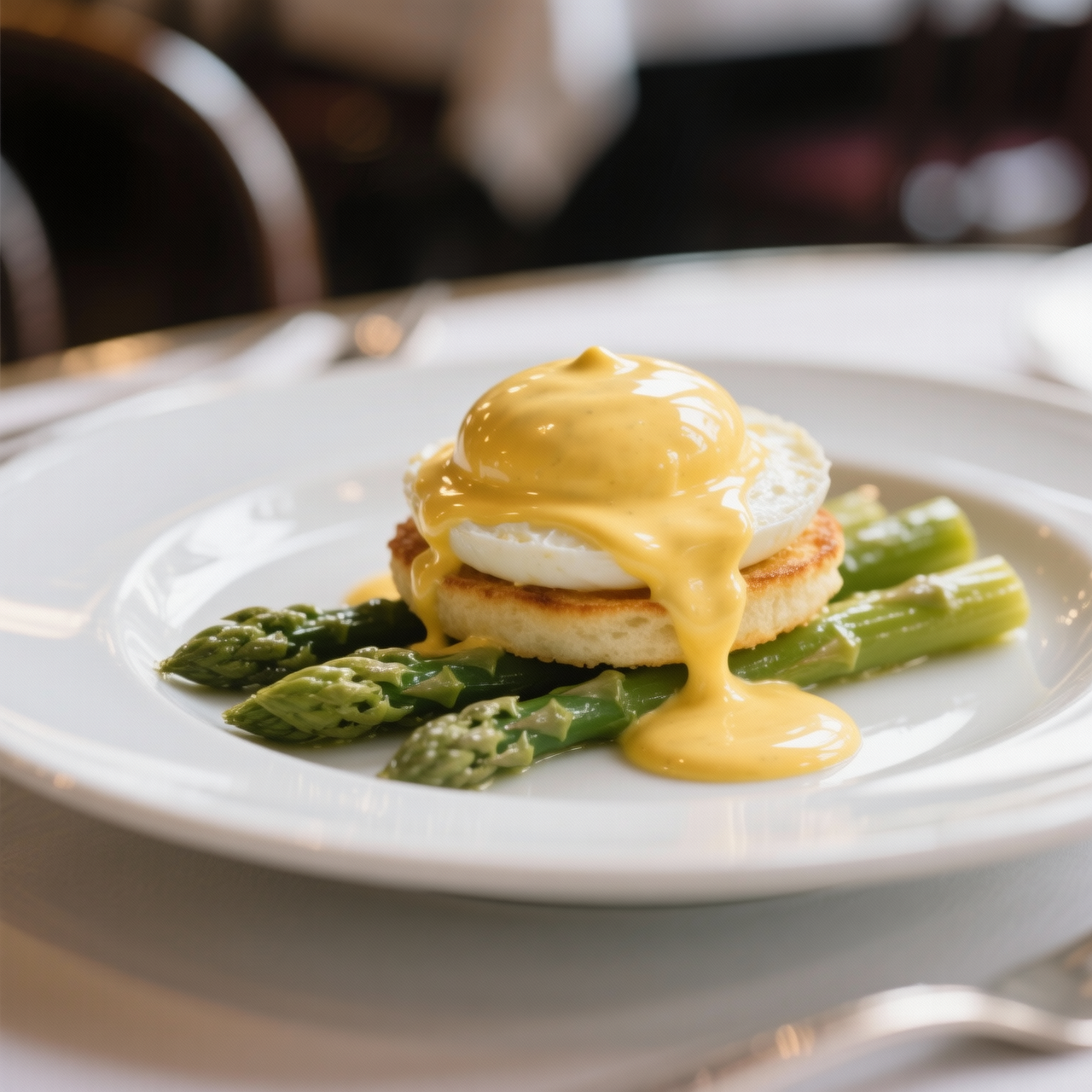
Hollandaise
Hollandaise has always felt to me like the quiet heartbeat of French brunch, a deceptively simple sauce that demands absolute respect. Born in the grand kitchens of nineteenth-century France, it likely evolved from earlier emulsions like sauce magnonnaise, eventually taking its name from the French word for the Netherlands, perhaps as a nod to Dutch dairy traditions or simply as a fashionable culinary flourish. What makes it so vital is its transformative power: a mere ribbon of pale gold can elevate humble asparagus, poached eggs, or delicate fish into something that feels celebratory and deeply comforting. Yet, for all its elegance, hollandaise is notoriously temperamental. The emulsion is a delicate negotiation between heat, fat, and acid, and it will break at the slightest provocation. Too hot, and the egg yolks scramble into bitter curds; too cold, and the butter refuses to bind, leaving you with a greasy, separated puddle. The secret lies in patience and gentle, consistent whisking, maintaining a temperature just shy of simmering while slowly coaxing clarified butter into the yolks. I always keep a bowl of ice water nearby, ready to arrest the heat the moment the sauce thickens. Many cooks rush this step, hoping for a shortcut, but hollandaise rewards only the attentive. It must be made fresh, served immediately, and never left to sit, as its structure is inherently fleeting. When you master it, though, the result is a luxuriously smooth, tangy silk that tastes like pure culinary intention.
Nutrition
| Per serving | Calories | Protein | Carbs | Fat | Sat fat | Fibre | Sugar | Sodium |
|---|---|---|---|---|---|---|---|---|
| beginner | 245kcal | 3g | 1g | 26g | 14g | 0g | 0g | 160mg |
| intermediate | 280kcal | 4g | 0g | 29g | 17g | 0g | 0g | 160mg |
| expert | 385kcal | 4g | 2g | 41g | 24g | 0g | 1g | 310mg |
Per serving · Ava-estimated — a guide, not a clinical figure.
- 60 gegg yolk— large, room temperature
- 225 gbutter— unsalted, melted and kept warm
- 15 mllemon juice— freshly squeezed
- 2 gsalt— fine sea salt
- 0.5 gwhite pepper(optional)— freshly ground
- 15 mlwater— for initial whisking
This beginner-friendly Hollandaise completely bypasses the traditional double-boiler whisking in favor of a highly reliable blender shortcut. By utilizing room-temperature ingredients and a controlled stream of gently melted butter, you can build a stable, silky emulsion without the constant fear of scrambling your yolks or breaking the sauce. The real secret lies in maintaining a slow, steady pour while the motor runs, allowing the fats and liquids to bind effortlessly. Keep a close eye on the texture as it transforms into a thick, ribbon-like coating that effortlessly clings to a spoon. Always serve immediately to capture the ideal mouthfeel, and if the sauce tightens too much while resting, whisk in exactly one teaspoon of warm water to restore its luxurious drape. This method guarantees a confident, stress-free first attempt with consistently professional results.
Equipment
- Countertop blender— Ensure lid has a removable center cap for pouring
- Small saucepan— For gentle butter melting without scorching
- Rubber spatula(optional)— For scraping down sides before final blend
Method
- 1
Melt the butter in a small saucepan over low heat until just liquid and warm.
Do not let it bubble, foam, or turn brown.
melting~ 2 min - 2
Place egg yolks, lemon juice, Dijon mustard, and a pinch of salt into the blender jar.
Room-temperature ingredients blend more smoothly and emulsify faster.
base prep~ 1 min - 3
Turn the blender to medium speed while slowly streaming the warm butter into the mixture.
Pour a thin, steady stream to prevent breaking the emulsion.
emulsification~ 2 minTricky bit - 4
Blend for ten more seconds until glossy and thick, then pour into a warmed serving vessel.
Keep the bowl warm over hot tap water until plating to maintain texture.
finishing~ 1 min
Storage times are a guide — always use your judgement and store food safely.