
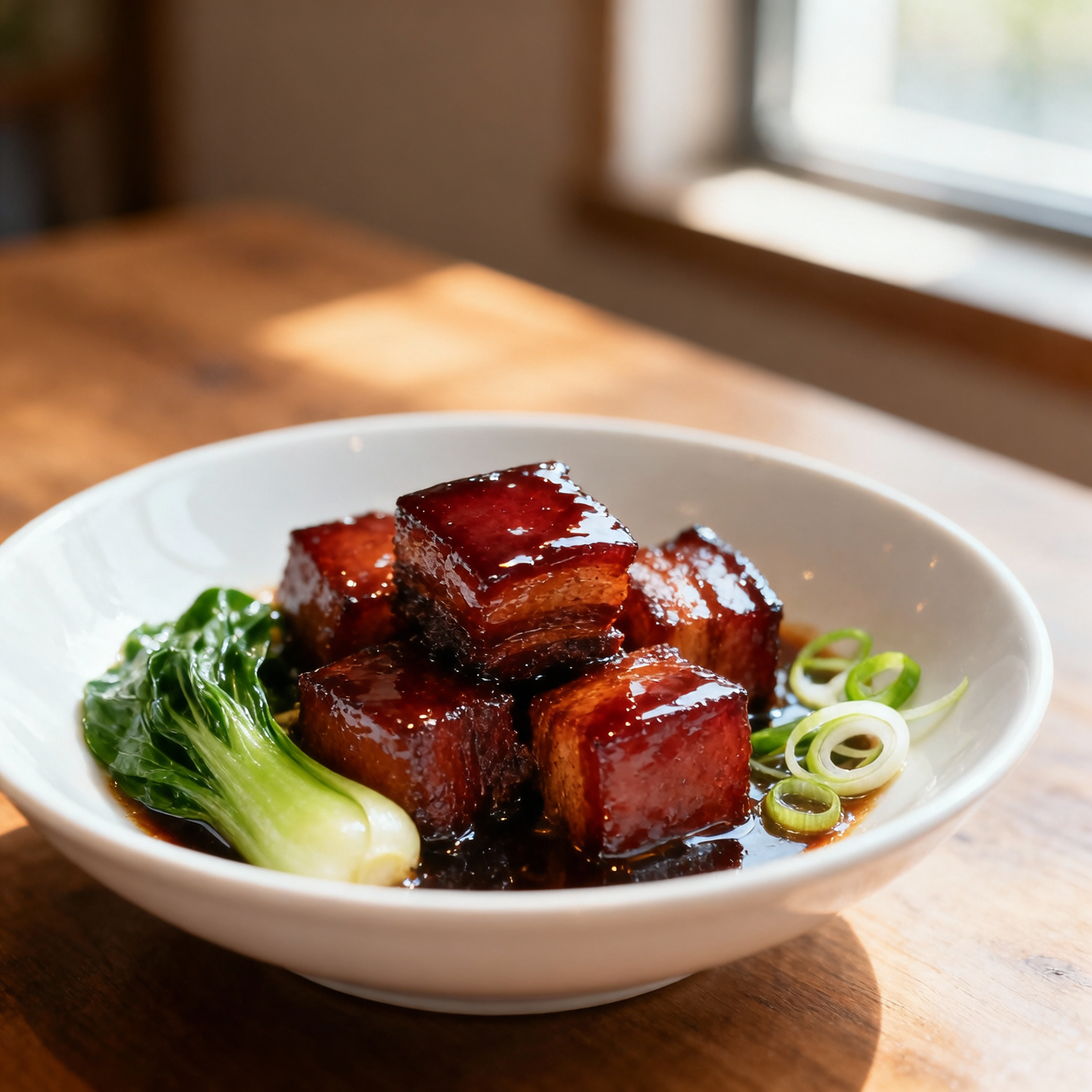
Hongshao Rou
I first encountered hongshao rou in a cramped Shanghai apartment kitchen, where the humid air hung heavy with the sweet-savory perfume of slowly caramelizing rock sugar and dark soy. This dish, whose literal translation is red-braised meat, carries a quiet history that stretches back to the Song dynasty, evolving through Jiangnan households into the quintessential Shanghainese comfort food. To me, it represents the profound elegance of Chinese home cooking: unpretentious, deeply rooted in seasonal rhythm, and entirely dependent on the alchemy of patience. The magic is not found in exotic spices, but in the deliberate layering of Shaoxing wine, ginger, and star anise, all coaxing collagen-rich pork belly into tender submission. Yet, despite its apparent simplicity, hongshao rou is notoriously unforgiving to the impatient. I have watched countless well-meaning cooks rush the sugar into a dark, acrid sludge, or worse, drown the braise in boiling water and wash away that essential, lacquered viscosity. Many skip the crucial step of parboiling the pork to purge impurities, leaving behind a murky, gamey aftertaste. Others over-reduce the sauce at the end, trading glossy richness for a harsh, salty crust. The true craft lies in listening to the pot, maintaining a barely-there simmer that allows fat to render and gelatinize without breaking the emulsion. When executed with care, each bite melts on the tongue, a perfect equilibrium of umami, subtle sweetness, and aromatic warmth. It matters because it reminds us that mastery in the kitchen is never about force, but about surrendering to time and trusting the slow, steady transformation of simple ingredients into something profoundly nourishing.
Nutrition
| Per serving | Calories | Protein | Carbs | Fat | Sat fat | Fibre | Sugar | Sodium |
|---|---|---|---|---|---|---|---|---|
| beginner | 950kcal | 29g | 14g | 82g | 29g | 1g | 11g | 1000mg |
| intermediate | 950kcal | 29g | 14g | 82g | 29g | 1g | 11g | 1000mg |
| expert | 950kcal | 29g | 14g | 82g | 29g | 1g | 11g | 1000mg |
Per serving · Ava-estimated — a guide, not a clinical figure.
- 800 gpork belly— skin-on, cut into 3cm cubes
- 40 grock sugar— yellow or white
- 120 mlShaoxing wine— authentic, aged
- 45 mllight soy sauce— for salinity and umami
- 15 mldark soy sauce— for color and depth
- 30 gginger— fresh, sliced into thick coins
- 50 gscallion— white and green parts separated
- 3 wholestar anise— intact pods
- 5 cmcassia bark— one piece
- 600 mlwater— preferably filtered
This version is built for your first confident attempt, stripping away the intimidation of traditional caramelizing and slow braising. Instead of toasting sugar to the precise amber stage, you will combine the soy sauces, wine, and sugar directly in the pot before adding the pork, using the gentle heat of the simmer to dissolve everything safely. The spice profile is simplified: we bundle the aromatics together and let a covered, low-heat braise do the heavy lifting. Watch the liquid level closely; a beginner’s pan often evaporates sauce too quickly, so keep a lid slightly ajar and add splashes of warm water as needed. The goal here is tenderness and a rich, glossy finish without burning the sugar or overcooking the meat. You will rely on a straightforward simmer rather than a rolling reduction, making it much harder to scorch the bottom. Focus on browning the pork just enough to develop surface flavor, then trust the covered braise to render the fat slowly. By the end, you will have a deeply savory, restaurant-style dish with minimal hands-on stress. The sauce will thicken naturally as you uncover the pot for the final glaze.
Equipment
- Heavy-bottomed skillet— non-stick is fine for beginners
- Silicone-tipped tongs— for safe turning
Method
- 1
Pat pork belly cubes completely dry with paper towels.
Moisture prevents browning.
drying~ 2 min - 2
Sear pork in a single layer over medium-high heat until lightly golden on all sides.
Work in batches to avoid steaming.
searing~ 5 min - 3
Transfer pork to a plate and pour out excess rendered fat, leaving two tablespoons in the pan.
Reserve fat for later if desired.
degreasing~ 1 min - 4
Add ginger, scallions, star anise, and cassia bark to the pan and stir for thirty seconds.
Keep heat medium to avoid burning.
blooming~ 1 min - 5
Pour in Shaoxing wine, light soy sauce, dark soy sauce, and rock sugar, stirring until the sugar fully dissolves.
Liquid will bubble vigorously.
deglazing~ 2 min - 6
Return pork to the pan, add water until barely covering the meat, and bring to a gentle simmer.
Lower heat immediately once bubbling.
simmering~ 5 minTricky bit - 7
Cover with a lid slightly ajar and cook on low heat for forty minutes, turning halfway through.
Check liquid level at twenty minutes.
braising~ 40 min - 8
Uncover the pan and simmer vigorously until the sauce coats the back of a spoon.
Sauce will reduce quickly here.
reducing~ 8 minTricky bit