
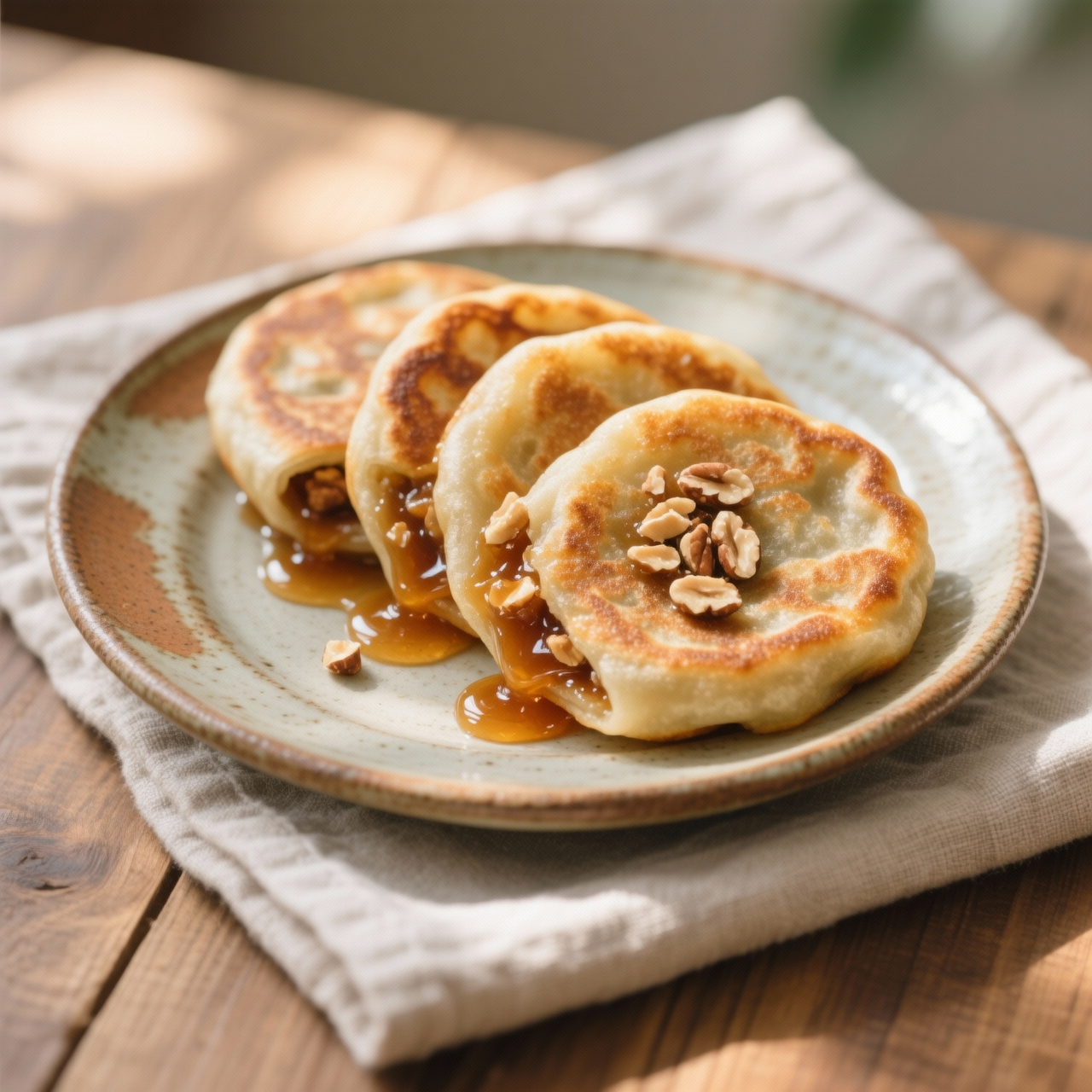
Hotteok (Sweet Pancakes)
I’ve always believed that true comfort lives in the contrast of textures, and nowhere is that more alive than in a freshly pressed hotteok. Born in the late nineteenth century when Chinese merchants introduced pan-frying techniques to Korea’s bustling port cities, these sweet pancakes quickly evolved from a winter street staple into a beloved domestic ritual. Making them from scratch matters because the commercial frozen versions you find in Asian supermarkets—usually priced around six dollars for a meager pack—are fundamentally compromised. They arrive pre-filled with a cloying, gelatinous syrup and rely on chemical stabilizers to survive the thaw, leaving you with a tough, chewy crust that never properly crisps. When you build the dough yourself using just flour, yeast, warm water, and a touch of salt, you gain complete control over the fermentation that gives the wrapper its signature pillowy lift. The most frequent pitfall I see is overstuffing the pockets or sealing them poorly, which guarantees a messy, sugar-leaking disaster the moment the dough hits the pan. Another common error is rushing the second proof; without that crucial resting period, the dough resists stretching and tears under the spatula’s pressure. The magic happens when you press the filled rounds firmly in the skillet, coaxing the brown sugar, crushed peanuts, and cinnamon into a molten core that caramelizes against the golden shell. Freezing the raw, stuffed rounds before cooking is the ultimate batch strategy, preserving the delicate yeast activity until you’re ready for them. By taking an hour to mix, rest, and portion, you replace artificial shortcuts with genuine, crackling warmth that tastes exactly like it should.
Nutrition
| Per serving | Calories | Protein | Carbs | Fat | Sat fat | Fibre | Sugar | Sodium |
|---|---|---|---|---|---|---|---|---|
| beginner | 540kcal | 10g | 78g | 20g | 3g | 3g | 30g | 180mg |
| intermediate | 265kcal | 6g | 43g | 9g | 1g | 2g | 21g | 165mg |
| expert | 590kcal | 12g | 76g | 24g | 3g | 3g | 31g | 220mg |
Per serving · Ava-estimated — a guide, not a clinical figure.
- 300 gall-purpose flour— Sifted to ensure smooth dough texture
- 180 mlwarm water— Approximately 35C to safely activate yeast
- 4 ginstant yeast— Can be replaced with active dry yeast with adjusted proofing time
- 15 ggranulated sugar— Added to the dough mixture for initial fermentation
- 2 gfine salt— Balances sweetness and strengthens gluten structure
- 100 gbrown sugar— Packed firmly for consistent filling sweetness
- 5 gground cinnamon— Mixed evenly with filling sugar
- 40 gchopped walnut(optional)— Lightly toasted before chopping to release oils
- 30 mlvegetable oil— Used for coating dough balls and greasing cooking surface
Store-bought frozen hotteok costs around six dollars for a small box, but they rely on chemical leaveners, excess refined sugar, and stabilizers that leave you with a tough, cardboard-like crust instead of the pillowy, yeasted chew this snack deserves. This beginner version keeps everything from scratch while stripping away the intimidation factor. Instead of a long overnight proof, we use a quick, warm-water yeast activation and a forgiving, slightly sticky dough that comes together in minutes. The key here is mastering the gentle stretch-and-fill technique: you will roll small dough balls, tuck in a simple homemade mix of brown sugar, toasted cinnamon, and crushed peanuts, then carefully seal the seams before pan-frying. Watch your oil temperature closely; too hot and the sugar burns before the dough cooks, too cool and the pancakes turn greasy. Keep a light touch when pressing them flat in the pan to keep the molten filling safely inside. This method is highly forgiving and scales beautifully, so you can easily shape, freeze, and pan-fry a big batch of raw rounds for instant weekend treats.
Equipment
- Heavy-bottomed skillet— 10-12 inch for even heat distribution
- Rolling pin(optional)— or a flat-bottomed glass
- Kitchen scale(optional)— helps with consistent dough portions
Method
- 1
Whisk warm water, a teaspoon of sugar, and instant yeast in a large bowl until frothy, then stir in flour and salt until a shaggy dough forms.
Water should feel like a warm bath, not hot enough to kill the yeast.
blooming~ 2 min - 2
Knead the dough on a lightly floured surface for three minutes until smooth, cover with a damp towel, and let it rest in a warm spot.
The dough will relax and become much easier to shape after resting.
resting~ 20 min - 3
Mix brown sugar, ground cinnamon, crushed roasted peanuts, and toasted sesame seeds in a small bowl until the dry ingredients are fully combined.
Crushing the nuts releases their oils for better flavor distribution.
combining~ 1 min - 4
Divide the dough into eight equal pieces, flatten each into a small cup, add a spoonful of filling to the center, and pinch the edges to seal tightly into a smooth ball.
Seal any visible cracks to prevent hot sugar from leaking during frying.
sealing~ 8 minTricky bit - 5
Heat a thin layer of neutral oil in a skillet over medium heat, place the dough balls seam-side down, and gently press them flat with an oiled spatula before cooking for two minutes per side.
Press gently to avoid bursting the filling; adjust heat if browning too fast.
pan-frying~ 4 minTricky bit - 6
Transfer the golden pancakes to a wire rack to cool briefly before serving to preserve the crisp exterior.
Stacking them immediately will trap steam and soften the crust.
draining~ 1 min
Cooking from frozen
Thaw slightly, then reheat in a dry skillet over medium-low heat until the crust crisps and the center warms through.
Storage times are a guide — always use your judgement and store food safely.