
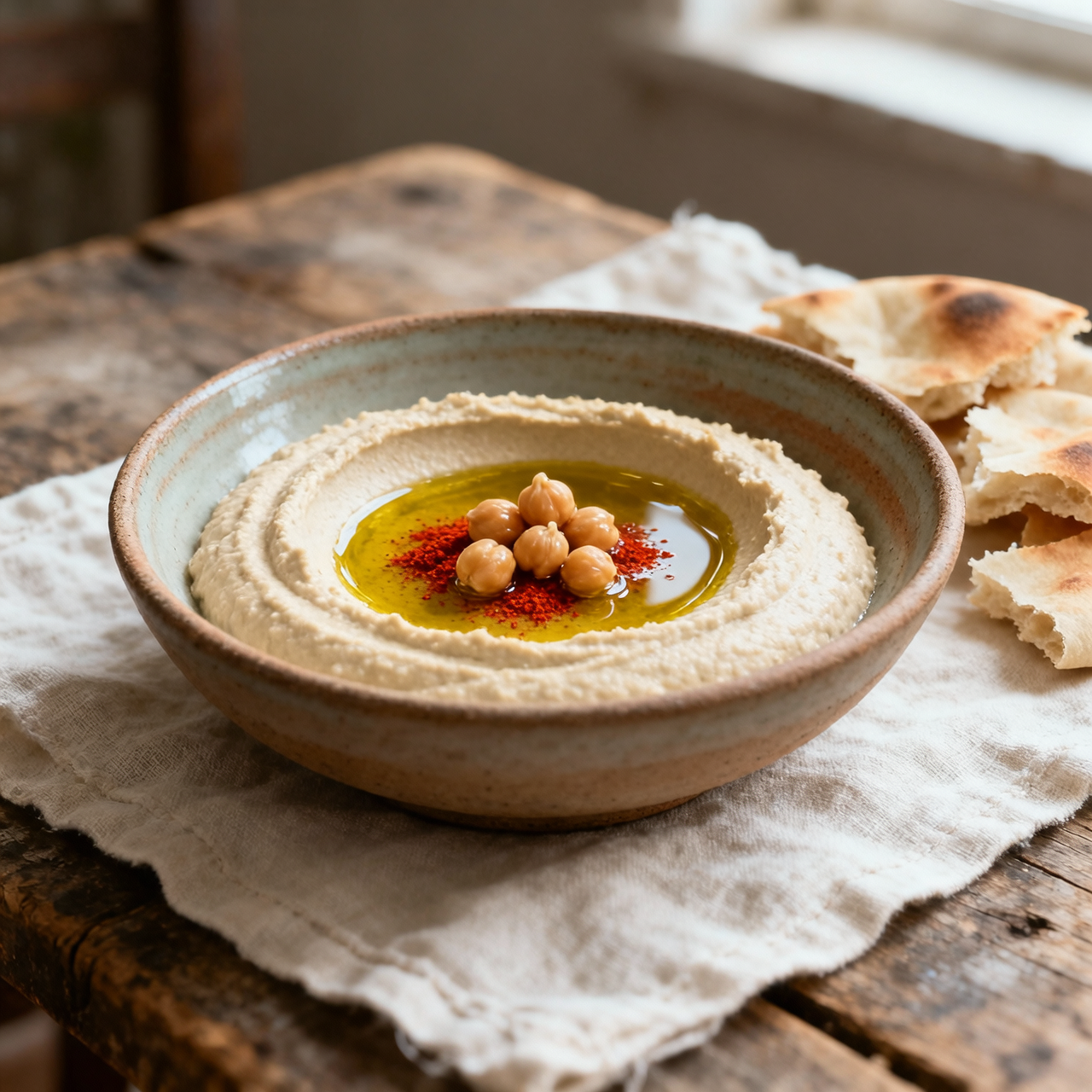
Hummus
I’ve always believed that hummus is less a dish and more a quiet testament to the patience required to honor the earth. Born in the sun-baked hills of the Levant, this Lebanese staple traces its roots to centuries-old traditions where chickpeas, tahini, lemon, and garlic were ground by hand in stone mortars. It’s a humble alchemy, yet it carries the weight of communal tables, shared stories, and the slow rhythm of village life. What makes it matter to me isn’t just its flawless balance of earthiness and brightness, but the way it demands respect for its ingredients. Too often, I see home cooks rush the process, skipping the crucial step of peeling the chickpeas or using undercooked beans, which leaves the final blend gritty and stubborn. Others drown it in cheap tahini or overwork it with warm water, breaking the emulsion until it turns dull and heavy. True hummus requires cold water, properly soaked and simmered chickpeas, and a high-speed blend that coaxes out a silk-like ribbon rather than a thick paste. I’ve learned that the secret lies not in adding more oil or acid, but in allowing the flavors to marry at the right temperature and texture. When done right, it spreads like velvet, tastes of toasted sesame and sun-ripened citrus, and becomes a canvas for olive oil and za’atar. It’s simple, yes, but simplicity is where mastery begins.
Ingredients
- 400 gchickpea— fully cooked and drained
- 60 gtahini— 100% sesame paste, well-stirred
- 30 mllemon juice— freshly squeezed and strained
- 5 ggarlic— peeled
- 15 mlolive oil— mild, high-quality
- 5 gsea salt— fine grain
- 1 gground cumin— freshly ground preferred
- 40 mlice water— near freezing
Method
Pick a skill levelThis pathway is designed for your absolute first attempt, prioritizing consistency over perfection. You will use a standard food processor and rely on pre-cooked chickpeas to eliminate lengthy soaking times. The core difference lies in temperature management: briefly warming your tahini and lemon juice before blending prevents the dreaded seizing that often frustrates newcomers. Watch closely as the mixture transitions from a thick, stubborn paste to a glossy, pale emulsion. Do not rush the addition of ice water; incorporate it one tablespoon at a time, pausing to scrape the bowl thoroughly. The biggest mistake at this stage is under-blending, which leaves a coarse, grainy finish, or over-blending, which generates friction heat and breaks the emulsion into a dull, oily mess. Taste after every adjustment. If the flavor feels flat, a pinch more salt or a splash of lemon will instantly brighten the profile. Trust the machine, but intervene with a spatula every thirty seconds to ensure even processing. By the end, you will have a reliable, restaurant-smooth baseline that proves technique can be learned incrementally. This version guarantees a confident start without sacrificing the dish’s essential character.
Method
- 1
Warm the tahini and lemon juice together in a microwave-safe bowl for fifteen seconds until just lukewarm.
Prevents immediate seizing when blended.
tempering~ 0 min - 2
Combine the garlic, salt, and cumin in the food processor and pulse until finely minced.
Scrape sides once halfway.
mincing~ 0 min - 3
Add the warmed tahini mixture and process on high until completely smooth and pale.
Scrape bowl every twenty seconds.
aerating~ 1 min - 4
Introduce the chickpeas in two batches, processing each addition until fully broken down.
Do not overfill the bowl.
blending~ 1 min - 5
Drizzle in the olive oil while the machine runs, then slowly stream in the ice water until the emulsion forms.
Watch for a sudden lightening in color.
emulsifying~ 1 minTricky bit - 6
Scrape down the bowl and process for one final minute to achieve a uniform, silky texture.
Stop when it holds a soft peak.
whipping~ 1 min
At this stage, you are expected to control every variable, transforming familiar ingredients into a refined, cohesive whole. You will begin by thoroughly rinsing canned or home-cooked chickpeas and manually removing their skins, a tedious but essential step that eliminates bitterness and guarantees an impossibly smooth mouthfeel. The tahini and lemon juice will be whisked vigorously by hand before ever meeting the processor, allowing you to monitor the exact moment the mixture seizes and then loosens into a fluid cream. This tactile feedback teaches you the precise acid-to-fat ratio required for balance. Watch for the visual shift as the blend turns from beige to a luminous ivory, signaling that the starches have fully hydrated and emulsified with the sesame oils. The primary challenge here is patience; rushing the whipping stage introduces unwanted air and creates a spongy, unstable texture. Instead, let the motor run at a steady medium speed, scraping the vessel frequently to ensure even incorporation. Adjust seasoning incrementally, tasting at room temperature rather than cold, as chilling dulls the aromatic compounds. This version rewards mindful execution and bridges the gap between casual home cooking and disciplined culinary craft.
Method
- 1
Drain and rinse the chickpeas, then gently rub them in a kitchen towel to remove every translucent skin.
Skins will float to the surface in water.
peeling~ 5 minTricky bit - 2
Whisk the tahini and lemon juice in a separate bowl until the mixture thickens, then thins into a smooth cream.
Add water drop by drop if needed.
seizing~ 2 minTricky bit - 3
Process the peeled garlic, salt, and cumin with the food processor blade spinning until uniformly pulverized.
Run motor while adding to prevent sticking.
mincing~ 0 min - 4
Fold in the chickpeas gradually, pausing to scrape the sides and ensure no whole beans remain.
Process until a thick paste forms.
milling~ 2 min - 5
Stream the whisked tahini blend and olive oil into the running processor, maintaining a steady, moderate speed.
Keep the lid securely fastened.
emulsifying~ 1 minTricky bit - 6
Add the ice water drop by drop until the hummus lightens in color and coats the back of a spoon evenly.
Texture should resemble heavy cream.
whipping~ 2 min - 7
Transfer to a shallow serving dish and use a spoon to create a traditional central well.
Swirl outward from the center.
plating~ 1 min
This pathway demands a reverence for time and a willingness to manipulate starch chemistry. You will start with dried chickpeas, soaked overnight in a precise alkaline solution of baking soda and water, which fundamentally alters their cellular structure to promote effortless breakdown and maximum silkiness. The cooking process requires a gentle, sustained simmer until the legumes yield completely to the slightest pressure, followed by a rapid chill to lock in moisture before blending. Unlike faster methods, this version relies on prolonged, high-speed whipping to fully aerate the sesame oils and hydrated starches, creating a texture that rivals the finest Beirut establishments. Watch the emulsion closely; the color must transition through distinct stages, from a dense beige paste to a translucent, cloud-like ivory. The most critical technical hurdle is managing friction heat. You must monitor the processor’s temperature, pausing frequently to rest the motor and prevent the oils from separating. Garlic is never raw; it will be blanched twice to strip sulfurous compounds while preserving pungency. This is hummus stripped of compromise, requiring exact measurements, unwavering attention, and an understanding that true luxury is simply patience applied correctly.
Method
- 1
Soak the dried chickpeas in cold water with baking soda for twelve hours, then drain and rinse thoroughly.
Ratio: 1 teaspoon soda per quart of water.
hydrating~ 720 min - 2
Simmer the legumes in fresh water with a pinch of soda until they disintegrate between your fingers without resistance.
Maintain a bare simmer, never a boil.
tenderizing~ 60 minTricky bit - 3
Shock the cooked chickpeas in an ice bath, then peel each one meticulously under cool running water.
Preserves structural integrity for blending.
peeling~ 8 minTricky bit - 4
Blanch the garlic cloves in boiling water for thirty seconds, drain, and repeat to neutralize harsh sulfur notes.
Cool completely before processing.
blanching~ 2 min - 5
Process the blanched garlic, salt, and cumin until completely homogenized, then add the peeled chickpeas.
Run until a dense, uniform paste forms.
milling~ 2 min - 6
Whip the tahini and lemon juice separately until fully emulsified, then slowly fold into the processor at high speed.
Pre-whip prevents shock and splitting.
emulsifying~ 3 minTricky bit - 7
Introduce the ice water in a thin, continuous stream while monitoring the motor temperature, pausing if the bowl warms.
Target bowl temp: below 25°C.
temperature_control~ 3 minTricky bit - 8
Run the machine continuously for eight minutes, scraping the vessel every two minutes until the mixture achieves a glossy, cloud-like consistency.
Do not stop once the final emulsion sets.
whipping~ 8 minTricky bit