
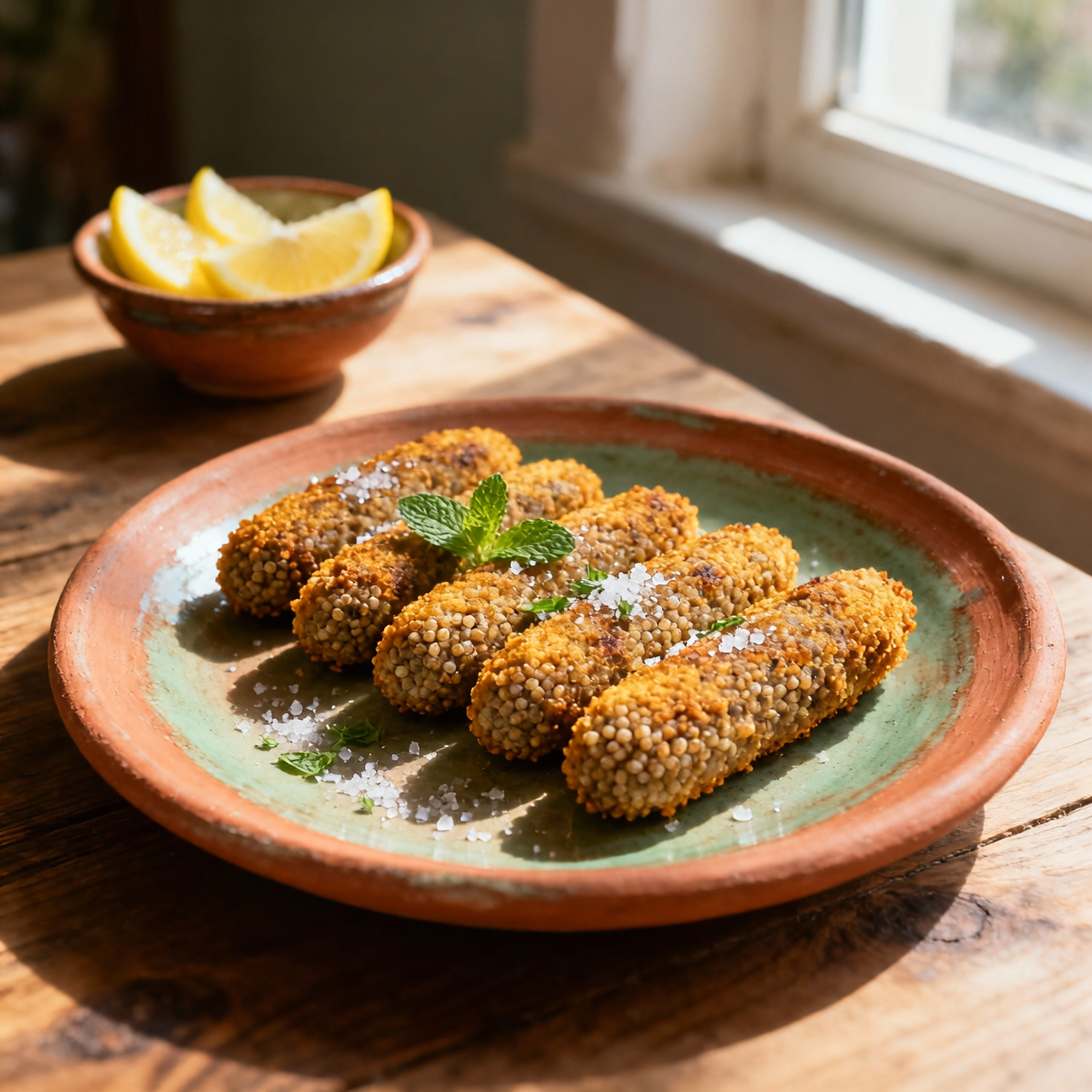
İçli köfte (stuffed bulgur shells)
İçli köfte arrived in my archive as a quiet testament to Ottoman patience, born in the southeastern kitchens where wheat and meat were coaxed into something far greater than their parts. The dish is a study in tension: a brittle, bulgur-thin shell protecting a rich, spiced core of beef and walnut. When executed well, it shatters on the first bite, releasing steam and savory depth that justifies every minute spent coaxing the dough into submission. The most common failure lies in the shell itself—too much water yields a gummy exterior, while rushed kneading invites catastrophic splits during frying. Many home cooks abandon the project after one split batch, but the truth is that temperature control and hydration are the only variables that matter. Today, supermarkets stock vacuum-sealed trays of içli köfte for roughly nine pounds, but the trade-off is steep: those versions rely on reformed meat binders, artificial stabilizers, and pre-fried shells that turn leathery upon reheating. They strip away the textural contrast and replace it with a uniform, processed chew. Making this entirely from scratch restores the integrity of the grain and the freshness of the meat. You will learn to read the dough’s resistance, to seal seams with practiced confidence, and to accept that a few imperfect shells are simply the cook’s snack. Once mastered, the technique scales effortlessly into a freezer-ready arsenal.
Nutrition
| Per serving | Calories | Protein | Carbs | Fat | Sat fat | Fibre | Sugar | Sodium |
|---|---|---|---|---|---|---|---|---|
| beginner | 485kcal | 26g | 36g | 24g | 7g | 5g | 2g | 620mg |
| intermediate | 485kcal | 26g | 36g | 24g | 7g | 5g | 2g | 620mg |
| expert | 485kcal | 26g | 36g | 24g | 7g | 5g | 2g | 620mg |
Per serving · Ava-estimated — a guide, not a clinical figure.
- 200 gfine bulgur wheat (köftelik)— must be the finest grind available, not coarse
- 250 gground beef— 15% fat minimum for moisture retention
- 150 gyellow onion— peeled and halved
- 80 gwalnuts— lightly toasted and finely chopped
- 500 mlneutral vegetable oil— for deep frying
- 5 gground allspice
- 3 gdried mint— rubbed between palms before use
- 10 gfine sea salt— divided evenly between dough and filling
- 2 gblack pepper— freshly cracked
- 100 mlice water— kept near freezing to bind the dough
- 20 gfresh flat-leaf parsley— finely chopped for garnish
This version prioritizes structural forgiveness over traditional shaping speed. Instead of relying on rapid hand-forming, we use a chilled spoon and an ice cube to create the cavity, a method that dramatically reduces the risk of tearing while you learn how the bulgur dough behaves. The filling is gently mixed rather than heavily emulsified, which keeps it moist without requiring aggressive kneading. We also fry at a slightly lower, steady temperature to give the outer shell time to set before the internal moisture expands. Watch your oil thermometer closely; if it dips below one hundred and sixty degrees Celsius, the dough will absorb fat and turn greasy. If it spikes, the exterior will burn before the interior cooks through. The dough is mixed until it just comes together, then rested briefly under a damp cloth so the grains fully hydrate without becoming sticky. Seams are pressed firmly with damp fingertips rather than smoothed into perfect torpedoes, which is perfectly acceptable for a first attempt. Focus on even thickness and secure closures. Any stray dough scraps should be re-rolled rather than forced. Once fried, drain them on a wire rack to prevent steaming, and serve immediately. The goal here is a reliable, crack-free shell that builds your confidence for the more tactile methods to come.
Equipment
- Heavy-bottomed pot— for stable deep frying
- Fine-mesh sieve— for draining bulgur
- Metal spoon— chilled for shaping cavities
- Kitchen thermometer— clip-on or digital
Method
- 1
Rinse the fine bulgur wheat under cold water and drain thoroughly in a fine-mesh sieve.
Do not squeeze dry.
rinsing~ 1 min - 2
Combine the bulgur, half the salt, and ice water in a large bowl, then cover with a damp cloth and rest.
Grains must fully absorb the liquid.
resting~ 20 min - 3
Finely chop the walnuts and mix them with half the ground beef, allspice, black pepper, and remaining salt.
Keep the mixture chilled until ready to fill.
mixing~ 3 min - 4
Divide the dough into twelve equal portions and roll each into a smooth ball.
Keep unused dough covered to prevent drying.
portioning~ 2 min - 5
Press a chilled metal spoon into each dough ball and rotate it to form a thin, even cavity.
Use an ice cube inside the spoon to prevent sticking.
shaping~ 5 minTricky bit - 6
Spoon one tablespoon of the meat mixture into each cavity and pinch the top closed with damp fingers.
Ensure no filling touches the seam line.
sealing~ 4 minTricky bit - 7
Heat the vegetable oil in a deep pot to one hundred sixty-five degrees Celsius, monitored with a thermometer.
Oil must be steady before adding shells.
temperature_control~ 5 min - 8
Fry the shells in batches for six minutes until golden brown, then transfer to a wire rack to drain.
Do not overcrowd the pot.
deep_frying~ 6 minTricky bit
Cooking from frozen
Fry directly from frozen in 170°C oil until golden and crisp, adding two minutes to the standard cook time.
Storage times are a guide — always use your judgement and store food safely.