
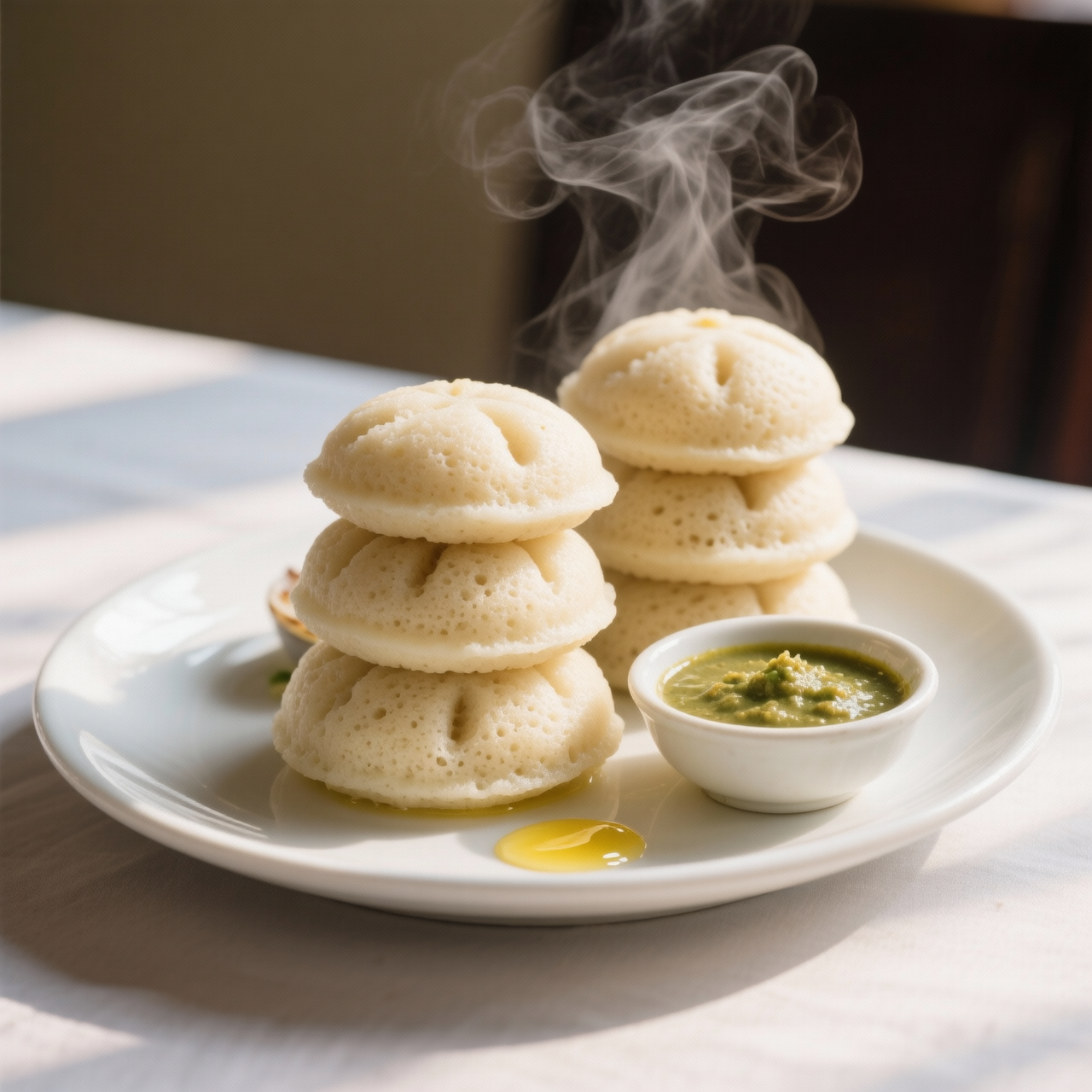
Idli
Idli traces its roots to ancient South India, where temple cooks and home kitchens discovered that blending soaked rice and black gram lentils, then leaving the mixture to naturally ferment, yielded impossibly light, digestible steamed cakes. In my kitchen, this process represents the quiet brilliance of patience over instant gratification. You will often see cartons of ready-made batter or instant semolina mixes lining supermarket shelves, usually priced between three and five dollars a pack. While convenient, they rely on chemical leaveners, stabilizers, and artificial acidity to mimic true fermentation, resulting in a dense, rubbery texture that completely misses the delicate, airy tang of the real thing. Making your own from scratch restores that ancient balance and costs pennies per serving. The process demands attention to a few critical details: always wash the lentils thoroughly to remove dust, use a wide container for fermentation to allow proper expansion, and never skip the resting period. The most common pitfall is rushing the fermentation or steaming over violently boiling water, which collapses the delicate crumb structure. Keep the batter in a warm, draft-free spot until it doubles and smells pleasantly sour. When it is ready, pour it gently into greased molds and steam over a steady, moderate simmer. The reward is a vegan breakfast staple that is naturally probiotic, remarkably versatile, and deeply nourishing. Once you experience the pillowy softness and subtle lactic tang of a properly fermented idli, the processed alternatives will forever taste like a hollow compromise.
Nutrition
| Per serving | Calories | Protein | Carbs | Fat | Sat fat | Fibre | Sugar | Sodium |
|---|---|---|---|---|---|---|---|---|
| beginner | 145kcal | 5g | 25g | 1g | 0g | 2g | 0g | 110mg |
| intermediate | 165kcal | 6g | 34g | 1g | 0g | 2g | 0g | 240mg |
| expert | 135kcal | 5g | 28g | 2g | 0g | 1g | 1g | 180mg |
Per serving · Ava-estimated — a guide, not a clinical figure.
- 500 gidli rice— Short-grain parboiled rice preferred for optimal texture
- 150 gurad dal— Skinless split black gram, rinsed until water runs clear
- 5 gfenugreek seed(optional)— Promotes fermentation and adds subtle bitterness
- 12 gsalt— Fine grain, mixed into the batter after grinding
- 650 mlwater— Filtered, divided for separate soaking and grinding stages
Store-bought frozen idli packs are convenient but often cost over six dollars per box, contain stabilizers, and yield dense, rubbery cakes that lack the signature airy crumb of fresh steamed batter. This beginner-friendly approach strips away the intimidation factor while keeping everything completely from scratch. Instead of wrestling with traditional stone grinders, we use a standard high-speed blender to achieve the correct texture, focusing on two simple rules: keep the lentil batter light and aerated, and leave the rice batter slightly granular for structure. Watch your water levels carefully during grinding—too much creates a runny mix that will not hold its shape, while too little strains the motor. Fermentation is entirely passive; simply combine the two pastes, add salt, cover with a clean towel, and place the bowl in a warm corner like an oven with only the pilot light on. The batter will naturally double and develop a pleasant tangy aroma overnight. When steaming, resist the urge to lift the lid early. A steady, rolling boil and exactly twelve minutes of undisturbed heat guarantee tender, pill-soft cakes that release cleanly from the moulds every time.
Equipment
- High-speed blender— Use pulse function to control water addition and prevent motor strain
- Large glass mixing bowl— Avoid reactive metals to protect the fermentation process
- Idli steamer tray or perforated baking tin— Lightly oil each cavity to ensure clean release
- Heavy-bottomed pot with tight-fitting lid— Must hold enough water for sustained boiling without drying out
Method
- 1
Drain the soaked rice and lentils thoroughly, then transfer the lentils to a blender with half a cup of fresh water.
Pulse in short bursts to prevent overheating the motor while building aeration.
blending~ 5 min - 2
Grind the lentils until they form a thick, pale paste that visibly increases in volume.
The mixture should hold soft peaks and feel smooth between your fingers.
aerating~ 3 minTricky bit - 3
Blend the drained rice with a quarter cup of water until it reaches a smooth but slightly grainy consistency.
Avoid over-processing; a fine grit provides the necessary structure during steaming.
grinding~ 4 min - 4
Fold the rice paste into the lentil mixture in a large bowl and stir in fine sea salt.
Use a clean hand to mix thoroughly, introducing oxygen and ensuring even salt distribution.
folding~ 2 min - 5
Cover the bowl with a breathable cloth and leave it in a warm spot for eight to twelve hours.
The batter is ready when it has visibly doubled and releases a mild sour aroma.
fermenting~ 600 min - 6
Lightly oil an idli steamer tray, pour the risen batter into the cavities, and steam over vigorously boiling water.
Keep the lid completely sealed for exactly twelve minutes to prevent structural collapse.
steaming~ 12 minTricky bit
Cooking from frozen
Steam directly from frozen for 8 to 10 minutes until piping hot and fluffy throughout.
Storage times are a guide — always use your judgement and store food safely.