
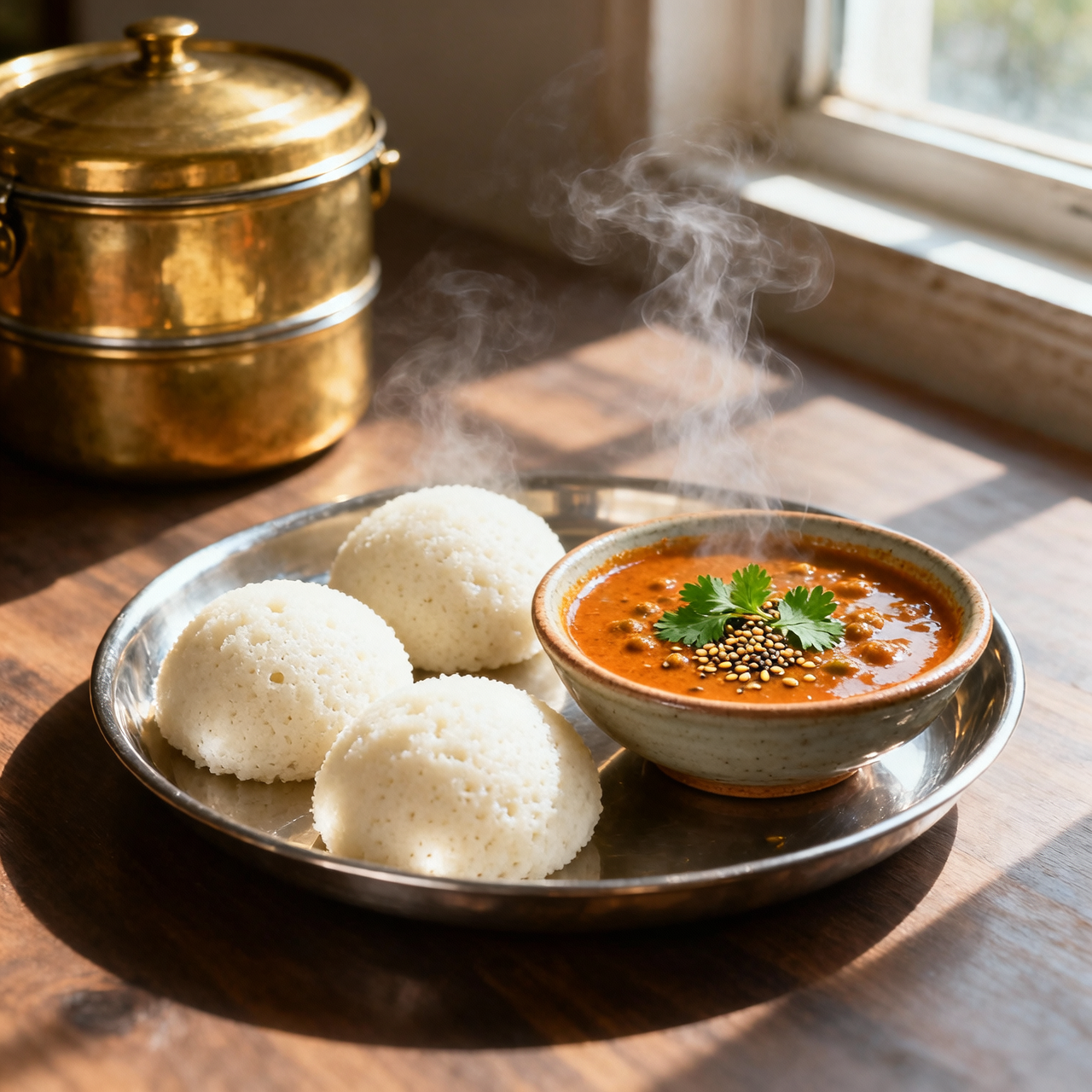
Idli Sambar
When I first encountered idli sambar in a quiet Chennai kitchen, I quickly realized this humble breakfast pairing is far more than just steamed rice cakes swimming in spiced lentil broth. It is a centuries-old culinary dialogue between the coastal trade routes and the agrarian heartlands of South India, born from the necessity of preserving nutrients through fermentation and slow simmering. The idli itself, likely tracing its lineage back to Indonesian influences before being perfected in the Tamil and Kannada regions, relies entirely on the quiet magic of naturally cultured batter. Meanwhile, sambar is the soulful accompaniment, a tangy, aromatic vegetable stew that transforms humble tamarind, turmeric, and freshly roasted spices into something deeply nourishing. What makes this dish matter to me is its quiet resilience; it is a meal that has sustained generations, adapting seamlessly to seasonal harvests and regional variations while remaining inherently vegan and deeply comforting. Yet, for all its simplicity, idli sambar is remarkably easy to misstep. I have seen countless home cooks rush the fermentation, yielding dense, sour batter instead of the pillowy, slightly sweet steamed cakes. Others drown the sambar in excessive tamarind or under-toast the spice blend, resulting in a flat, one-dimensional broth that lacks the signature earthy depth. The true secret lies in patience—allowing the batter to rest until it doubles, tempering the sambar with fresh mustard seeds and curry leaves at the precise moment, and never, ever skipping the freshly ground spice paste. When honored correctly, this breakfast becomes a quiet meditation on balance.
Nutrition
| Per serving | Calories | Protein | Carbs | Fat | Sat fat | Fibre | Sugar | Sodium |
|---|---|---|---|---|---|---|---|---|
| beginner | 718kcal | 25g | 134g | 10g | 1g | 16g | 8g | 1520mg |
| intermediate | 718kcal | 25g | 134g | 10g | 1g | 16g | 8g | 1520mg |
| expert | 718kcal | 25g | 134g | 10g | 1g | 16g | 8g | 1520mg |
Per serving · Ava-estimated — a guide, not a clinical figure.
- 400 grice— short-grain or idli rice, thoroughly washed
- 100 gurad dal— whole black gram, hulled
- 150 gtoor dal— split pigeon peas, rinsed
- 30 gtamarind— seedless pulp
- 10 gmustard seed— whole black
- 5 gcumin seed— whole
- 1 gasafoetida— pure resin or certified gluten-free powder
- 15 gcurry leaf— fresh sprigs
- 5 gturmeric— ground
- 15 gsalt— fine sea salt
- 30 mlvegetable oil— sesame or groundnut
- 200 gtomato— ripe, finely diced
- 150 gcarrot— peeled and cut into 2-inch batons
- 100 gdrumstick(optional)— cut into 3-inch segments
- 20 gcoriander leaf— fresh, roughly chopped
- 1500 mlwater— for soaking, steaming, and simmering
This path prioritizes confidence and clarity over tradition, allowing you to achieve authentic flavor without the overhead of fermentation or spice grinding. You will rely on refrigerated idli batter and a high-quality commercial sambar paste, which collapses hours of prep into manageable stages. The primary focus here is temperature control and timing. Steam the idlis just until they double in volume and a toothpick inserted into the center comes out completely clean; overcooking will collapse their delicate crumb. When preparing the broth, bring the paste to a gentle simmer rather than a rolling boil to prevent the tamarind from turning harsh or the lentils from breaking apart entirely. Pay close attention to the tempering phase: add the mustard seeds to moderately hot oil and wait for the first sharp pops before introducing the curry leaves and asafoetida. If the oil is too cool, the spices will remain raw and bitter; if it is too hot, the leaves will scorch instantly. Stir the sambar continuously for the final three minutes to help the commercial thickeners integrate smoothly with the lentil base. Taste for salt and acidity before serving, adjusting with a splash of warm water if the consistency feels too dense. This approach guarantees a reliable, comforting bowl on your first attempt.
Equipment
- electric steamer— or any tiered bamboo steamer
- medium saucepan— non-stick or stainless steel
- small skillet— for tempering spices
Method
- 1
Pour the store-bought idli batter into greased molds until two-thirds full.
Do not overfill; they will expand during steaming.
filling~ 1 min - 2
Place the molds in a preheated steamer and cover tightly with a lid.
Steam for 12 minutes until firm to the touch.
steaming~ 12 min - 3
Simmer 500 ml of water with the sambar paste and diced vegetables in a saucepan.
Stir continuously to prevent clumping.
simmering~ 10 min - 4
Heat oil in a small skillet over medium heat until shimmering.
Oil should ripple but not smoke.
heating~ 2 min - 5
Add mustard seeds to the hot oil and wait until they begin to pop.
Listen for rapid, consistent cracking.
tempering~ 1 minTricky bit - 6
Toss in cumin seeds, curry leaves, and asafoetida, then pour the mixture into the simmering pot.
Stand back; the oil will splatter briefly.
blooming~ 0 minTricky bit