
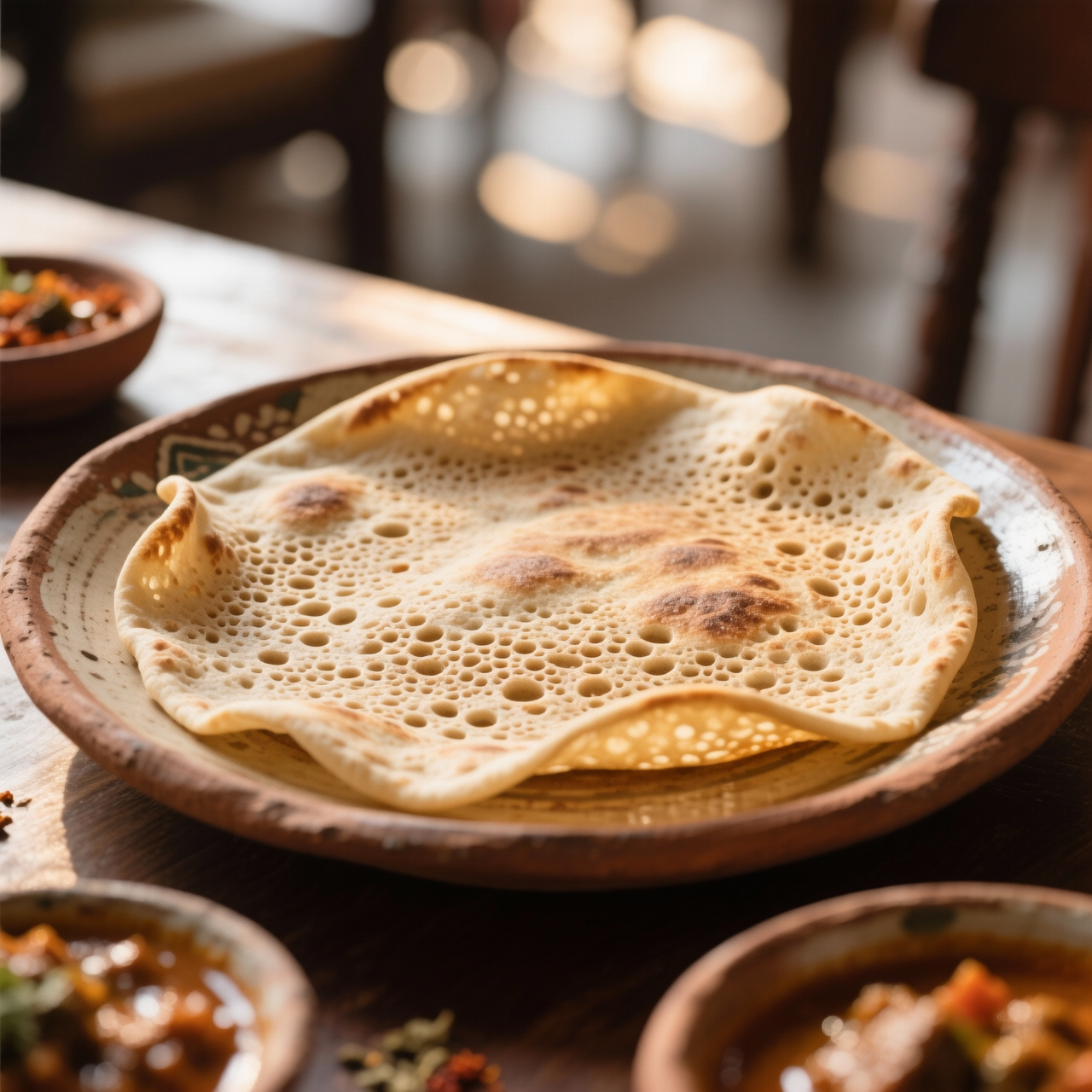
Injera (teff flatbread)
Injera is the edible foundation of Ethiopian dining, a spongy, sourdough flatbread born from the highlands of Ethiopia where teff has been cultivated for millennia. I’ve spent years coaxing this batter to life, and I can tell you that the magic lies entirely in patience and a living starter. When you buy injera at the supermarket, you’re usually paying eight to twelve dollars for a small, tightly rolled package that’s been sitting in plastic for weeks. Those commercial versions are often gummy, cut heavily with wheat flour, and stripped of the signature tang that comes from proper wild fermentation. They’re a pale imitation that misses the point entirely. Real injera breathes. Its signature honeycomb surface isn’t just beautiful; it’s engineered to scoop up rich wots and stews while delivering a gentle probiotic punch. The most common mistakes home cooks make are rushing the fermentation, using boiling pans that seal the batter instead of letting it bloom, or skipping the crucial resting period after the first rise. You don’t need special equipment, just a consistent warm spot, a heavy non-stick skillet, and a willingness to listen to the batter. It will bubble, separate slightly, and develop a bright, lactic aroma when it’s ready. Once you master the rhythm of pour, rest, and steam, you’ll never look back. This isn’t just a side dish; it’s a communal vessel, a fermented superfood, and a testament to how simple ingredients transform when given time to work.
Nutrition
| Per serving | Calories | Protein | Carbs | Fat | Sat fat | Fibre | Sugar | Sodium |
|---|---|---|---|---|---|---|---|---|
| beginner | 260kcal | 10g | 48g | 3g | 0g | 6g | 1g | 8mg |
| intermediate | 340kcal | 10g | 65g | 2g | 0g | 7g | 0g | 5mg |
| expert | 285kcal | 10g | 56g | 2g | 0g | 7g | 1g | 140mg |
Per serving · Ava-estimated — a guide, not a clinical figure.
- 400 gteff flour— Finely milled, preferably whole grain for authentic sour flavor and porous texture
- 850 mlwater— Filtered or non-chlorinated to support wild yeast fermentation, divided for mixing and adjusting batter consistency
- 8 gsalt— Fine sea salt, added after the initial fermentation period to preserve yeast activity
- 60 gactive starter(optional)— Reserved from a previous batch or naturally fermented teff and water culture
This beginner-friendly injera strips away the traditional three-day fermentation guesswork by using a reliable overnight sourdough-style rest, making your first batch far less intimidating. Instead of wrestling with inconsistent wild starters, we rely on a simple flour-and-water slurry that develops just enough tang and lift for a tender, spongy crumb. Watch your batter’s consistency closely; it must thin to the texture of heavy cream after resting, otherwise the bread will turn dense or tear during cooking. Store-bought injera often costs upwards of eight dollars for a single pack, arrives dry and rubbery, and frequently hides preservatives or wheat fillers that compromise the authentic gluten-free profile. Making it from scratch at home costs under three dollars, guarantees a perfectly porous surface for soaking up rich wats, and preserves teff’s natural nutritional density. The key here is temperature control and patience during the active cooking phase. Keep your pan consistently hot but not smoking, and resist the urge to flip the bread—steam does the work. You will learn to recognize the signature honeycomb bubbles that signal a perfect set, building a foundational skill for all Ethiopian cooking.
Equipment
- Large mixing bowl— glass or food-safe plastic for fermentation
- 12-inch non-stick skillet or electric griddle— essential for even heat distribution
- Measuring cup or ladle— for consistent batter pouring
- Fine-mesh sieve(optional)— helps beginners remove lumps before cooking
Method
- 1
Whisk whole teff flour and warm water in a large bowl until completely smooth and free of lumps.
Use a whisk or fork to break up any teff clumps.
hydration~ 2 min - 2
Cover the bowl loosely with a clean kitchen towel and leave it undisturbed in a warm spot for eighteen hours.
The batter will separate slightly; this is normal.
fermentation~ 1 min - 3
Stir the rested batter gently and whisk in an additional quarter cup of cool water to reach a heavy cream consistency.
Test by dropping a spoonful; it should coat the back smoothly.
adjustment~ 2 minTricky bit - 4
Heat a lightly greased twelve-inch non-stick skillet or griddle over medium-high heat until a water droplet sizzles instantly.
Do not let the pan smoke, or the first injera will burn.
preheating~ 3 min - 5
Pour a quarter cup of batter into the center of the pan and quickly spiral outward to cover the surface in a thin, even layer.
Work fast and do not spread or smooth the batter once poured.
spiraling~ 1 minTricky bit - 6
Cover the pan immediately and cook until the surface is completely dry and covered in visible honeycomb bubbles.
Resist flipping; the injera steams itself from the bottom up.
steaming~ 3 min
Cooking from frozen
Thaw at room temperature for an hour, then lightly steam or microwave with a damp paper towel for ten seconds to restore pliability.
Storage times are a guide — always use your judgement and store food safely.