
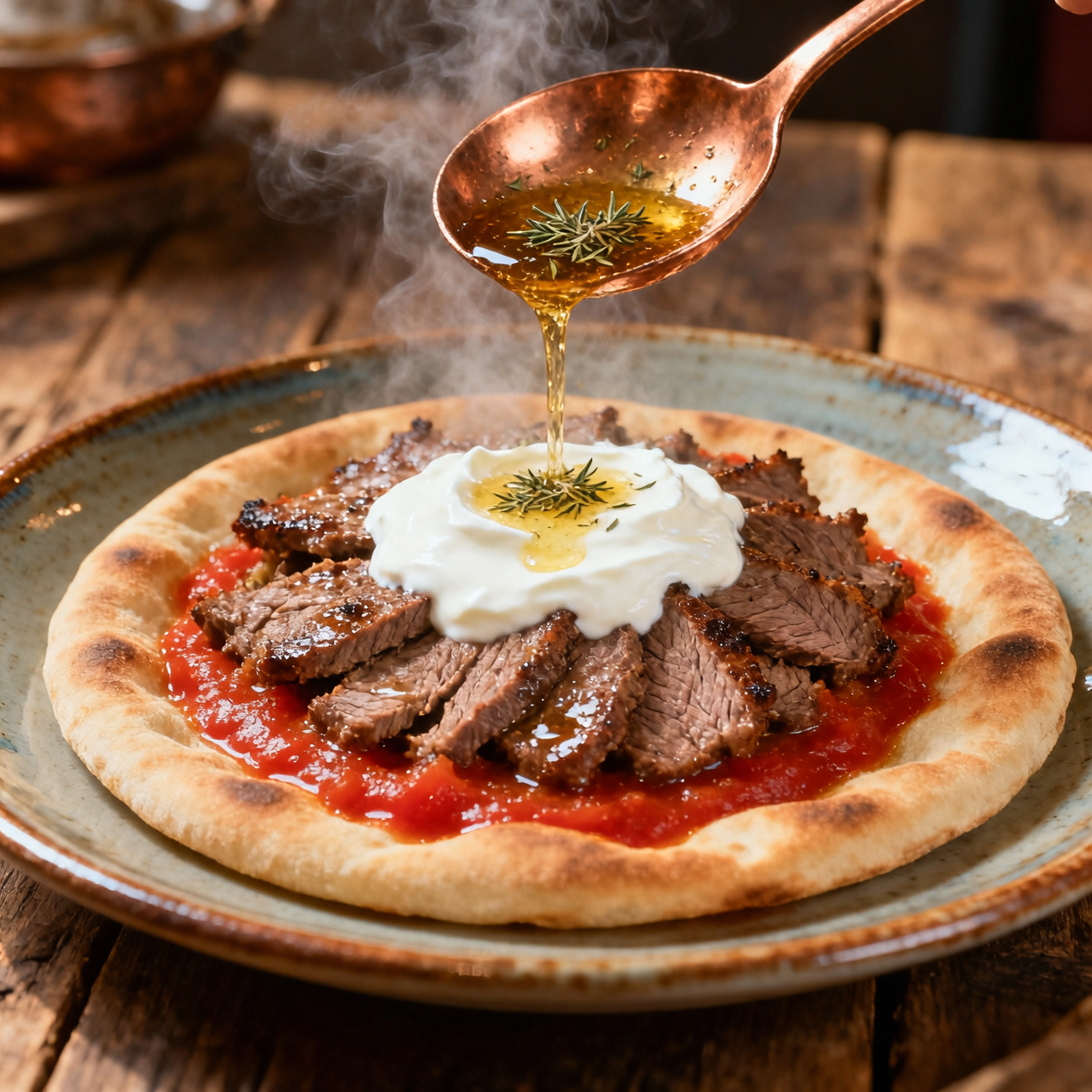
Iskender Kebab
When I first encountered Iskender Kebab in a bustling Bursa eatery, I understood immediately why it holds such a sacred place in Turkish culinary history. Conceived in the late nineteenth century by Iskender Efendi, this dish revolutionized how we think about grilled meats by layering thinly sliced döner over a foundation of warm, buttery pide, then drowning it in rich tomato sauce and a generous pour of sizzling browned butter, finished with a dollop of thick yogurt. It matters because it represents a beautiful tension between rustic street food and refined technique, a balance that has traveled far beyond Anatolia while never losing its soul. Yet, in my years of testing and refining recipes for this masterpiece, I have watched countless cooks stumble over the very details that make it sing. The most frequent misstep is using thick, poorly sliced meat that refuses to absorb the tomato reduction, or worse, skipping the crucial step of properly toasting the pide until it is crisp enough to hold its structure but soft enough to melt into the butter. I have also seen too many kitchens rush the browned butter, letting it burn instead of coaxing it to a nutty amber that carries the dish's entire aromatic weight. The yogurt must be room temperature and luxuriously thick, never cold or watery, because it is meant to temper the heat and richness, not fight it. When you respect these layers, you do not just make a meal; you honor a century-old tradition that turns simple ingredients into something profoundly comforting.
Nutrition
| Per serving | Calories | Protein | Carbs | Fat | Sat fat | Fibre | Sugar | Sodium |
|---|---|---|---|---|---|---|---|---|
| beginner | 740kcal | 32g | 40g | 48g | 21g | 4g | 9g | 1100mg |
| intermediate | 740kcal | 32g | 40g | 48g | 21g | 4g | 9g | 1100mg |
| expert | 740kcal | 32g | 40g | 48g | 21g | 4g | 9g | 1100mg |
Per serving · Ava-estimated — a guide, not a clinical figure.
- 600 glamb shoulder— trimmed and sliced paper-thin against the grain
- 4 piecepita bread— day-old works best for structural integrity
- 300 gplain yogurt— full-fat, preferably strained
- 400 gcrushed tomatoes— unsalted, high-quality canned
- 60 gunsalted butter— European style preferred
- 30 gtomato paste— concentrated, double-strength
- 2 clovegarlic— peeled and finely minced
- 15 mlolive oil— extra virgin
- 5 gdried oregano— crushed lightly by hand
- 5 gsumac— coarse grind, for finishing
- 10 gsalt— fine sea salt
- 5 gblack pepper— freshly cracked
This version prioritizes accessibility and confidence over traditional complexity. You will use pre-sliced lamb shoulder from your butcher and a reliable jarred tomato sauce base to eliminate the guesswork of balancing acidity and sweetness. The yogurt is simply whisked with a pinch of salt and a splash of olive oil to keep it smooth and pourable. Focus entirely on heat management: ensure your pita is thoroughly warmed in a dry skillet to create a moisture barrier before layering. The browned butter step is simplified by using medium heat and watching for a steady golden foam rather than a nutty aroma. Watch for overcooking the meat; thin slices require only a rapid sear. Assemble quickly on a warm plate to preserve the temperature contrast. This approach guarantees a satisfying, restaurant-adjacent result on a busy weeknight without demanding advanced knife skills or sauce reduction techniques. Trust the shortcuts, follow the timing cues, and let the natural richness of the lamb and butter carry the dish.
Equipment
- heavy-bottomed skillet— non-stick or cast iron both work
- small saucepan— for gentle sauce warming
- silicone whisk— prevents scratching
Method
- 1
Warm the pita halves in a dry skillet until lightly toasted.
Do not let them crisp completely.
toasting~ 2 min - 2
Whisk the yogurt with half the salt and olive oil until smooth.
Keep at room temperature.
whisking~ 1 min - 3
Heat olive oil in a heavy skillet over high heat and sear the lamb slices in a single layer.
Work in batches to avoid steaming.
searing~ 3 minTricky bit - 4
Simmer crushed tomatoes, tomato paste, and garlic in a separate pot until thickened.
Stir frequently to prevent scorching.
reducing~ 7 min - 5
Melt butter in a small pan until it foams and turns light gold, then pour over the assembled plate.
Watch closely for color change.
browning~ 3 minTricky bit