
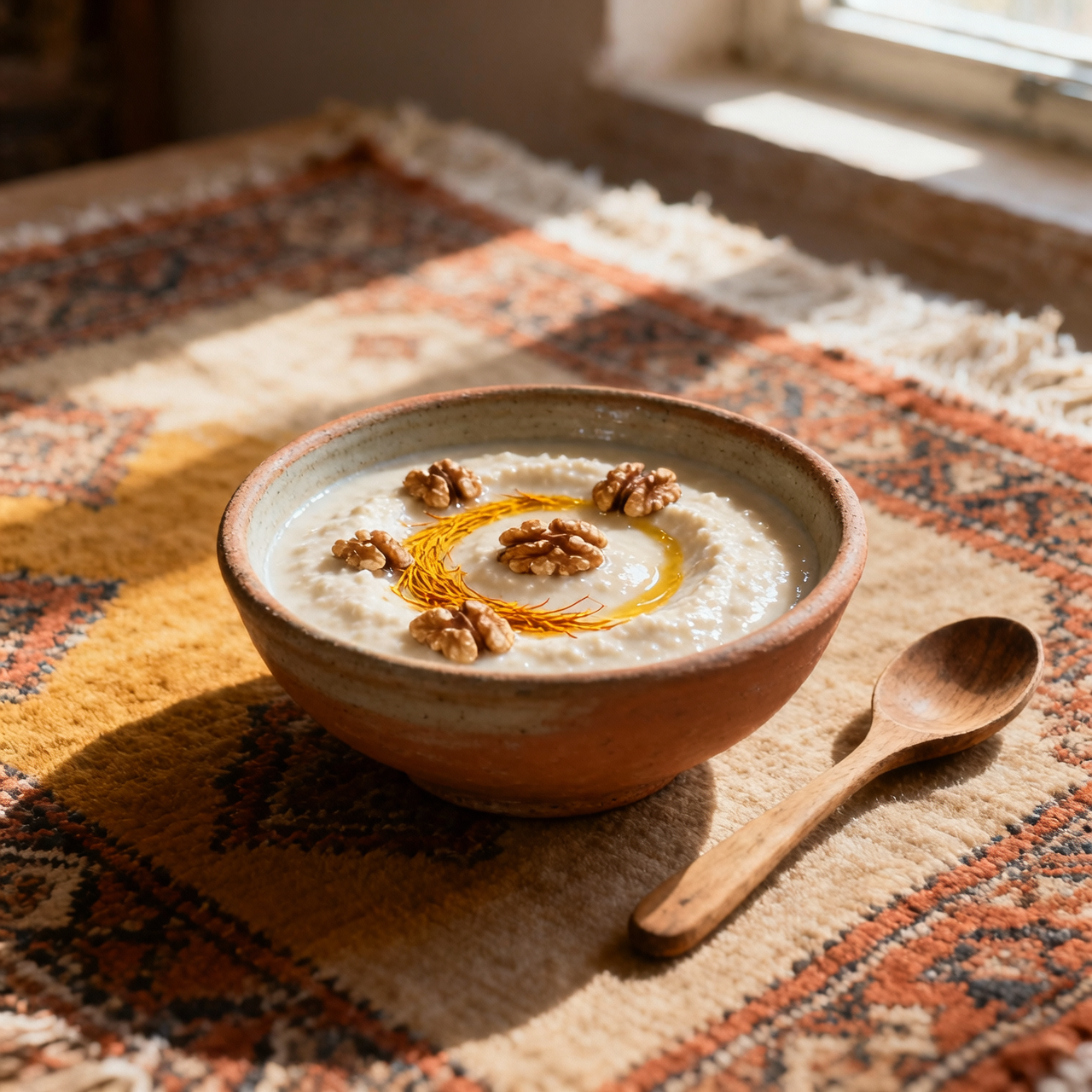
Kashk (fermented whey)
I’ve always believed that the most profound pantry staples are born from necessity and patience, and kashk is the quiet masterpiece of Persian dairy preservation. Long before refrigeration, Persian cooks simmered leftover yogurt whey into a thick, tangy concentrate, then sun-dried it into hard, shelf-stable spheres. This isn’t just a side dish; it’s a flavor bomb—a deeply savory, umami-rich paste that transforms humble stews and eggplants into something transcendent. A great batch of kashk should taste sharply acidic, deeply mineral, and richly creamy when reconstituted, with a texture that coats the back of a spoon. The most common pitfall is rushing the reduction. Boil too hard, and the proteins scorch into bitter, grainy clumps. Reduce too quickly, and you lose the delicate fermentation notes that develop as the whey concentrates. You’ll find commercial kashk paste in specialty markets, often priced steeply and loaded with preservatives, stabilizers, and artificial acidity that strip away the living, cultured soul of the dairy. Making it yourself costs a fraction of that price, requires only two pantry staples, and rewards you with a product that tastes exactly as it should: bright, complex, and profoundly Persian. In this library, I’ve structured the process so you can start simply with a yogurt-based reduction, then graduate to a full whey-extraction and traditional drying method. Whether you’re folding it into a quick dip or building a multi-day batch for your winter stores, the foundation remains the same. Trust the slow simmer, respect the salt, and let the dairy do its work.
Nutrition
| Per serving | Calories | Protein | Carbs | Fat | Sat fat | Fibre | Sugar | Sodium |
|---|---|---|---|---|---|---|---|---|
| beginner | 310kcal | 20g | 24g | 18g | 11g | 0g | 24g | 2100mg |
| intermediate | 310kcal | 20g | 24g | 18g | 11g | 0g | 24g | 2100mg |
| expert | 310kcal | 20g | 24g | 18g | 11g | 0g | 24g | 2100mg |
Per serving · Ava-estimated — a guide, not a clinical figure.
- 2000 gwhole-milk yogurt— full-fat, live-culture preferred
- 20 gfine sea salt— non-iodized for cleaner flavor
- 500 mlfiltered water(optional)— for reconstitution only
This version strips away the traditional whey-extraction phase by starting directly with plain yogurt, making the process far more forgiving and accessible for a first attempt. Instead of relying on days of sun-drying, you will use a low-temperature oven to gently dehydrate the reduced paste into stable, shelf-ready pieces. The focus here is on temperature control and consistent stirring to prevent scorching, which is the most common beginner mistake. You will learn how to recognize the proper thickening stage by the ribbon consistency, and how to safely reconstitute the dried pieces into a smooth, pourable sauce. Because we skip the initial straining and long fermentation, the flavor will be slightly milder, but still authentically tangy and rich. Watch your heat closely during the reduction phase; if the mixture begins to foam aggressively or stick, lower the burner immediately. This approach guarantees a reliable, from-scratch kashk that can be batched, dried, and stored without specialized equipment. It is designed to build confidence while preserving the core dairy chemistry that defines Persian kashk.
Equipment
- Heavy-bottomed pan— enamel or stainless steel works best
- Fine-mesh sieve(optional)— for optional smoothing
- Parchment-lined baking sheet— standard half-sheet size
Method
- 1
Place the yogurt in a heavy-bottomed pan over medium-low heat.
Use a wooden spoon to prevent scratching.
tempering~ 2 min - 2
Stir continuously as the yogurt gently simmers and begins to separate.
Keep heat low to avoid scorching.
reducing~ 15 minTricky bit - 3
Add the salt and blend until the mixture is completely smooth and uniform.
An immersion blender works best here.
emulsifying~ 2 min - 4
Continue simmering until the paste thickens and pulls cleanly away from the pan sides.
Watch for a glossy, ribbon-like consistency.
nappe~ 30 minTricky bit - 5
Spread the thickened paste onto a parchment-lined baking sheet in a thin, even layer.
A silicone spatula ensures uniform thickness.
sheeting~ 3 min - 6
Dehydrate in a 175°F oven with the door cracked until completely firm and dry.
Rotate the tray halfway through the process.
dehydrating~ 120 min - 7
Break the dried kashk into small pieces and transfer to an airtight container.
Store in a cool, dark pantry.
storing~ 2 min - 8
Reconstitute one cup of dried pieces with three cups of filtered water, whisking until smooth.
Let it rest for ten minutes before serving.
reconstituting~ 10 min
Cooking from frozen
Thaw overnight in the refrigerator, then whisk vigorously with warm water until fully smooth.
Storage times are a guide — always use your judgement and store food safely.