
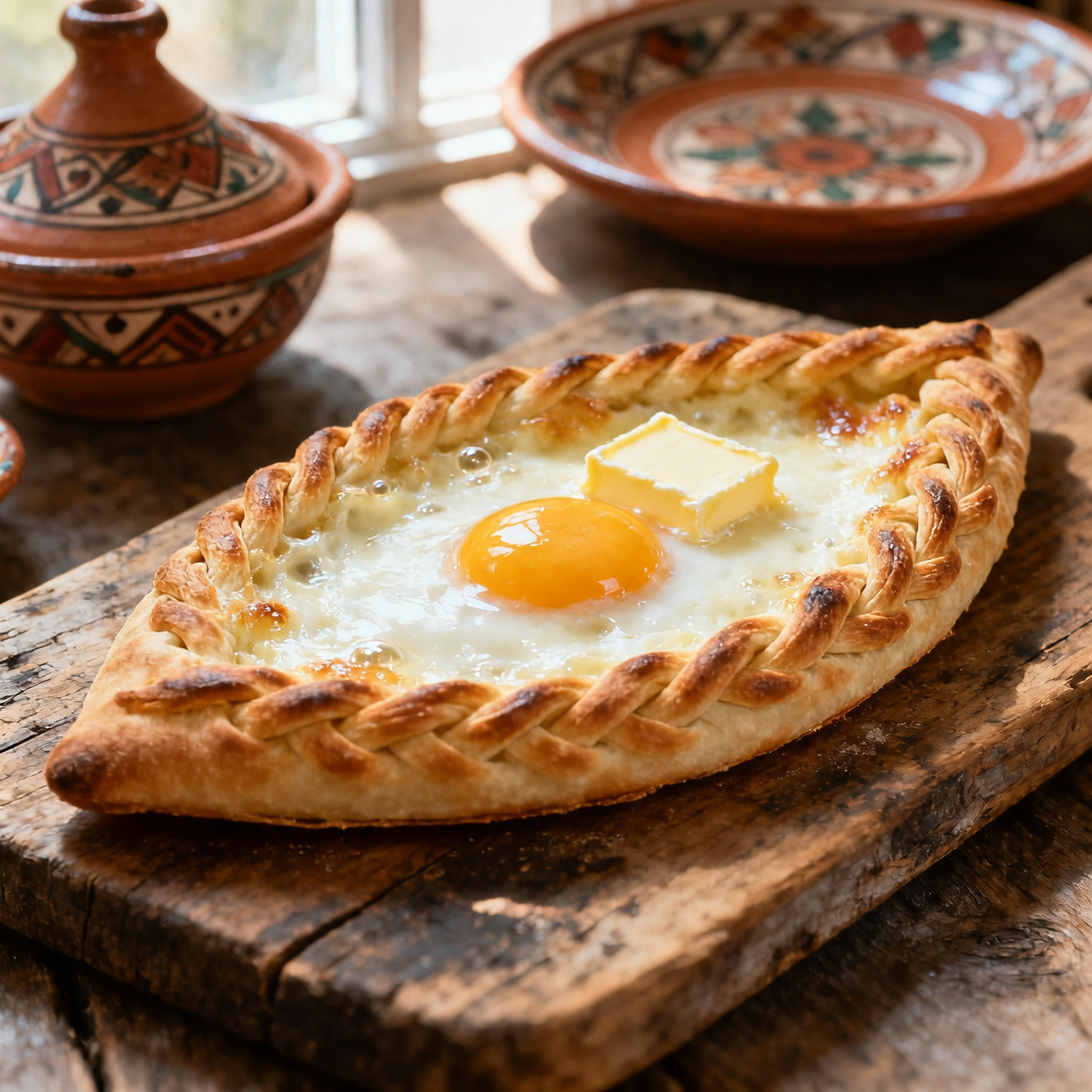
Khachapuri Adjaruli
I’ve always believed that food is geography made edible, and nowhere is that truer than in the boat-shaped embrace of Khachapuri Adjaruli. Born along Georgia’s sun-drenched Black Sea coast, particularly in the Adjara region, this bread was originally a humble sustenance for sailors and farmers who needed something hearty, portable, and deeply nourishing. Over time, it evolved into a national emblem of Georgian hospitality, a dish that demands to be shared straight from the oven. When I first learned to shape the dough, I quickly realized that making authentic Adjaruli isn’t just about following steps; it’s about understanding the rhythm of fermentation and the delicate balance of rich, tangy sulguni cheese. The most frequent mistake I see is treating it like a regular pizza or calzone—overworking the dough, skipping the crucial resting period, or drowning the cheese filling in heavy cream instead of letting the natural brine and milk solids shine. Another common misstep is cracking the egg too early or baking at the wrong temperature, which leaves the center raw while the crust turns brittle. True Adjaruli requires patience: a slow proof, a careful stretch into that iconic oval, and a final high-heat bake that puffs the edges while keeping the center luxuriously molten. You don’t cut this bread with a knife. You tear off the crust, swirl the raw egg and butter into the hot cheese, and eat it with your hands. It’s messy, deeply comforting, and entirely alive. That’s why it matters. It’s a reminder that some of the best meals aren’t perfected, but experienced.
Nutrition
| Per serving | Calories | Protein | Carbs | Fat | Sat fat | Fibre | Sugar | Sodium |
|---|---|---|---|---|---|---|---|---|
| beginner | 1050kcal | 45g | 95g | 52g | 30g | 3g | 3g | 1720mg |
| intermediate | 1050kcal | 45g | 95g | 52g | 30g | 3g | 3g | 1720mg |
| expert | 1050kcal | 45g | 95g | 52g | 30g | 3g | 3g | 1720mg |
Per serving · Ava-estimated — a guide, not a clinical figure.
- 500 gbread flour— high-protein for chewy crust
- 300 mlwarm water— around 38°C / 100°F
- 7 gactive dry yeast— one standard packet
- 10 ggranulated sugar— feeds yeast activation
- 10 gfine sea salt— balances rich dairy
- 400 gsulguni cheese— traditional Georgian, grated
- 200 gimeretian cheese— mild and fresh, grated
- 3 wholelarge eggs— room temperature preferred
- 60 gunsalted butter— cut into pats for topping
This version prioritizes accessibility and confidence, using a stand mixer or simple hand-mixing to eliminate the intimidation of traditional dough handling. Instead of wrestling with delicate stretches, you will roll the rested dough into a simple rectangle and pinch the long sides to form a reliable boat. The cheese is pre-grated and mixed thoroughly, ensuring even melting without guesswork. Watch the oven closely during the final ten minutes; visual cues like golden crust edges and vigorous bubbling replace thermometer checks. If the dough resists rolling, let it relax for five minutes rather than forcing it. The egg is cracked directly onto the hot cheese straight from the oven, and the butter is stirred in immediately to create a rich, emulsified center. This approach guarantees a structurally sound vessel every time, removing the anxiety of collapsing seams or undercooked dough. Focus on gentle shaping, consistent heat, and immediate serving. You will gain a reliable baseline before advancing to artisanal folding techniques.
Equipment
- Stand mixer— paddle or dough hook attachment
- Rimmed baking sheet— lined with parchment paper
- Rolling pin— wooden or silicone
Method
- 1
Combine flour, yeast, sugar, and salt in a stand mixer bowl fitted with a dough hook.
Scrape down sides if clumps form.
mixing~ 1 min - 2
Add warm water and mix on medium speed until the dough pulls away cleanly from the bowl.
Dough should feel slightly tacky but not sticky.
kneading~ 8 min - 3
Transfer dough to a lightly oiled bowl, cover with plastic wrap, and let rest until doubled.
Warm spot speeds up fermentation.
proofing~ 60 min - 4
Roll dough into a large rectangle on a floured surface and pinch both long sides upward to form a boat.
Keep edges about two inches wide for structural support.
shaping~ 3 minTricky bit - 5
Spread the mixed cheeses evenly into the center and bake on a preheated sheet until bubbling.
Rotate halfway through for even browning.
baking~ 20 min - 6
Remove from oven, crack an egg directly into the hot cheese, and place butter on top.
Stir immediately until the butter melts and the egg thickens slightly.
finishing~ 1 min