
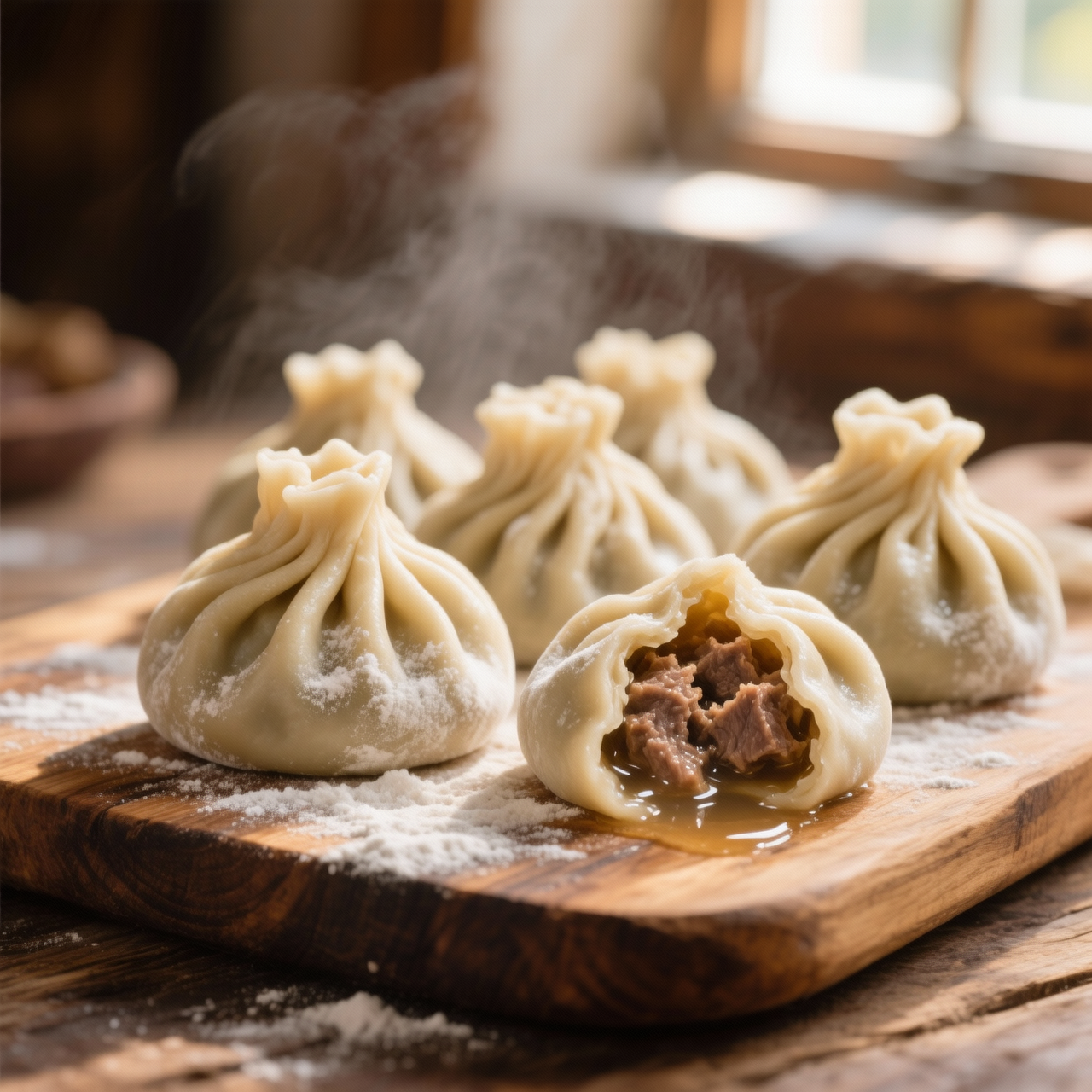
Khinkali
I have always believed that to truly understand Georgia is to first feel the quiet reverence surrounding a perfectly folded khinkali. Born in the rugged highlands of Khevsureti and Pshavi, these meat-filled dumplings were originally crafted as hearty, portable sustenance for mountain shepherds and travelers enduring the brutal Caucasus winters. Over generations, they transcended their utilitarian roots to become the beating heart of the Georgian supra, where their arrival on the table signals warmth, patience, and shared celebration. Crafting them is never about rigid precision, but about honoring a deeply tactile heritage. The dough must be stretched thin enough to hint at the savory filling beneath, yet resilient enough to survive vigorous boiling without splitting. The filling requires a deliberate balance of coarsely ground beef and pork, brightened by fresh cilantro, sharp black pepper, and carefully measured chilled water that transforms into a rich, steaming broth during cooking. I have watched countless enthusiastic cooks stumble into the same predictable traps: kneading the dough until it turns tough and unyielding, pinching the tops so tightly that no broth remains, or carelessly discarding the essential dough handle that dictates how the dumpling should be lifted and eaten. Enjoying khinkali is a practiced ritual. You tear a small opening, carefully sip the hot juices, and consume the rest, leaving the pleated crown on your plate as a silent count of your meal. When your fingers finally learn the rhythm of those eighteen to twenty-two folds, you stop merely cooking and begin participating in a living, centuries-old dialogue between land, labor, and love.
Nutrition
| Per serving | Calories | Protein | Carbs | Fat | Sat fat | Fibre | Sugar | Sodium |
|---|---|---|---|---|---|---|---|---|
| beginner | 817kcal | 39g | 94g | 30g | 11g | 5g | 3g | 1355mg |
| intermediate | 817kcal | 39g | 94g | 30g | 11g | 5g | 3g | 1355mg |
| expert | 817kcal | 39g | 94g | 30g | 11g | 5g | 3g | 1355mg |
Per serving · Ava-estimated — a guide, not a clinical figure.
- 400 gbeef chuck— well-chilled, trimmed of excess sinew
- 200 gpork shoulder— well-chilled, with visible fat marbling
- 250 gyellow onion— peeled, kept cold until use
- 40 gfresh cilantro— stems and leaves, thoroughly washed
- 10 ggarlic— fresh cloves, peeled
- 8 gblack pepper— freshly cracked, coarse grind
- 12 gfine sea salt— divided between filling and dough
- 450 gall-purpose flour— high protein for optimal gluten development
- 225 mlice water— chilled to prevent dough warming
- 100 mlbeef stock— unsalted, thoroughly chilled
This beginner pathway strips away the intimidation factor by embracing smart, modern shortcuts while preserving the essential geometry of a proper khinkali. You will rely on a food processor to achieve a uniform filling quickly, and you will use a standard wide glass to cut perfect dough circles instead of wrestling with a rolling pin. The goal here is confidence, not perfection. Watch closely for dough elasticity; if it snaps back while rolling, let it rest for five minutes under a damp towel. The most critical step is the pleating. Do not rush the twist at the top. It does not need to be symmetrical, but it must be completely sealed to trap the precious broth inside. When boiling, maintain a gentle simmer rather than a rolling boil to prevent the dumplings from bursting. Serve immediately, remembering that khinkali are meant to be eaten hot. You will leave the thick dough handles on your plate, a polite tradition that honors the craft while keeping the focus on the juicy, spiced center you worked so carefully to create.
Equipment
- food processor— standard 7-cup bowl works best
- wide drinking glass— approximately 8 cm rim diameter
- large pot— minimum 6-quart capacity
- slotted spoon— heat-resistant handle
Method
- 1
Combine beef, pork, onion, cilantro, garlic, pepper, and half the salt in a food processor.
Keep meat chilled to prevent emulsion breakdown.
emulsifying~ 1 min - 2
Pulse the mixture until a coarse, cohesive paste forms, scraping the sides twice.
Stop before it becomes completely smooth.
pulsing~ 1 min - 3
Transfer the filling to a mixing bowl and stir in the chilled beef stock until fully absorbed.
Liquid should disappear into the meat.
binding~ 2 minTricky bit - 4
Mix flour, remaining salt, and ice water in a large bowl until a shaggy dough forms.
Add water gradually if dough feels dry.
mixing~ 3 min - 5
Knead dough on a lightly floured surface for five minutes until smooth, then cover and rest.
Dough should feel like a soft earlobe.
resting~ 15 minTricky bit - 6
Roll dough to three millimeters thickness and cut circles using the wide drinking glass.
Press firmly and twist slightly to release.
cutting~ 5 min - 7
Place a heaping tablespoon of filling in each circle and pinch the edges upward into a tight pleated knot.
Aim for at least ten pleats.
pleating~ 10 minTricky bit - 8
Boil dumplings in salted water for twelve minutes until they float, then drain gently.
Water should barely bubble to avoid tearing.
simmering~ 12 min