
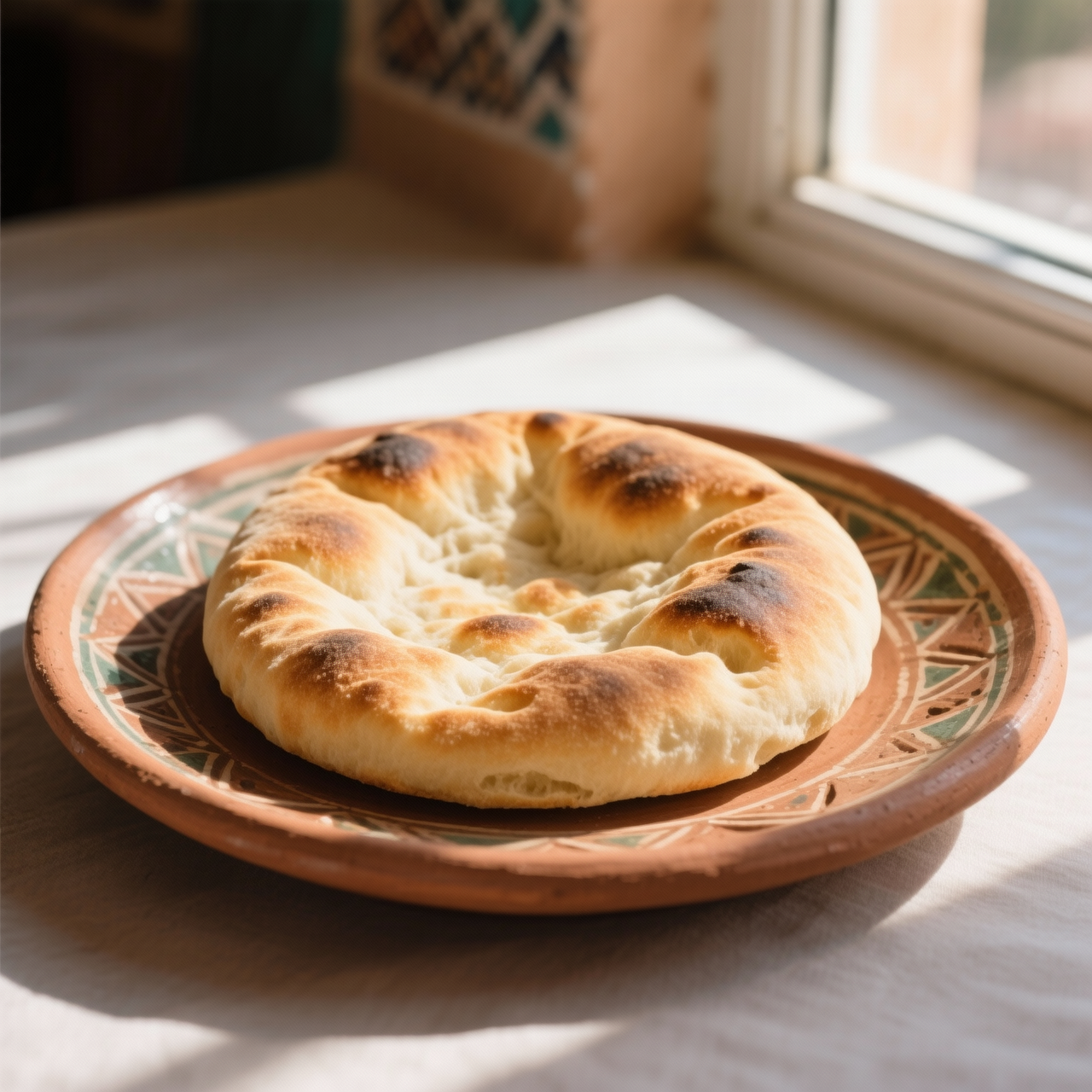
Khobz (Moroccan bread)
I grew up watching my grandmother knead khobz on a flour-dusted wooden board, treating each round like a quiet promise to the family table. This isn’t just bread; it’s the edible utensil of Morocco, the daily semolina loaf that quietly replaces the hollow, plastic-wrapped loaves lining supermarket aisles. You can grab a cheap factory-made sandwich bread for roughly a pound, but it’s little more than stabilizers and empty air, crumbling into dry flakes and leaving your palate completely numb. Making khobz from scratch reclaims that lost integrity. You’re working with fine semolina, a touch of whole wheat flour, sea salt, water, fresh yeast, and olive oil—nothing hidden, nothing processed. The real magic lies in hydration and gentle folding, which builds a soft crumb without demanding hours of expert kneading. The most common pitfall I see is rushing the proof. Khobz requires patience; if you bake before the dough fully relaxes, the crust sets too early and the interior turns dense and gummy. Another frequent mistake is baking in a dry oven. A quick splash of water into a preheated pan mimics the traditional neighborhood bakery, giving the loaf that characteristic golden, slightly blistered crust while keeping the inside tender. Always let it cool completely before slicing, or the trapped steam will escape and collapse your delicate crumb. Once you taste the clean, nutty sweetness of properly baked semolina, you will never return to the shelf-stable impostors.
Nutrition
| Per serving | Calories | Protein | Carbs | Fat | Sat fat | Fibre | Sugar | Sodium |
|---|---|---|---|---|---|---|---|---|
| beginner | 295kcal | 9g | 54g | 4g | 1g | 3g | 2g | 340mg |
| intermediate | 345kcal | 11g | 64g | 4g | 1g | 3g | 1g | 570mg |
| expert | 485kcal | 13g | 90g | 6g | 1g | 5g | 1g | 580mg |
Per serving · Ava-estimated — a guide, not a clinical figure.
- 300 gfine semolina— Medium-fine grind yields the traditional tender crumb
- 200 gall-purpose flour— Provides necessary gluten structure for the round shape
- 350 mlwarm water— Aim for 38C to properly hydrate the semolina and activate yeast
- 7 ginstant yeast— Distribute evenly with dry ingredients for uniform rise
- 10 gfine sea salt— Essential for flavor balance and gluten strengthening
- 30 mlolive oil(optional)— Adds moisture and a subtle traditional flavor to the dough
- 5 ggranulated sugar— Feeds the yeast during initial fermentation
This beginner-friendly version strips the traditional khobz process down to its most forgiving, reliable steps without relying on any processed shortcuts. Unlike the £1.50 supermarket flatbreads that rely on preservatives, dough conditioners, and excessive sodium to mimic softness, this from-scratch loaf uses just pantry staples to deliver a naturally chewy crumb and crisp, golden crust. You will mix a straightforward wet-dough by hand, skip the intensive windowpane test in favor of a simple stretch-and-rest cycle, and bake it in a standard home oven rather than a scorching hearth. Watch the dough hydration closely; it should feel tacky but not sticky, and the yeast will activate faster if your water is comfortably warm rather than hot. The single rise happens right in the bowl, saving you from multiple kneading rounds and complex folding techniques. Once shaped, the loaf bakes until deeply browned and hollow-sounding when tapped. Store it wrapped in linen at room temperature, or slice and freeze for daily use. This approach guarantees consistent results for first-timers while preserving the authentic, unprocessed character that makes homemade bread a worthwhile daily staple.
Equipment
- Large mixing bowl— glass or stainless steel works best for temperature retention
- Digital kitchen scale— essential for accurate hydration ratios
- Heavy baking tray— preheat for better bottom crust
- Pastry brush(optional)— for the final water wash
Method
- 1
Whisk the warm water, sugar, and active dry yeast together until fully dissolved.
Water should feel like a warm bath, not hot.
blooming~ 2 min - 2
Combine the semolina, all-purpose flour, and fine salt in a large bowl.
Sift if your flour tends to clump.
dry mixing~ 1 min - 3
Pour the yeast mixture and olive oil into the dry ingredients and stir until a shaggy dough forms.
Switch to your hands once it becomes too stiff for a spoon.
hydration~ 5 min - 4
Turn the dough onto a lightly floured surface and knead firmly for eight minutes until smooth.
It will feel tacky at first but will clear the board as gluten develops.
kneading~ 8 minTricky bit - 5
Place the dough back in the bowl, cover tightly, and rest in a warm spot for one hour.
Look for a visible doubling in volume and a domed surface.
bulk fermentation~ 60 min - 6
Gently deflate the dough, shape it into a tight round, and flatten it into an eight-inch disc.
Avoid tearing the surface skin during shaping.
shaping~ 3 minTricky bit - 7
Score a shallow cross on top, brush lightly with water, and rest uncovered for twenty minutes.
The water encourages steam for a softer crust during baking.
proofing~ 20 min - 8
Bake on the preheated tray at 220°C until the crust is deep golden and sounds hollow when tapped.
Rotate halfway through for even browning.
baking~ 30 min
Cooking from frozen
Thaw wrapped at room temperature for two hours, then refresh in a hot oven for five minutes.
Storage times are a guide — always use your judgement and store food safely.