
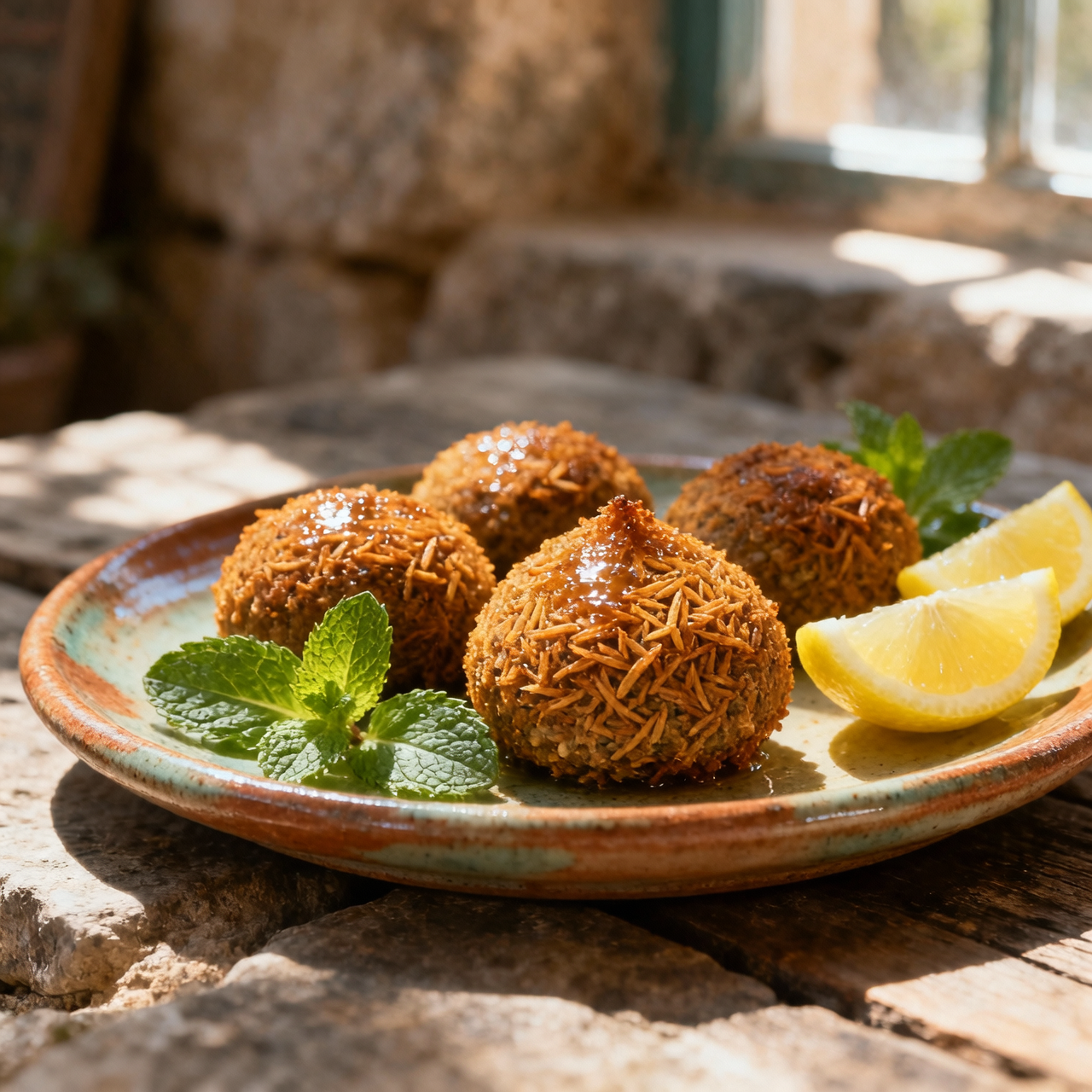
Kibbeh
I have always believed that kibbeh is less a recipe and more a quiet conversation between generations of Levantine cooks. Born in the mountainous villages of Lebanon and Syria, this dish began as a practical necessity, a way to stretch precious meat with finely ground bulgur wheat and aromatic spices. Over centuries, it evolved into a centerpiece of hospitality, its torpedo-shaped shells or baked layers carrying the weight of family gatherings and festive tables. What makes it so deeply meaningful to me is the rhythm it demands. You cannot rush the kneading of the meat and bulgur, nor can you ignore the patience required to shape each piece by hand. The pitfalls are deceptively simple. Many home cooks fail to soak and drain the bulgur thoroughly, leaving the dough too wet or grainy. Others skip the crucial step of chilling the mixture before shaping, which causes the delicate shells to fracture in the hot oil. And then there is the filling. Too much onion or not enough toasted pine nuts and lamb fat will unbalance the delicate harmony of flavors. When I make kibbeh, I treat the process as a meditation, listening to the dough texture and feeling for the exact moment it becomes smooth and pliable. It is a dish that rewards attention, forgiving only those who respect its quiet rules. That reverence is what transforms it from mere food into a living heirloom.
Nutrition
| Per serving | Calories | Protein | Carbs | Fat | Sat fat | Fibre | Sugar | Sodium |
|---|---|---|---|---|---|---|---|---|
| beginner | 710kcal | 28g | 55g | 44g | 11g | 13g | 3g | 1250mg |
| intermediate | 710kcal | 28g | 55g | 44g | 11g | 13g | 3g | 1250mg |
| expert | 710kcal | 28g | 55g | 44g | 11g | 13g | 3g | 1250mg |
Per serving · Ava-estimated — a guide, not a clinical figure.
- 250 gfine bulgur wheat— must be extra fine grade
- 400 glamb shoulder— trimmed of excess fat and gristle
- 150 gyellow onion— divided between shell and filling
- 50 gpine nuts— raw, for toasting
- 60 mlextra virgin olive oil— for frying
- 8 gground allspice
- 4 gground cinnamon
- 12 gkosher salt
- 5 gblack peppercorns
- 120 mlice water
This version prioritizes confidence over tradition, replacing the most labor-intensive steps with reliable shortcuts while preserving the dish’s essential character. You will use a food processor to blend the meat and grain, bypassing the traditional mortar-and-pestle rhythm. The spice mixture is added as a pre-measured blend to guarantee balanced flavor without guesswork. The primary focus here is temperature control and moisture management. Watch your oil closely; it must hover steadily at the correct heat to form a crisp crust without absorbing excess fat. When shaping, keep a bowl of cold water nearby to prevent the dough from sticking to your hands. If the mixture feels too wet, a brief fifteen-minute chill in the refrigerator will firm it perfectly. Do not rush the resting phase, as it allows the bulgur to fully hydrate and bind. Fry in small batches to maintain consistent heat, and drain immediately on paper towels to preserve texture. This approach guarantees a structurally sound, deeply flavorful result on your very first attempt.
Equipment
- Food processor— standard 10-cup capacity
- Deep skillet— heavy-bottomed for even heat distribution
- Kitchen thermometer— digital instant-read type
Method
- 1
Pulse the lamb, half the onion, and spices in a food processor until completely smooth.
Stop immediately if the mixture begins to heat up.
blending~ 2 min - 2
Transfer the mixture to a bowl and gently fold in the soaked bulgur and ice water.
Use a spatula to prevent overworking.
folding~ 1 min - 3
Refrigerate the combined dough for fifteen minutes to solidify the fat matrix.
Cover tightly with plastic wrap.
resting~ 15 min - 4
Shape the chilled dough into uniform cylinders, pressing firmly to seal the filling inside.
Dip hands in cold water to prevent sticking.
molding~ 5 minTricky bit - 5
Heat the oil in a heavy skillet until it reaches exactly three hundred fifty degrees.
Test with a bread crumb first.
tempering~ 5 minTricky bit - 6
Fry the shaped kibbeh in small batches until the exterior turns a uniform golden brown.
Do not crowd the pan.
deep_frying~ 8 min - 7
Transfer the cooked pieces to a lined tray to drain excess oil before plating.
Serve immediately for optimal crunch.
draining~ 2 min