
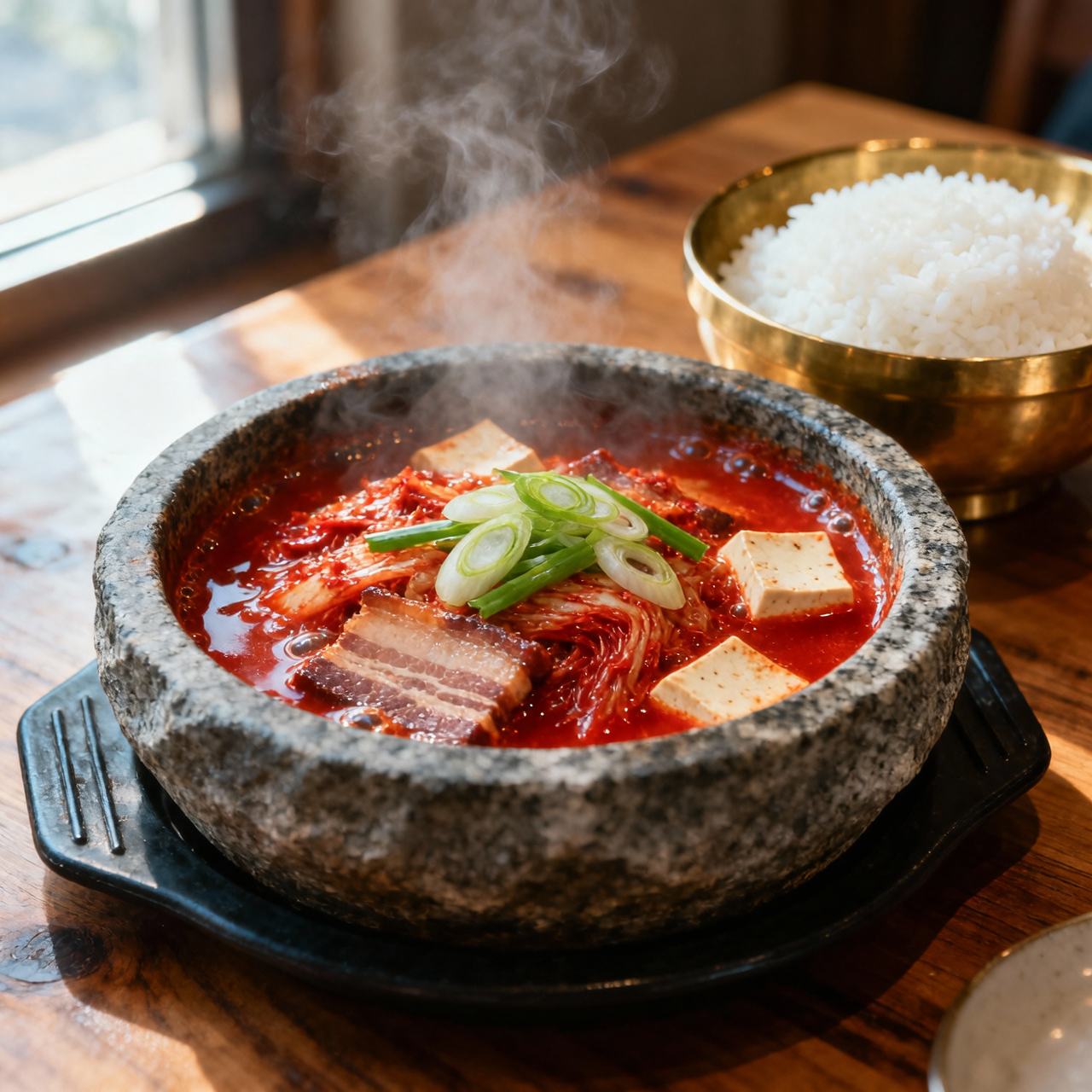
Kimchi Jjigae
I still remember the exact moment I first understood why kimchi jjigae is the soul of a Korean winter table. It wasn’t in a restaurant, but in my grandmother’s cramped kitchen, where the rhythmic bubbling of a clay pot felt like a heartbeat. This stew didn’t just warm us; it transformed time. Leftover, deeply fermented kimchi—the kind that had sat in the cellar for months—was never discarded. Instead, it became the foundation of something profoundly comforting. That’s the beautiful paradox of this dish: it thrives on patience and imperfection. Yet, so many modern attempts miss the point entirely. I see home cooks rushing the process with fresh kimchi, hoping for that signature tang, only to end up with a flat, watery soup that lacks depth. Others drown it in gochugaru or overcomplicate the broth with store-bought stocks, forgetting that the magic lies in the marriage of aged kimchi, pork belly fat, and a slow, gentle simmer. The pork isn’t just a protein; it’s a flavor anchor. As it renders, the fat coats the sharp lactic notes of the kimchi, mellowing the heat into something rich and rounded. When you skip the initial stir-frying step, you lose that crucial Maillard reaction that builds the stew’s backbone. I’ve learned that making kimchi jjigae isn’t about following rigid measurements. It’s about listening to the pot. Let the kimchi caramelize until the edges crisp. Let the broth reduce just enough to cling to the spoon. This dish asks for presence, not precision. When you honor its humble origins, you aren’t just cooking; you’re preserving a quiet, resilient tradition.
Nutrition
| Per serving | Calories | Protein | Carbs | Fat | Sat fat | Fibre | Sugar | Sodium |
|---|---|---|---|---|---|---|---|---|
| beginner | 380kcal | 18g | 14g | 28g | 9g | 5g | 5g | 920mg |
| intermediate | 380kcal | 18g | 14g | 28g | 9g | 5g | 5g | 920mg |
| expert | 380kcal | 18g | 14g | 28g | 9g | 5g | 5g | 920mg |
Per serving · Ava-estimated — a guide, not a clinical figure.
- 300 gPork belly— thick-cut, skinless
- 400 gKimchi— well-fermented napa cabbage
- 60 mlKimchi juice— strained from the jar
- 1000 mlAnchovy stock— or dashi for depth
- 200 gTofu— soft or medium-firm, cubed
- 30 gGochugaru— coarse Korean chili flakes
- 15 mlSoy sauce— standard Korean or Japanese
- 15 gGarlic— minced
- 5 gGinger— finely grated
- 30 gScallions— cut into 5 cm lengths
- 10 mlSesame oil— toasted
- 5 gSugar(optional)— balances acidity
This version is designed for your first successful attempt, prioritizing clarity over complexity. We lean on straightforward techniques and accessible pacing, using a pre-measured spice blend to guarantee balanced flavor without requiring you to source multiple specialty pastes. The goal is to build confidence through predictable steps. Watch closely for the initial simmer; this stew relies on a gentle bubble to coax out the kimchi’s tang without turning the pork tough. Keep your heat at a steady medium-low once boiling, and resist the urge to stir aggressively, which will cloud the broth and break the tofu. The shortcut here is using a ready-made kimchi stew seasoning mix alongside your base ingredients, which eliminates guesswork with chili ratios. Pay attention to the visual cue of the oil separating slightly at the surface—that is your signal that the flavors have properly married. Serve immediately over warm rice, letting the residual heat in the pot keep it bubbling. You will learn to recognize the exact moment the kimchi softens and the broth turns a rich, opaque crimson. Trust the process, follow the timing precisely, and you will achieve a deeply comforting bowl on your very first try.
Equipment
- Heavy-bottomed pan— non-stick is fine here
- Wooden spoon— for gentle stirring
Method
- 1
Heat the heavy-bottomed pot over medium heat and add the pork belly.
Do not add oil; the pork will release its own fat.
rendering~ 5 min - 2
Add the chopped kimchi to the pot and stir until evenly coated in the rendered fat.
Listen for a steady sizzle, not a pop.
sweating~ 5 min - 3
Sprinkle in the gochugaru, soy sauce, minced garlic, and grated ginger.
Stir constantly for thirty seconds to awaken the spices without burning.
blooming~ 1 min - 4
Pour in the anchovy stock and reserved kimchi juice, scraping the bottom of the pot.
Use a wooden spoon to lift any caramelized bits.
deglazing~ 2 min - 5
Reduce the heat to medium-low and let the stew simmer uncovered.
Aim for small, gentle bubbles rather than a rolling boil.
simmering~ 15 minTricky bit - 6
Gently nestle the tofu cubes and scallion lengths into the broth.
Do not stir after this point to preserve the tofu's shape.
steeping~ 3 min - 7
Turn off the heat and drizzle the toasted sesame oil over the surface.
Let it rest for two minutes before serving.
finishing~ 2 min