
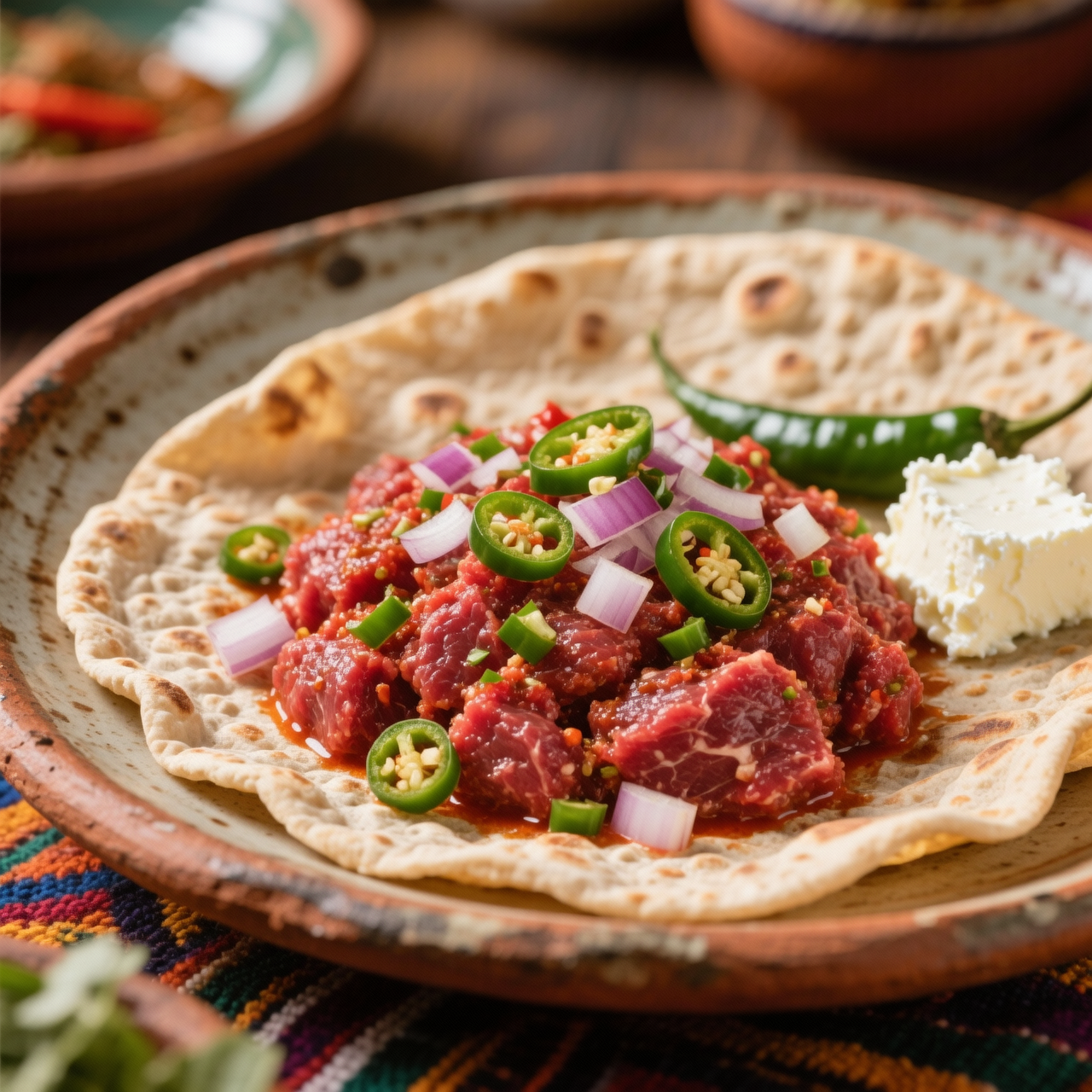
Kitfo (minced beef tartare)
I first learned to make kitfo in a cramped Addis Ababa kitchen where the scent of niter kibbeh blooming with cardamom and fenugreek was practically a religion. This isn’t just raw beef; it’s a celebration of Ethiopian hospitality, where the quality of the meat and the patience of the spice work are non-negotiable. When I see the supermarket equivalent—those vacuum-packed, pre-seasoned minced beef bowls that cost nearly eight pounds—I’m always struck by how much they miss the point. They rely on citric acid preservatives and stale, mass-produced spice blends that taste flat and metallic, completely bypassing the slow, gentle warming of clarified butter that carries the mitmita and awaze into the meat fibers. Making it yourself transforms it from a sterile, expensive novelty into something vibrant and deeply comforting. The real magic lies in hand-mincing lean, impeccably fresh beef and folding it into warm, not hot, niter kibbeh so the fat coats rather than cooks the meat. The most common pitfall I see is rushing the spice bloom or letting the butter overheat, which turns the dish into a greasy, slightly cooked scramble instead of a silky tartare. Another mistake is using beef straight from the fridge; cold meat refuses to absorb the spiced butter, leaving the seasoning sitting on top rather than marrying with the flesh. Take your time, source your meat from a trusted butcher, and trust the warmth of your hands to finish the emulsion. When done right, every bite should feel impossibly rich, bright with chili, and utterly alive.
Nutrition
| Per serving | Calories | Protein | Carbs | Fat | Sat fat | Fibre | Sugar | Sodium |
|---|---|---|---|---|---|---|---|---|
| beginner | 390kcal | 33g | 1g | 27g | 14g | 0g | 0g | 410mg |
| intermediate | 510kcal | 40g | 3g | 36g | 20g | 1g | 1g | 480mg |
| expert | 460kcal | 26g | 2g | 38g | 20g | 1g | 0g | 480mg |
Per serving · Ava-estimated — a guide, not a clinical figure.
- 500 gbeef tenderloin— Fresh, high-quality, suitable for raw consumption, trimmed of all fat and sinew
- 60 gniter kibbeh— Ethiopian spiced clarified butter
- 10 gmitmita— Ethiopian chili and spice powder blend
- 5 gsalt— Fine sea salt
- 150 gayib(optional)— Ethiopian fresh cottage cheese, crumbled
Store-bought pre-seasoned beef tartare or fast-food beef patties typically cost $10–14 per serving and rely on heavy sodium, stabilizers, and artificial preservatives to mask lower-quality meat. This beginner version strips away those additives while simplifying traditional techniques for a reliable, restaurant-quality result. Focus on keeping all ingredients thoroughly chilled until the final toss to ensure food safety and optimal texture. You will gently warm homemade niter kibbeh (clarified spiced butter) and whole spices just until fragrant, avoiding any browning that could overpower the delicate beef. Hand-mincing or careful food-processor pulsing keeps the meat distinct and tender. The key moment to watch for is when the butter stops bubbling and coats the back of a spoon; that signals it is perfectly tempered. Fold the warm spiced butter into the cold beef slowly, stopping exactly when the mixture turns glossy. Taste a small pinch before plating to gauge the mitmita heat, adjusting gradually. This straightforward approach guarantees a clean, rich flavor profile without overwhelming beginners.
Equipment
- Large glass mixing bowl— chill in freezer for 10 minutes beforehand
- Small heavy saucepan— for gentle spice infusion
- Chef’s knife— keep it honed for clean cuts
- Food processor(optional)— pulse carefully to avoid paste
Method
- 1
Pulse the beef in a food processor or hand-mince until finely textured.
Stop immediately when grains separate easily.
mincing~ 2 min - 2
Place the minced beef into a pre-chilled glass bowl and season with fine salt.
Add salt only right before mixing to prevent moisture loss.
seasoning~ 1 min - 3
Warm the clarified butter in a small heavy saucepan over the lowest heat.
Never let it simmer or brown the milk solids.
tempering~ 2 minTricky bit - 4
Add the whole spices to the butter and stir gently until fragrant.
Remove from heat the moment you smell toasted earthiness.
blooming~ 2 min - 5
Pour the warm spiced butter directly over the beef and fold with a rubber spatula.
Stop mixing when the meat looks uniformly glossy.
emulsifying~ 1 min - 6
Taste a tiny portion and adjust the spice level before serving immediately.
Raw meat carries heat differently, so add spices incrementally.
balancing~ 1 min
Storage times are a guide — always use your judgement and store food safely.