
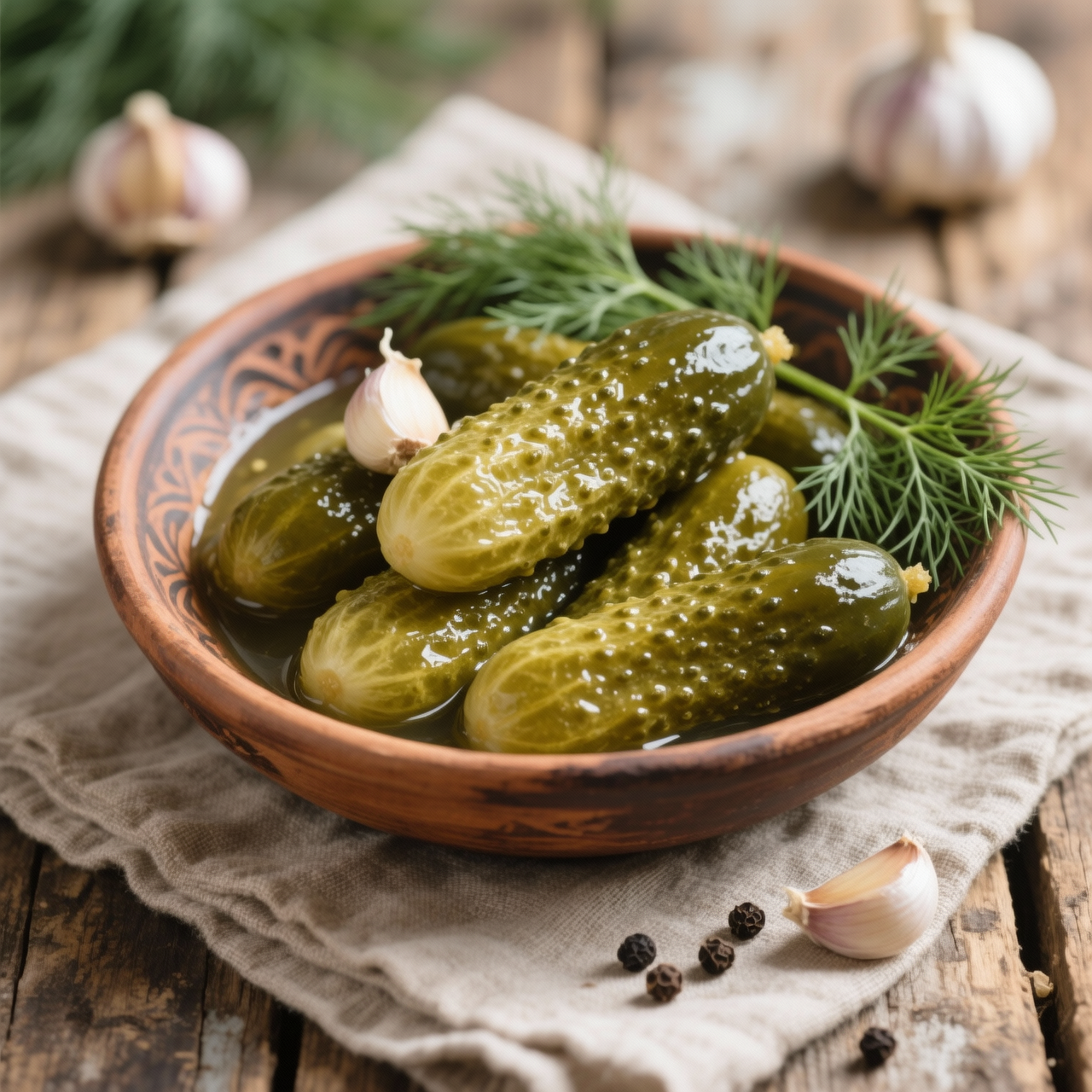
Kvasheni ohirky (fermented cucumbers)
When I think of the soul of Ukrainian cuisine, my mind immediately goes to the humble kvasheni ohirky, our traditional lacto fermented cucumbers. Unlike their vinegar pickled cousins found in Western supermarkets, these barrel style sour pickles rely entirely on the natural alchemy of salt and time. Historically, fermenting was not just a culinary preference but a vital survival strategy, allowing our ancestors to preserve the fleeting bounty of summer harvests through the harsh, unforgiving winters. Today, they remain a cornerstone of our table, offering a crisp, tangy, probiotic bite that cuts through the richness of borscht, varenyky, and hearty meat dishes. The magic lies in the brine, a simple mixture of water, salt, garlic, dill, horseradish, and cherry or oak leaves, which provide tannins to keep the cucumbers miraculously crisp. However, achieving that perfect, satisfying crunch requires vigilance. The most common pitfall is accidentally using vinegar; true kvasheni ohirky are never vinegared. Another frequent mistake is using cucumbers that are too large or have thick, waxy skins, which results in a mushy interior rather than a snappy crunch. Furthermore, if your tap water is heavily chlorinated, it will inhibit the growth of the beneficial lactobacillus bacteria, so always use filtered or spring water. Finally, patience is your greatest tool. Rushing the fermentation by keeping them in a warm room for too long can lead to overly sour, soft pickles, while moving them to cold storage too early leaves them under fermented. Mastering this batch hero technique means you are not just making a condiment; you are participating in a centuries old ritual of preservation.
Nutrition
| Per serving | Calories | Protein | Carbs | Fat | Sat fat | Fibre | Sugar | Sodium |
|---|---|---|---|---|---|---|---|---|
| beginner | 15kcal | 1g | 3g | 0g | 0g | 1g | 1g | 950mg |
| intermediate | 12kcal | 1g | 2g | 0g | 0g | 1g | 1g | 850mg |
| expert | 15kcal | 1g | 3g | 0g | 0g | 1g | 1g | 850mg |
Per serving · Ava-estimated — a guide, not a clinical figure.
- 1000 gcucumber— Small, firm pickling cucumbers, washed and ends trimmed
- 1000 mlwater— Filtered or non-chlorinated
- 50 gsalt— Coarse, non-iodized salt such as kosher or sea salt
- 4 piecedill head— Mature dill umbrellas with seeds
- 30 ggarlic— Peeled and lightly crushed
- 2 piecehorseradish leaf— Washed and torn into pieces
- 3 pieceoak leaf(optional)— Washed, provides tannins to keep the cucumbers crunchy
- 5 gblack peppercorn— Whole
- 3 gallspice berry— Whole
This beginner-friendly approach to traditional Ukrainian kvasheni ohirky simplifies the barrel-style process into an easy, foolproof glass jar method. We use a pre-mixed pickling spice blend to eliminate the need for foraging or measuring out individual esoteric leaves, while still delivering that classic garlicky, dill-forward tang. The key to success here is patience and strict cleanliness; ensure your jar is thoroughly sterilized and your cucumbers are fully submerged under the brine to prevent any unwanted mold. Expect a crisp, sour pickle in about three to five days at room temperature, which you can then move to the fridge to halt fermentation and keep for many months. This method hand-holds you through the crucial submerging and burping steps, ensuring your very first batch of lacto-fermented pickles is safe, perfectly crunchy, and packed with probiotic goodness without the intimidation of traditional oak barrels.
Equipment
- 1-quart glass mason jar— Must be thoroughly sterilized with boiling water before use.
- Glass fermentation weight— Keeps cucumbers submerged; a small ziplock bag filled with water works in a pinch.
- Medium mixing bowl— For dissolving the salt into the water.
Method
- 1
Wash the cucumbers, garlic, and dill thoroughly under cold running water, and trim the blossom ends off the cucumbers.
Removing the blossom end prevents mushy pickles by eliminating enzymes that break down pectin.
trimming~ 5 min - 2
Dissolve the kosher salt in filtered water in a mixing bowl, stirring until the liquid is completely clear.
Use filtered water to avoid chlorine, which can inhibit the good bacteria needed for fermentation.
dissolving~ 2 min - 3
Pack the garlic, pre-mixed pickling spice blend, dill, and cucumbers tightly into the sterilized glass jar.
Pack them snugly so they don't float, leaving about an inch of headspace at the top.
packing~ 5 min - 4
Pour the saltwater brine over the cucumbers until they are completely covered, then place the glass weight on top to hold them under.
Any vegetable exposed to air will mold; ensure everything is submerged by at least half an inch.
submerging~ 2 minTricky bit - 5
Seal the jar loosely and let it sit at room temperature away from direct sunlight for 3 to 5 days until it reaches your desired sourness.
Burp the jar daily to release built-up gases, and move it to the fridge once it tastes perfectly sour to you.
fermenting~ 3 min
Storage times are a guide — always use your judgement and store food safely.