
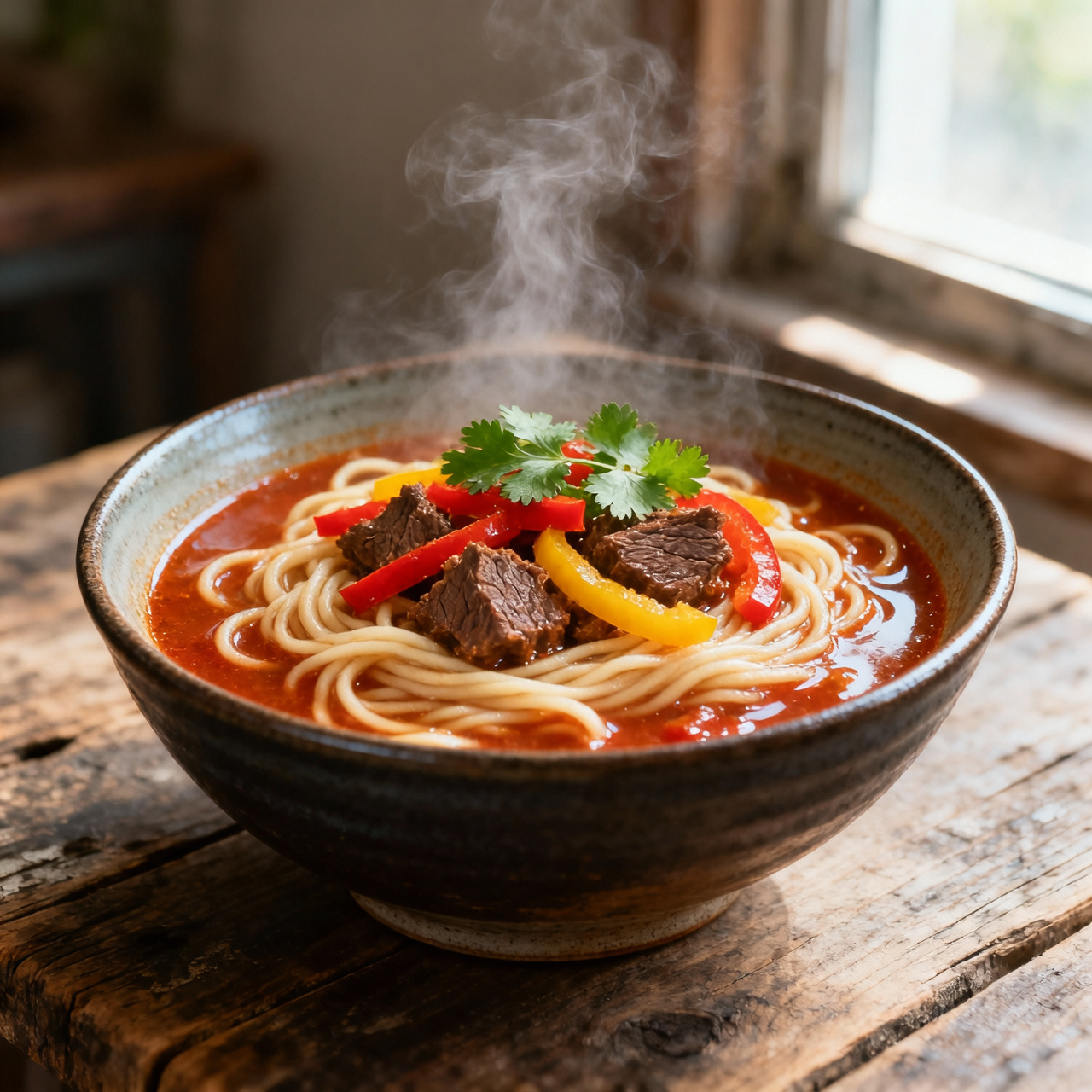
Lagman
When I first encountered lagman, I didn’t realize I was holding centuries of Silk Road history in a single bowl. This dish isn’t just food; it’s a living archive of trade, migration, and cultural exchange across Central Asia. Originally brought to the region by Dungan and Uyghur merchants traveling the ancient caravan routes, lagman evolved from a simple hand-pulled noodle and broth into a deeply regional staple, with the Uzbek interpretation favoring rich, slow-simmered beef, vibrant vegetables, and a fragrant, tomato-anchored sauce. What makes it so vital to me is its insistence on patience. In a world obsessed with quick meals, lagman demands that you knead dough until it yields like silk, simmer meat until it surrenders to the spoon, and balance spices so no single flavor overpowers another. Yet, for all its depth, it’s remarkably approachable once you respect its rhythm. The most common pitfalls I see home cooks stumble into are rushing the dough development, which leaves the noodles brittle instead of springy, and overcrowding the wok when stir-frying the topping, which steams rather than sears the ingredients and dulls the broth’s complexity. Another frequent mistake is skimping on the resting time for the dough or neglecting to stretch the noodles gently; they must be coaxed, not forced. When done right, lagman becomes more than dinner. It becomes a meditation on texture, temperature, and tradition, a bowl that connects you to generations of cooks who understood that the best meals are never rushed, only earned.
Nutrition
| Per serving | Calories | Protein | Carbs | Fat | Sat fat | Fibre | Sugar | Sodium |
|---|---|---|---|---|---|---|---|---|
| beginner | 860kcal | 38g | 95g | 33g | 11g | 8g | 9g | 1520mg |
| intermediate | 860kcal | 38g | 95g | 33g | 11g | 8g | 9g | 1520mg |
| expert | 860kcal | 38g | 95g | 33g | 11g | 8g | 9g | 1520mg |
Per serving · Ava-estimated — a guide, not a clinical figure.
- 600 gbeef chuck roast— trimmed and cut into 2 cm cubes
- 350 gyellow onion— finely diced
- 250 gred bell pepper— seeds removed, julienned
- 300 gtomato— ripe, diced
- 30 ggarlic clove— minced
- 25 gfresh ginger root— peeled and finely grated
- 10 gcumin seed— whole, toasted or ground acceptable
- 8 gcoriander seed— whole, lightly crushed
- 5 gfennel seed— whole
- 400 gwheat flour— high-protein bread flour
- 45 mlneutral vegetable oil— for cooking
- 800 mlwater— divided for dough and broth
- 500 mlbeef stock— low-sodium preferred
- 20 gfresh cilantro— roughly chopped for garnish
- 12 gfine sea salt— divided between dough and seasoning
This version prioritizes confidence and approachability without sacrificing the dish’s core identity. You will bypass traditional dough resting and complex spice grinding by using a reliable jarred lagman paste and pre-measured flour blends. The noodles are rolled out simply and cut into strips, which is perfectly acceptable for your first attempt. Watch your heat carefully when browning the beef; overcrowding the pan steams the meat instead of searing it, robbing the broth of its foundational flavor. Keep the vegetables vibrant by adding them in stages, allowing the onions and peppers to soften without collapsing into mush. When combining the broth, taste for balance before pouring it over the noodles. The goal here is to understand the architecture of the stew—how fat, acid, and aromatics interact—while letting trusted shortcuts carry the heavy lifting. If the dough feels slightly sticky during rolling, dust it lightly with extra flour rather than adding water, which can make the noodles gummy. You will learn to recognize when the broth has properly thickened and how to judge noodle doneness by texture rather than strict timing. This pathway builds muscle memory and flavor intuition, setting you up perfectly for more hands-on techniques when you are ready.
Equipment
- large skillet— non-stick works well here
- stockpot— minimum 4-liter capacity
- mixing bowl— medium size
- rolling pin— wooden or silicone
Method
- 1
Heat the vegetable oil in a large skillet over medium-high heat until shimmering.
oil should ripple but not smoke
searing~ 1 min - 2
Add the beef cubes in a single layer and cook until deeply browned on all sides.
work in batches to avoid steaming
browning~ 5 minTricky bit - 3
Stir in the diced onions and bell peppers, cooking until just translucent.
keep stirring to prevent burning
softening~ 4 min - 4
Combine the tomatoes, garlic, ginger, and jarred lagman paste with the vegetables.
cook until the raw smell dissipates
blooming~ 2 min - 5
Mix the flour, half the salt, and water into a smooth dough, then roll and cut into wide strips.
dust lightly if dough sticks
kneading~ 5 minTricky bit - 6
Boil the noodles until tender, drain, and divide into bowls before ladling the hot broth over them.
reserve pasta water if broth needs thinning
assembling~ 3 min