
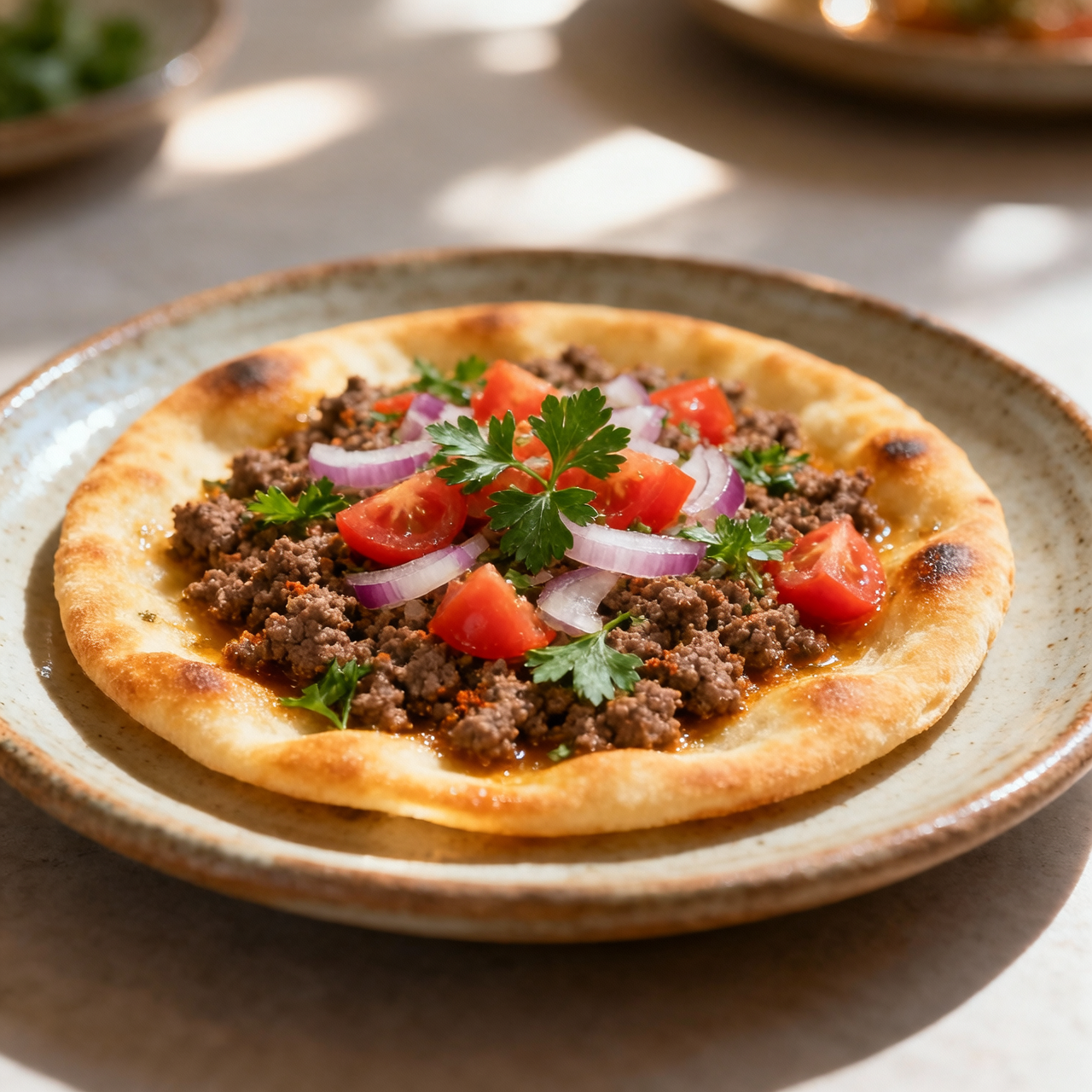
Lahm bi ajeen
I grew up watching my grandmother knead dough for lahm bi ajeen, those humble Lebanese meat pies that have anchored family tables and street corners across Beirut for generations. Long before frozen pastry cases and heavily processed snack aisles existed, these open-faced pies were the original batch hero, designed to feed crowds without demanding hours at the stove. Today’s supermarket equivalents often cost upwards of eight dollars for a box of six, yet they deliver little more than greasy, rubbery dough and a salty, unrecognizable meat paste masked by artificial smoke flavoring and preservatives. Making them from scratch isn’t just about saving money; it’s about reclaiming the bright, aromatic balance of sumac, allspice, and toasted pine nuts that defines true Lebanese cooking. The dough should be soft but elastic, resting long enough to relax so it doesn’t shrink in a hot oven. The filling must stay lean and finely chopped rather than ground into a paste, ensuring each bite has texture and breathes with citrusy acidity. The most common pitfall I see is rushing the assembly: overloading the dough causes it to tear, while under-seasoning the meat leaves it dull and heavy. I always let the spiced beef mixture chill briefly before spreading it thinly, which keeps the crust crisp and the edges from collapsing. These pies are deeply forgiving once you respect their rhythm. They scale effortlessly for gatherings, freeze beautifully before baking, and thaw into something that actually tastes like home. When you skip the industrial shortcuts and build everything from scratch, you’re not just baking a snack—you’re preserving a quiet, resilient tradition that refuses to be flattened by convenience.
Nutrition
| Per serving | Calories | Protein | Carbs | Fat | Sat fat | Fibre | Sugar | Sodium |
|---|---|---|---|---|---|---|---|---|
| beginner | 420kcal | 22g | 45g | 15g | 4g | 3g | 5g | 550mg |
| intermediate | 460kcal | 26g | 48g | 15g | 4g | 3g | 7g | 540mg |
| expert | 415kcal | 21g | 42g | 17g | 6g | 3g | 4g | 540mg |
Per serving · Ava-estimated — a guide, not a clinical figure.
- 500 gall-purpose flour— Sifted before mixing
- 7 gactive dry yeast— Proofed in warm water until foamy
- 250 mlwarm water— Heated to approximately 40C
- 30 mlolive oil— Used in dough and for brushing trays
- 10 gfine sea salt— Divided between dough and filling
- 400 gground beef— 80 percent lean 20 percent fat ratio recommended
- 200 gyellow onion— Peeled and finely minced
- 30 gtomato paste— Standard canned variety
- 15 mlpomegranate molasses— Adds traditional tangy depth
- 5 gground allspice— Freshly ground preferred
- 3 gground cinnamon— Ceylon variety recommended
- 10 gsumac— Coarse grind reserved for garnish
- 50 gpine nut(optional)— Dry toasted until golden
This beginner-friendly approach to lahm bi ajeen strips away intimidating pastry techniques while keeping the recipe entirely from scratch. It replaces costly frozen meat pies, which typically run eight to ten dollars per box and rely on hydrogenated fats, excessive sodium, and artificial flavorings for shelf stability. Instead, you will work with a forgiving, no-yeast dough that rests for just fifteen minutes, paired with a straightforward beef-and-onion filling seasoned with pantry spices and a touch of pomegranate molasses for tang. The key to success is rolling the dough thin but resilient, then pinching the edges firmly to seal before baking. Watch the oven closely during the final five minutes, as the thin crust can transition from golden to burnt quickly. This method yields twelve snack-sized portions that bake beautifully straight from the freezer, giving you a reliable batch of wholesome, deeply flavorful Lebanese flatbread pies without the guesswork. Serve warm alongside fresh cucumber slices or a simple herb salad for a complete, satisfying snack.
Equipment
- Rolling pin— A standard fourteen-inch pin works best
- Rimmed baking sheet— Line with parchment paper for easy transfer
- Pastry brush(optional)— Silicone or natural bristle for oiling tops
Method
- 1
Combine all-purpose flour, salt, olive oil, and warm water in a large bowl until a shaggy mass forms.
Water temperature should feel comfortably warm to the touch.
hydrating~ 2 min - 2
Turn the dough onto a lightly floured surface and knead for two minutes until smooth, then wrap and rest.
Resting relaxes the gluten for much easier rolling.
kneading~ 15 min - 3
Mix the ground beef, finely diced onion, tomato paste, pomegranate molasses, and warm spices in a separate bowl.
Dice the onion small so it softens completely during baking.
binding~ 3 min - 4
Divide the rested dough into twelve equal pieces and roll each into a thin, six-inch circle.
Keep the center slightly thicker than the edges to support the meat.
rolling~ 8 minTricky bit - 5
Spread a thin layer of the meat mixture over each circle, leaving a half-inch border, then fold and crimp the edges shut.
Press firmly with your fingertips or a fork to seal completely.
crimping~ 5 minTricky bit - 6
Arrange the pies on the prepared baking sheet, brush the tops with olive oil, and bake until golden and crisp.
Rotate the pan halfway through to guarantee even browning.
baking~ 18 min
Cooking from frozen
Bake straight from frozen at 200°C for 20–22 minutes until the crust is golden and the filling is piping hot; no thawing needed.
Storage times are a guide — always use your judgement and store food safely.