
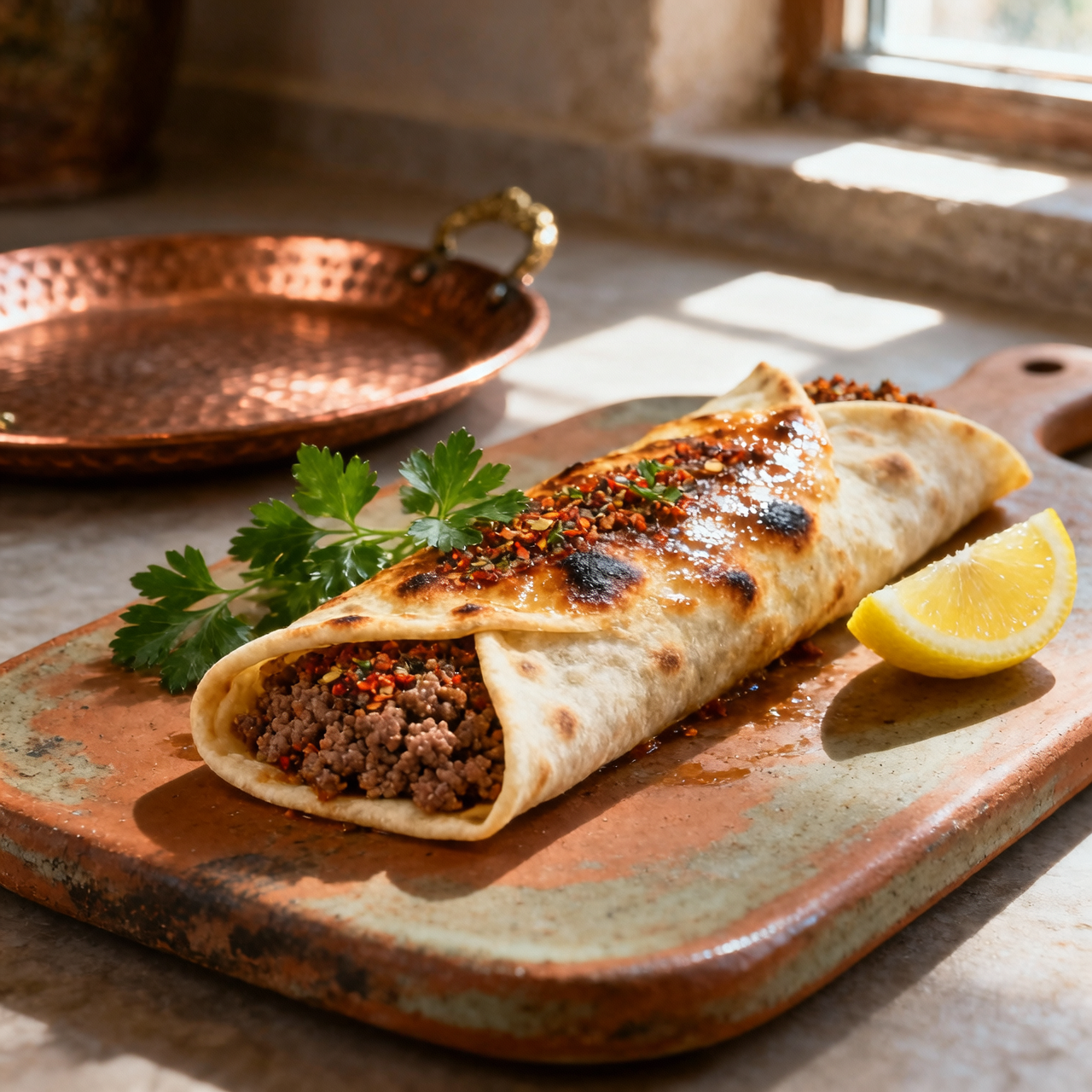
Lahmacun
I’ve always believed that lahmacun is less a dish and more a quiet testament to how street food can hold centuries of cultural memory. Born along the southeastern edges of Turkey, particularly in Gaziantep and Şanlıurfa, it emerged as a portable, affordable meal that married finely minced lamb or beef with a bright, herbaceous topping of tomatoes, onions, parsley, and warm spices like cumin and Aleppo pepper. What makes it truly matter isn’t just its crisp, paper-thin crust or the way it folds effortlessly into a wrap with fresh lemon and herbs; it’s how it bridges generations and geographies, adapting without losing its soul. Yet so many attempts at recreating it stumble at the very threshold of its simplicity. The most common pitfall I see is treating the dough like ordinary pizza crust, overworking it or letting it rise too long until it loses that signature shatter. Another is drowning the topping in heavy tomato paste instead of balancing fresh aromatics with just enough paste for depth. Spices should whisper, not shout, and the meat must be lean enough to crisp without pooling in grease. I’ve learned that patience with the resting dough and precision with the topping’s moisture are everything. When you roll it out thin enough to see the silhouette of your fingers beneath, bake it fiercely hot, and finish it with a sharp squeeze of citrus and a handful of cool parsley, you’re not just making flatbread. You’re participating in a living tradition that demands respect, restraint, and a willingness to let the ingredients speak for themselves.
Nutrition
| Per serving | Calories | Protein | Carbs | Fat | Sat fat | Fibre | Sugar | Sodium |
|---|---|---|---|---|---|---|---|---|
| beginner | 650kcal | 25g | 87g | 22g | 6g | 6g | 5g | 850mg |
| intermediate | 650kcal | 25g | 87g | 22g | 6g | 6g | 5g | 850mg |
| expert | 650kcal | 25g | 87g | 22g | 6g | 6g | 5g | 850mg |
Per serving · Ava-estimated — a guide, not a clinical figure.
- 400 gall-purpose flour— high protein preferred
- 200 mlwarm water— roughly 35°C
- 5 ginstant yeast— active dry can be substituted
- 8 gfine sea salt— for dough and topping
- 300 gground lamb— preferably shoulder, 20% fat
- 150 gyellow onion— finely minced
- 10 ggarlic— 2 medium cloves
- 60 gtomato paste— concentrated
- 40 gred pepper paste— biber salçası preferred
- 30 gfresh flat-leaf parsley— leaves and tender stems
- 5 gground cumin— toasted if possible
- 10 gAleppo pepper— mild, fruity heat
- 30 mlextra virgin olive oil— divided use
- 2 wholelemon— for finishing
This version prioritizes accessibility without sacrificing the dish’s essential character. You will work with the same foundational ingredients, but the process is streamlined to minimize stress and maximize success. The dough is mixed by hand and given a brief rest, which keeps the schedule tight while still developing enough gluten for a pliable base. The topping comes together quickly in a single bowl, relying on precise chopping rather than advanced emulsification techniques. Watch closely when rolling the dough; beginners often leave the edges too thick or tear the center from aggressive stretching. Use a standard rimmed baking sheet instead of specialty stones to avoid temperature shock. The most critical cue is the crust: it should turn golden and firm up completely before you remove it from the oven. If the center feels soft, it needs a few more minutes. Embrace the process, trust your timing, and do not rush the final squeeze of lemon. The goal here is a confident first attempt that proves you can absolutely master this iconic street food in your own kitchen.
Equipment
- large mixing bowl— stainless steel works best
- rolling pin— standard wooden type
- rimmed baking sheet— preheat with the oven
- silicone spatula— for scraping and spreading
Method
- 1
Mix flour, yeast, salt, and warm water in a large bowl until a shaggy dough forms.
Water should feel like a warm bath.
mixing~ 2 min - 2
Knead on a lightly floured surface until smooth and elastic.
Push, fold, and turn until it springs back.
kneading~ 5 minTricky bit - 3
Cover and let rest at room temperature for thirty minutes.
Keep away from drafts.
proofing~ 30 min - 4
Finely chop the onion and garlic, then combine with lamb, pastes, parsley, spices, salt, and oil.
Uniform pieces prevent burning.
combining~ 3 min - 5
Divide the dough into four equal portions and roll each into a thin, round disc.
Aim for consistent thickness.
rolling~ 5 minTricky bit - 6
Spread a thin, even layer of the meat mixture over each dough disc.
Less is more to avoid sogginess.
spreading~ 4 minTricky bit - 7
Bake on a preheated rimmed baking sheet until golden and crisp.
Rotate halfway for even color.
baking~ 15 min - 8
Remove from the oven and immediately squeeze fresh lemon juice over the top.
Acid cuts the rich fat.
finishing~ 1 min