
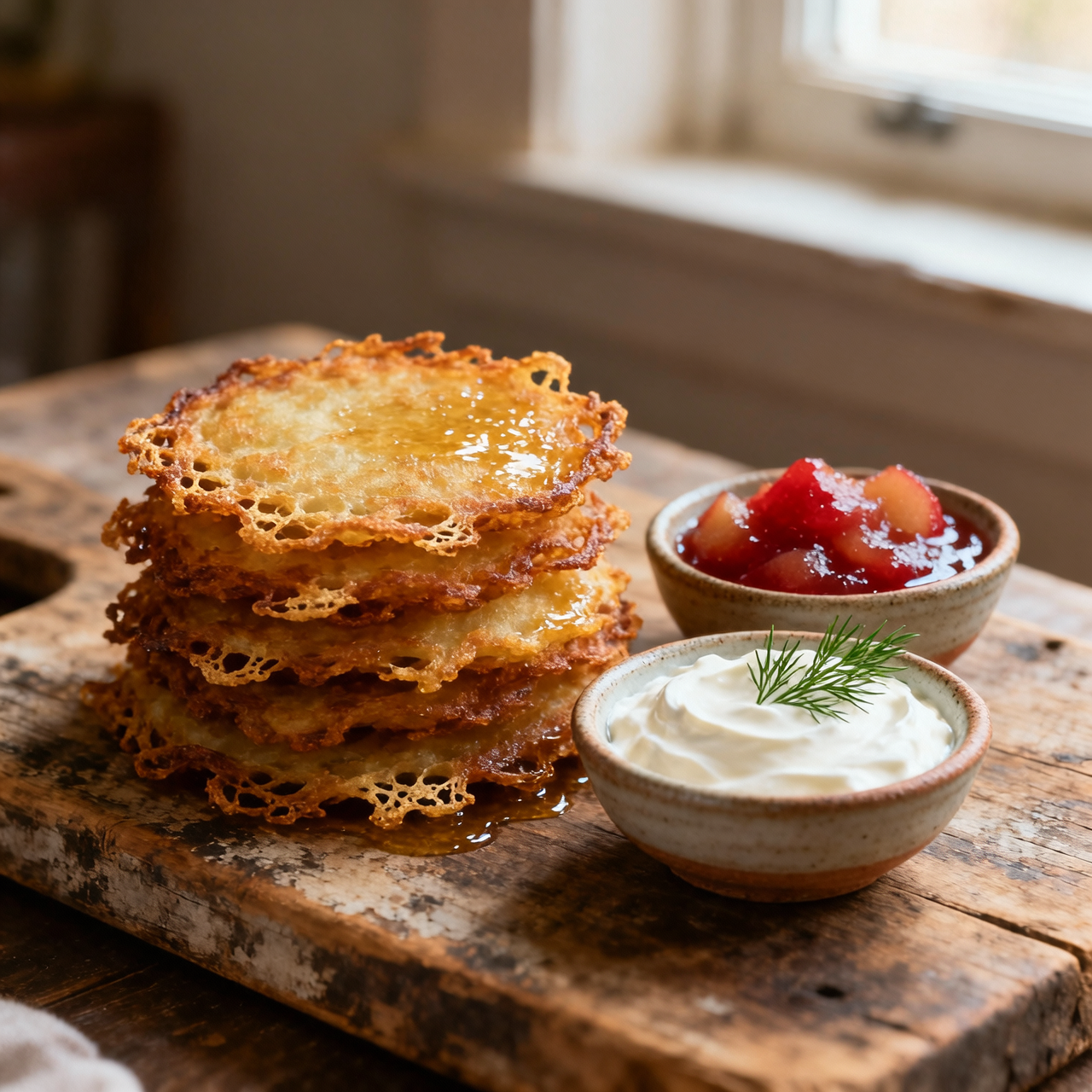
Latkes
I have always believed that the true magic of a latke lies not in its golden crispness, but in the quiet resilience it represents. Born from the ancient miracle of Hanukkah, where a single flask of oil burned for eight days, these humble potato pancakes carry centuries of diaspora stories. While they are deeply woven into Ashkenazi tradition, their embrace across Israeli kitchens speaks to a shared cultural warmth, a vegetarian comfort that bridges continents. When I make them, I am not just grating potatoes and onions; I am participating in a ritual that has survived exile, adaptation, and time. What matters most is the oil, that shimmering pool that transforms starch into something sacred. Yet, I have seen too many well-intentioned cooks fall into predictable traps. The most common pitfall is failing to squeeze every last drop of moisture from the grated potatoes. Excess water guarantees a soggy center and a dangerous splatter when the batter hits hot oil. Another mistake is overcrowding the pan, which drops the temperature and steams the pancakes instead of searing them. And please, never rush the flip. Patience is the secret ingredient. Let the edges brown deeply, let the bottom form a sturdy crust, and trust that a single, confident turn will yield a latke that shatters at the first bite. This is not just a snack; it is a testament to how simple ingredients, handled with care, can become a quiet celebration of survival.
Nutrition
| Per serving | Calories | Protein | Carbs | Fat | Sat fat | Fibre | Sugar | Sodium |
|---|---|---|---|---|---|---|---|---|
| beginner | 450kcal | 10g | 57g | 20g | 5g | 7g | 9g | 1510mg |
| intermediate | 450kcal | 10g | 57g | 20g | 5g | 7g | 9g | 1510mg |
| expert | 450kcal | 10g | 57g | 20g | 5g | 7g | 9g | 1510mg |
Per serving · Ava-estimated — a guide, not a clinical figure.
- 900 gpotato— russet or yukon gold, peeled
- 150 gyellow onion— roughly chopped
- 2 wholeegg— large, lightly beaten
- 45 gmatzo meal— fine grind
- 15 gkosher salt— for batter and seasoning
- 3 gblack pepper— freshly cracked
- 240 mlneutral oil— high smoke point, for frying
- 120 gapplesauce(optional)— unsweetened, for serving
- 100 gsour cream(optional)— full-fat, for serving
- 10 gfresh dill(optional)— finely chopped, for garnish
This version prioritizes confidence and accessibility over tradition, using modern tools to eliminate the most intimidating parts of latke making. Instead of hand-grating vegetables, you will rely on a food processor or box grater with a safety guard to achieve uniform shreds quickly. The biggest hurdle for newcomers is managing potato moisture, so we use a clean kitchen towel and a simple pressing technique that guarantees a dry mixture before any binder is added. Temperature control is handled with an accessible instant-read thermometer, taking the guesswork out of when the oil is ready. Watch closely for steady, active bubbling around the edges of each patty before you attempt to flip; premature turning will tear the fragile structure. I have designed these steps to prevent common beginner mistakes like soggy centers or greasy exteriors by emphasizing a thin, even spread in the pan. Do not rush the resting phase after mixing, as it allows the starches to hydrate properly and act as a natural glue. Keep your batches small to maintain consistent heat. By the end of this process, you will have a reliable rhythm that transforms simple pantry items into crisp, golden discs without the stress of traditional hand-technique.
Equipment
- heavy-bottomed skillet— 10 to 12 inches wide
- kitchen towel— lint-free cotton
- instant-read thermometer— digital preferred
- slotted spatula— wide and sturdy
Method
- 1
Peel and shred the potatoes and onion using a food processor fitted with the grating disk.
Pulse in short bursts to prevent pureeing.
shredding~ 2 min - 2
Transfer the shredded vegetables to a clean kitchen towel and twist tightly over the sink to extract all excess moisture.
Squeeze until no water drips.
wringing~ 3 min - 3
Combine the drained vegetables, egg, matzo meal, salt, and pepper in a large mixing bowl until evenly distributed.
Mix gently to preserve texture.
folding~ 1 min - 4
Pour the oil into the skillet and heat until the thermometer registers one hundred seventy degrees Celsius.
Do not exceed the target temperature.
heating~ 5 minTricky bit - 5
Scoop quarter-cup portions of the mixture into the pan and press flat with the back of a spoon.
Leave space between each patty.
pan-frying~ 4 minTricky bit - 6
Flip each latke when the underside turns deep golden and the edges crisp, then drain on paper towels.
Serve immediately for maximum crunch.
flipping~ 3 min