
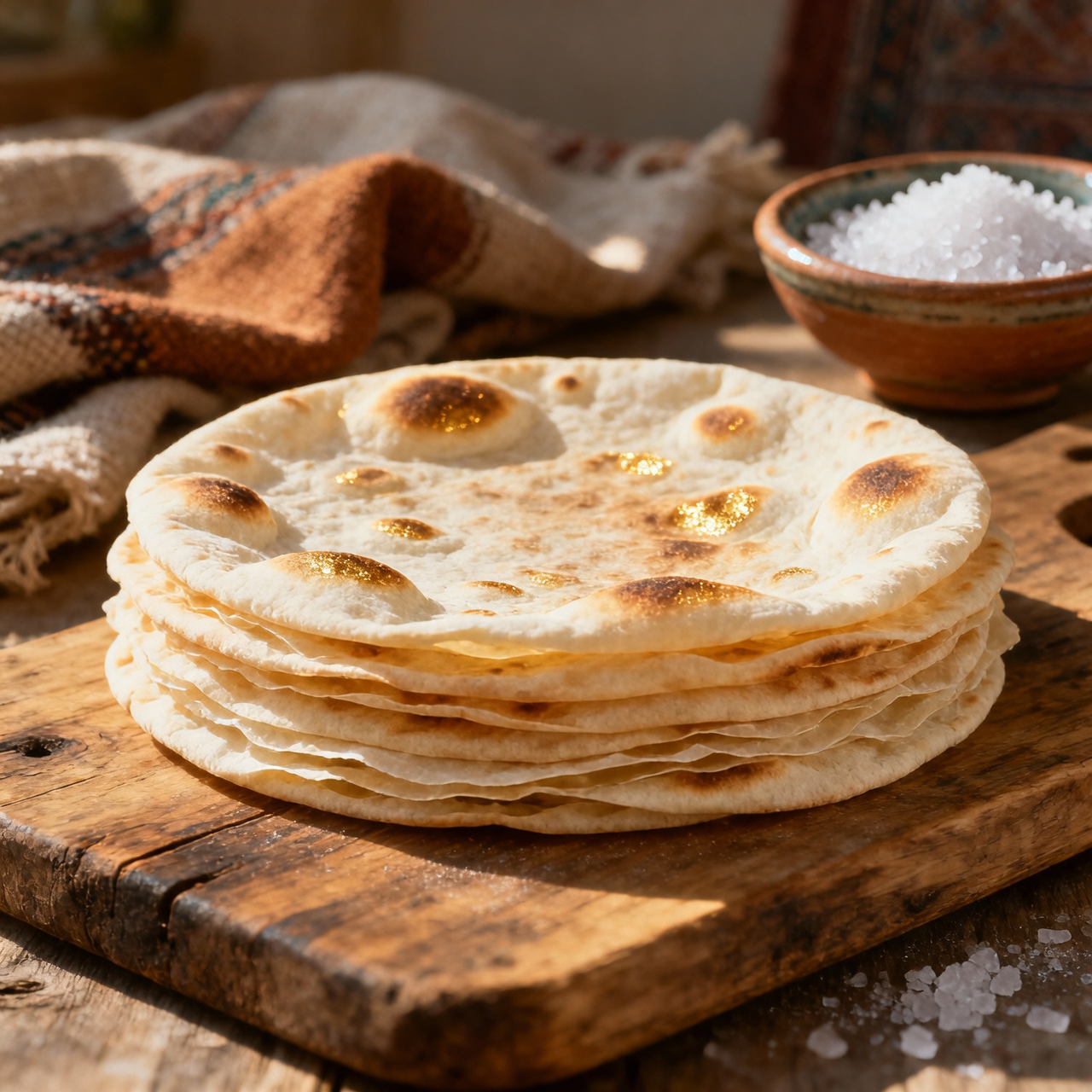
Lavash bread
I first understood the quiet authority of Persian lavash not in a bustling Tehran bakery, but in the patient stretch of dough across a sunlit kitchen counter. This ancient flatbread, baked against the clay walls of a tandoor or pressed onto a hot griddle, is less a recipe and more a meditation on flour, water, and heat. It matters because it is the edible foundation of a meal, soaking up stews, cradling fresh herbs, and outlasting the week without losing its character. A great lavash yields a paper-thin, pliable centre with a delicate, blistered crust that softens when wrapped and crisps when left to rest. The most common pitfall is rushing the rest; without it, gluten fights you, and the dough shrinks back into a thick, stubborn disc. Another is overheating the cooking surface, which traps moisture and makes the bread tough rather than tender. Commercial packets promise convenience, but they cost nearly four times as much and deliver a cardboard sheet laced with preservatives, dough conditioners, and artificial softeners that mask the true flavour of wheat. Making it from scratch takes minutes of active work and a little patience, but the result is a supple, clean-tasting bread that transforms leftovers into a batch-hero staple. You can stack, dry, and store it for weeks, reviving it with a quick steam. Once you learn to read the dough tension and trust your heat, lavash becomes your most reliable kitchen companion.
Nutrition
| Per serving | Calories | Protein | Carbs | Fat | Sat fat | Fibre | Sugar | Sodium |
|---|---|---|---|---|---|---|---|---|
| beginner | 510kcal | 16g | 88g | 9g | 1g | 4g | 1g | 970mg |
| intermediate | 510kcal | 16g | 88g | 9g | 1g | 4g | 1g | 970mg |
| expert | 510kcal | 16g | 88g | 9g | 1g | 4g | 1g | 970mg |
Per serving · Ava-estimated — a guide, not a clinical figure.
- 500 gBread flour— high-protein for optimal elasticity
- 300 mlWarm water— around 38C for gentle activation
- 5 gInstant yeast— no need to bloom if mixed directly
- 10 gFine sea salt— evenly distributed for consistent flavour
- 30 mlNeutral oil— sunflower or grapeseed, divided
This version strips away the intimidation of hand-stretching and focuses on reliable, tool-assisted shaping. You will use a standard rolling pin and a heavy skillet instead of a traditional tandoor, which guarantees even heat without the learning curve of clay baking. The dough gets a shorter, room-temperature rest, trading a fraction of elasticity for a much quicker workflow that still respects the gluten. Watch your surface heat carefully; a medium setting allows the bread to puff gently without scorching or drying out before the centre cooks. I recommend dividing the dough into four even portions and rolling each to a consistent thickness, which prevents the uneven bubbling that often frustrates first attempts. Keep a damp cloth over your rolled sheets while you cook to stop the edges from curling. Flip only once, pressing lightly with a spatula to encourage steam pockets. The result is a soft, pliable flatbread that stores beautifully and reheats without cracking.
Equipment
- Rolling pin— standard wooden or silicone
- Heavy non-stick skillet— flat surface for even cooking
- Pastry brush— for light oil application
- Kitchen scale— ensures even division
Method
- 1
Combine the warm water and instant yeast in a large bowl until fully dissolved.
Water should feel comfortably warm, not hot.
blooming~ 1 min - 2
Add the flour, salt, and half the oil to the yeast mixture, then knead until a smooth ball forms.
Add a splash of extra water only if the dough feels crumbly.
kneading~ 8 min - 3
Cover the bowl with a damp towel and let the dough rest at room temperature.
The dough will relax and become noticeably softer.
resting~ 15 min - 4
Divide the dough into four equal pieces and roll each into a thin oval using a rolling pin.
Keep the surface lightly floured to prevent sticking.
rolling~ 5 min - 5
Heat a heavy skillet over medium heat and cook each piece for ninety seconds per side.
Flip when the surface shows pale bubbles and the edges lift.
searing~ 3 minTricky bit
Cooking from frozen
Thaw at room temperature, then wrap in a damp towel and warm in a low oven for two minutes until pliable.
Storage times are a guide — always use your judgement and store food safely.