
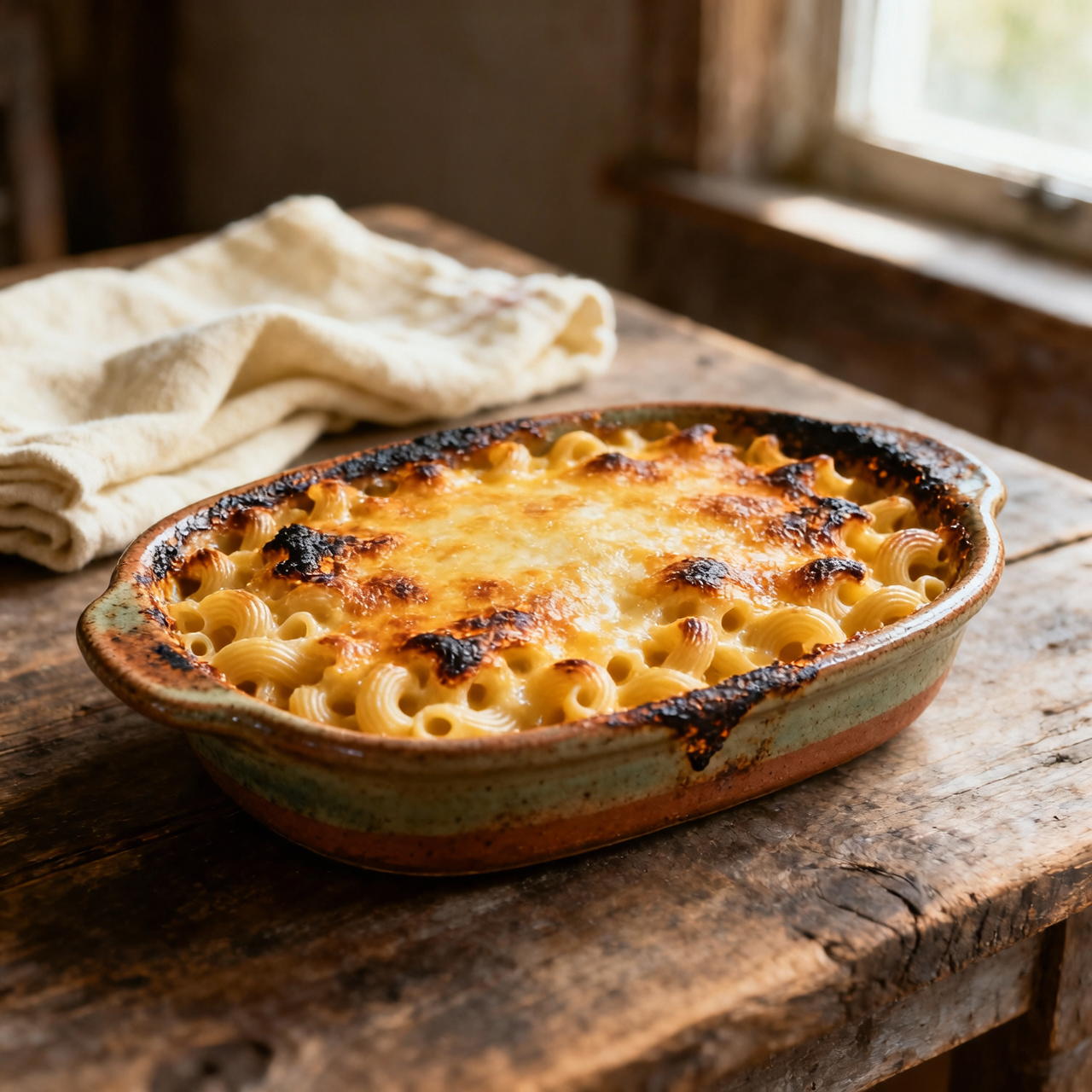
Mac and Cheese
When I first learned to bake a proper Southern mac and cheese, I quickly realized it was never just about pasta and dairy. It’s a quiet heirloom, passed down through church potlucks and Sunday suppers, where the real magic happens in the oven. Though Thomas Jefferson famously introduced the dish to America after his travels in France, it was the South that transformed it into something deeply our own. We traded the delicate, creamy French versions for a sturdy, custard-based bake that relies on sharp, aged cheddar and a slow, patient heat. To me, this matters because it proves that vegetarian cooking doesn’t need to apologize for its richness. A well-made Southern mac holds its own at any table, offering a profound, unpretentious comfort that speaks to generations of resourceful home cooks who knew how to stretch simple pantry staples into something extraordinary. Yet, I’ve watched too many people ruin it by rushing the process. The most common pitfalls are almost always the same: reaching for pre-shredded cheese coated in potato starch, which refuses to melt properly, or skipping the crucial egg-and-milk custard that binds everything together into a silky, cohesive bake. Overcooking the noodles before they hit the oven guarantees a mushy disaster, while under-salting leaves the whole dish tasting flat. When you respect the technique, though, the crust forms perfectly, the center stays tender, and every bite carries the weight of history without feeling heavy at all.
Nutrition
| Per serving | Calories | Protein | Carbs | Fat | Sat fat | Fibre | Sugar | Sodium |
|---|---|---|---|---|---|---|---|---|
| beginner | 1100kcal | 46g | 107g | 55g | 33g | 4g | 16g | 1550mg |
| intermediate | 1100kcal | 46g | 107g | 55g | 33g | 4g | 16g | 1550mg |
| expert | 1100kcal | 46g | 107g | 55g | 33g | 4g | 16g | 1550mg |
Per serving · Ava-estimated — a guide, not a clinical figure.
- 400 gelbow macaroni— dried, standard size
- 85 gunsalted butter— high fat content preferred
- 60 gall-purpose flour— unbleached
- 950 mlwhole milk— full fat, not ultra-pasteurized
- 225 gsharp cheddar cheese— block, freshly grated
- 115 ggruyère cheese— block, freshly grated
- 15 gdijon mustard— smooth
- 5 gdry mustard powder— finely ground
- 3 gsmoked paprika— sweet variety
- 10 gkosher salt— diamond crystal preferred
- 3 gblack pepper— freshly cracked
- 1 gcayenne pepper— pure ground
- 40 gpanko breadcrumbs— Japanese style
This version prioritizes confidence over complexity, using streamlined techniques to deliver a reliably comforting result without demanding culinary intuition. You will work with simplified roux assembly and pre-measured additions to bypass the most anxiety-inducing moments of sauce making. The focus is entirely on temperature management and timing: boiling your pasta to the exact point of tenderness, gently folding in your cheese base without scorching, and letting the oven handle the browning. Watch closely during the initial melt phase; if the butter begins to foam aggressively or the milk curdles, immediately pull the pan from the heat and whisk vigorously. The goal here is to build muscle memory. You do not need to master emulsion theory or temper dairy to succeed. Simply follow the rhythm of this method, trust your visual cues, and you will achieve a cohesive, creamy bake that tastes like it came from a seasoned kitchen. Mistakes are forgiving at this stage, and the rich cheese matrix will easily mask minor textural inconsistencies.
Equipment
- large stockpot— minimum 6-quart capacity
- heavy saucepan— non-stick is perfectly acceptable
- silicone spatula— heat resistant
- 9x13 baking dish— ceramic or glass
Method
- 1
Fill a large pot with cold water, add half the salt, and bring to a rolling boil.
Water should bubble vigorously before pasta touches it.
boiling~ 5 min - 2
Add the macaroni and cook according to package directions until just tender.
Reserve a half cup of starchy water before draining.
parboiling~ 8 min - 3
Melt the butter in a heavy pot over medium heat, then whisk in the flour until a pale paste forms.
Cook for exactly sixty seconds to remove raw flour taste.
making a roux~ 1 min - 4
Slowly pour in the milk while whisking constantly to prevent lumps, cooking until the mixture thickens.
Keep the whisk moving in one direction to maintain a smooth emulsion.
whisking~ 4 minTricky bit - 5
Remove from heat and fold in the cheeses, dijon, mustard powder, paprika, and remaining seasonings until fully melted.
Off-heat melting prevents the dairy proteins from breaking.
tempering~ 2 minTricky bit - 6
Toss the drained pasta into the sauce, transfer to a baking dish, sprinkle with panko, and bake until golden.
Broil for the final ninety seconds for maximum crust.
baking~ 20 min