
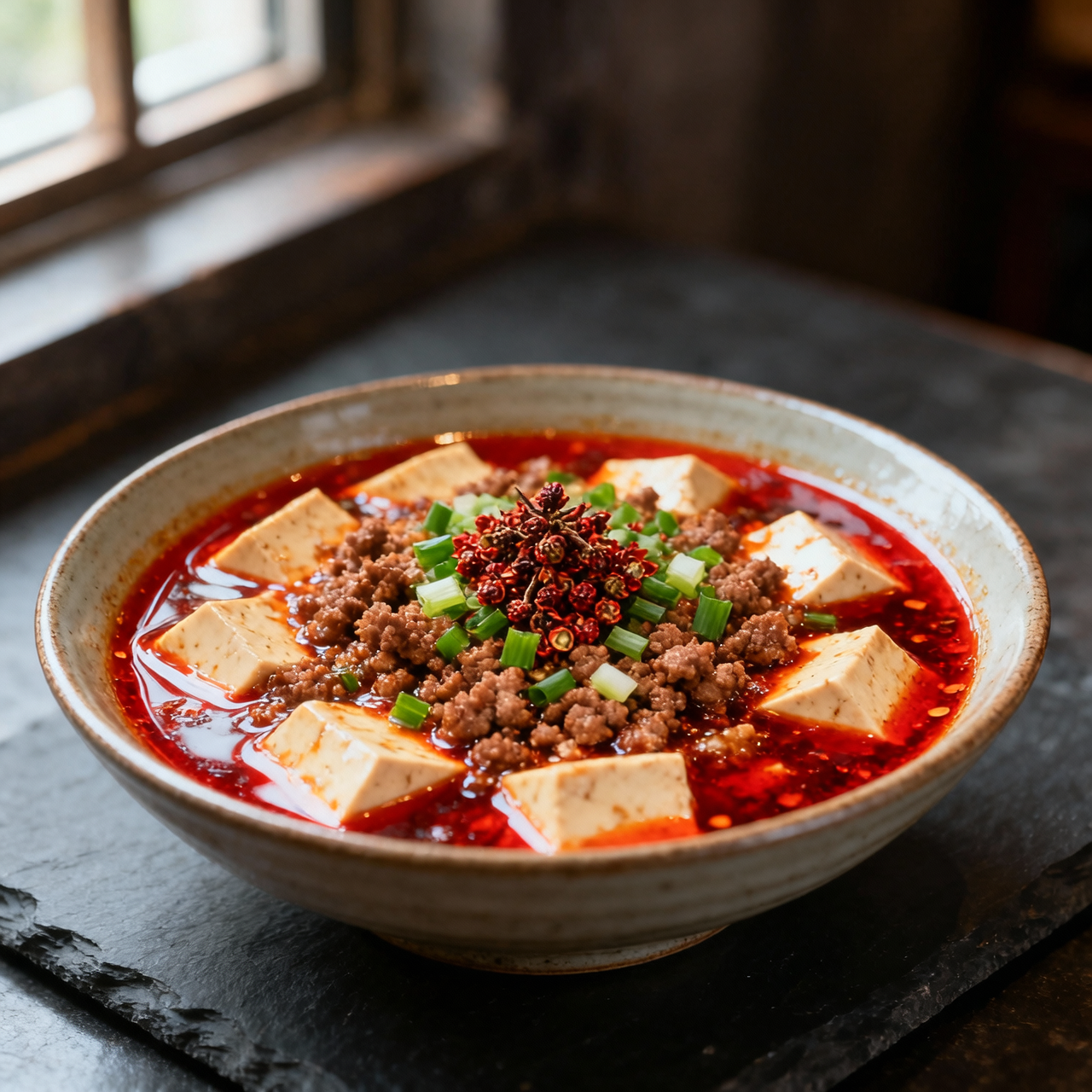
Mapo Tofu
I first encountered mapo tofu in a cramped Chengdu eatery where the air itself seemed to vibrate with the scent of toasted chilies and fermented bean paste. The dish, born in the late Qing dynasty from the hands of a pockmarked old woman whose nickname gave it its name, is far more than a simple stir-fry; it is a masterclass in the Sichuan philosophy of málà—numbing and spicy. What draws me back to it time and again is the profound harmony it achieves between contradiction. Silken tofu yields to the palate while ground pork provides a savory crunch, all suspended in a glossy, crimson broth that dances on the tongue. Yet, for all its rustic elegance, it is notoriously easy to ruin. The most frequent mistake I see is treating it like a standard sauté, where the tofu is handled roughly and the aromatics are rushed into submission. True mapo tofu demands patience: the doubanjiang must be slowly fried in oil until it bleeds its deep red color, and the Sichuan peppercorns require a final, fragrant bloom to awaken their citrusy numbness. Too many cooks drown the dish in cornstarch slurry, creating a gloppy, lifeless sauce rather than the delicate, broth-kissed glaze it deserves. I always remind myself that this is a dish of restraint as much as intensity. Respect the ingredients, control the heat, and let the tofu absorb the flavors rather than forcing them upon it. When done right, it doesn’t just feed you; it tells a story of Sichuan’s culinary soul.
Nutrition
| Per serving | Calories | Protein | Carbs | Fat | Sat fat | Fibre | Sugar | Sodium |
|---|---|---|---|---|---|---|---|---|
| beginner | 330kcal | 19g | 13g | 22g | 5g | 2g | 3g | 1150mg |
| intermediate | 330kcal | 19g | 13g | 22g | 5g | 2g | 3g | 1150mg |
| expert | 330kcal | 19g | 13g | 22g | 5g | 2g | 3g | 1150mg |
Per serving · Ava-estimated — a guide, not a clinical figure.
- 500 gtofu— silken or soft, cubed
- 150 gground pork— preferably with visible fat content
- 30 gdoubanjiang— fermented broad bean paste
- 15 gfermented black bean— rinsed and roughly chopped
- 5 gSichuan peppercorn— whole, preferably red variety
- 20 ggarlic— fresh cloves, peeled
- 20 gginger— fresh root, peeled
- 40 gscallion— white and green parts separated
- 250 mlchicken stock— low sodium preferred
- 15 mllight soy sauce— standard brewing method
- 5 gsugar— white granulated
- 30 mlneutral oil— vegetable or canola
- 10 mltoasted sesame oil— pure pressed
- 15 gcornstarch— food grade thickener
This version is engineered for your first successful attempt without sacrificing the soul of the dish. Instead of hunting down multiple fermented pastes, we rely on a high-quality, all-in-one mapo tofu sauce or jarred doubanjiang to deliver the foundational flavor profile. The technique prioritizes gentle handling and clear timing over complex temperature management. You will learn to blanch the tofu briefly to prevent crumbling, fold ingredients carefully with a spatula rather than stirring vigorously, and use a simple cornstarch slurry to achieve the signature glossy finish. Watch the heat closely during the initial sauté; the sauce can scorch quickly if left unattended. The goal here is confidence. By the end of this cook, you will understand how the elements layer together, how to adjust saltiness on the fly, and why the dish needs a brief rest before serving. I have removed the need for grinding spices or hand-mincing, but kept the essential steps intact. Trust the process, keep your movements deliberate, and you will produce a deeply satisfying, restaurant-adjacent result that proves you do not need years of wok experience to master this classic.
Equipment
- Large skillet— non-stick is highly recommended for beginners
- Silicone spatula— flexible edge for gentle folding
- Whisk— for lump-free slurry mixing
Method
- 1
Bring a medium pot of salted water to a rolling boil.
Water should taste lightly seasoned.
boiling~ 3 min - 2
Gently lower the cubed tofu into the water and simmer briefly.
Do not stir; let the water do the work.
blanching~ 1 minTricky bit - 3
Heat neutral oil in a large skillet over medium heat and add the jarred mapo sauce.
Watch for the oil to turn a deep red.
blooming~ 1 min - 4
Add the ground pork and cook until fully browned, then pour in the chicken stock.
Break up clumps as they form.
simmering~ 5 min - 5
Carefully fold in the drained tofu cubes and let them absorb the broth.
Use a silicone spatula to push, never stir.
folding~ 3 minTricky bit - 6
Whisk cornstarch with a splash of cold water and stir it into the pan.
Add slowly until the sauce coats the back of a spoon.
thickening~ 1 minTricky bit - 7
Turn off the heat and drizzle with sesame oil before serving.
Residual heat will bloom the aroma.
finishing~ 0 min