
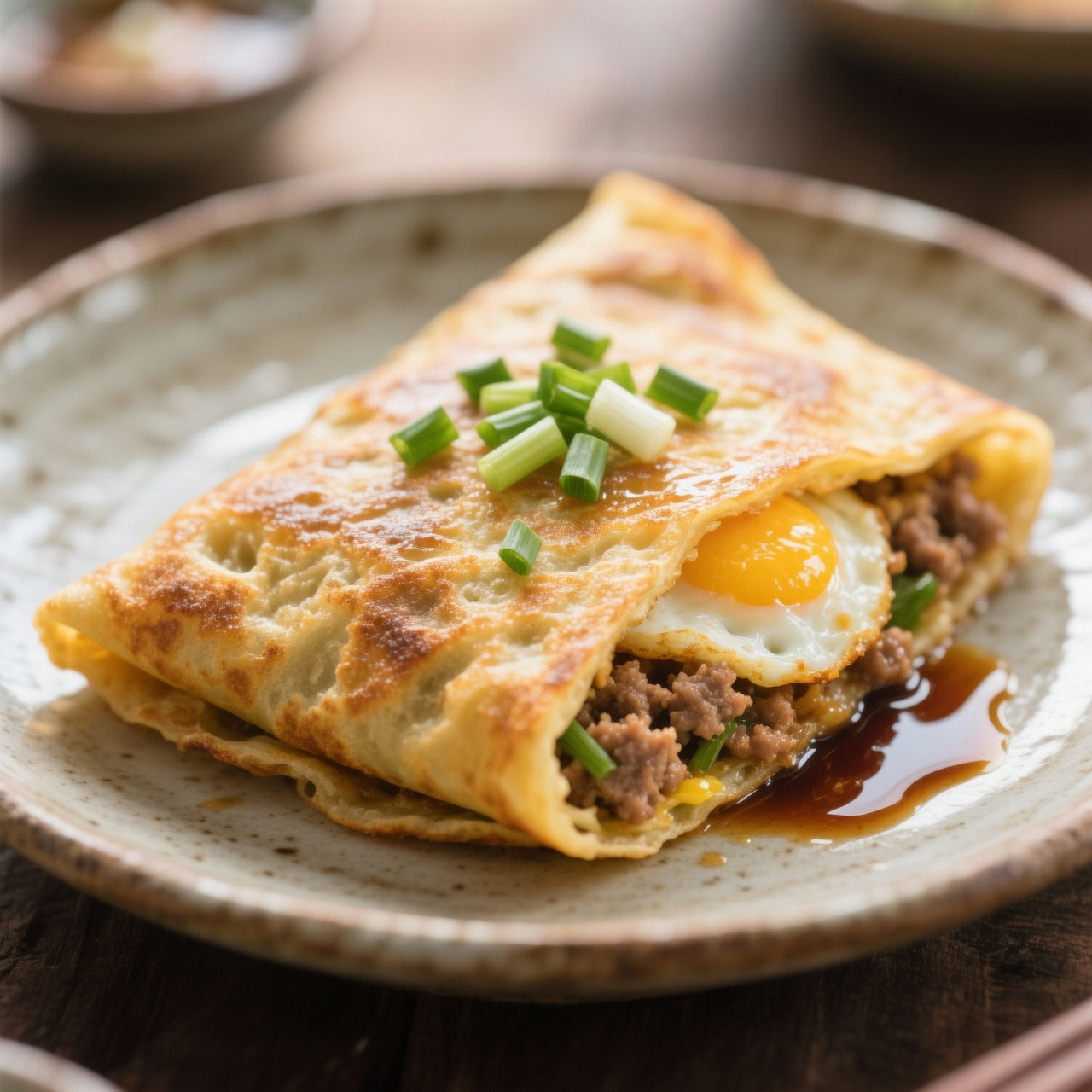
Martabak Telur
I first learned to fold Martabak Telur watching a street vendor in Jakarta stretch thin dough over a sizzling griddle, a technique that traces its roots to South Asian murtabak but has been thoroughly claimed by Indonesian culinary culture. Making it from scratch isn’t just about authenticity; it’s about capturing that precise textural contrast where the outer layer shatters into delicate, golden lace while the interior stays tender and deeply savory. You’ll often find frozen, supermarket versions priced around five dollars a box, but they’re a pale imitation. Those mass-produced rounds rely on pre-rolled, preservative-laden wrappers and heavily spiced, homogenized fillings that steam rather than fry, leaving behind a greasy, cardboard-like crust. The real dish demands patience, and the most common pitfall I see home cooks make is rushing the resting period. Without a proper thirty-minute rest, the gluten stays tense and tears instead of stretching. Overfilling the pocket is another trap; it guarantees a rupture when the egg mixture hits the pan. Temperature control matters just as much—too hot, and the exterior burns before the interior sets; too cool, and the dough drinks the oil. By building the filling with fresh ground meat, finely chopped aromatics, and a light hand with the spices, you avoid the one-note heaviness of shop-bought kits. When you pull a perfectly folded martabak from the pan, the crackle of the crust and the bright, balanced interior make every stretched sheet worth the effort. It’s a humble street staple that transforms completely when treated with care rather than convenience.
Nutrition
| Per serving | Calories | Protein | Carbs | Fat | Sat fat | Fibre | Sugar | Sodium |
|---|---|---|---|---|---|---|---|---|
| beginner | 540kcal | 26g | 46g | 25g | 6g | 2g | 3g | 580mg |
| intermediate | 480kcal | 26g | 42g | 23g | 6g | 3g | 3g | 750mg |
| expert | 585kcal | 27g | 46g | 31g | 6g | 3g | 4g | 610mg |
Per serving · Ava-estimated — a guide, not a clinical figure.
- 200 gAll-purpose flour— Sifted before mixing
- 120 mlWater— Room temperature
- 4 unitEgg— Divided between dough and filling
- 200 gGround beef— Pre-cooked and crumbled
- 3 stalkSpring onion— Finely chopped
- 5 unitShallot— Thinly sliced
- 2 tspCurry powder— Mild or hot blend acceptable
- 100 mlVegetable oil— For dough resting and frying
- 5 gSalt— Adjust to preference
This beginner-friendly version strips away the intimidating dough-stretching technique used by street vendors, replacing it with a simple, forgiving roll-and-fold method that guarantees crispy layers without tearing. You will work entirely from scratch using pantry staples; there are no jarred curry pastes, stock cubes, or frozen wrappers here. Frozen or pre-packaged martabak typically costs around $4 to $6 per piece, but relies on heavily processed minced meats, cheap palm oil, and high sodium to mask stale flavors, leaving a heavy, greasy aftertaste. Making it fresh at home delivers a clean, bright spice profile and a shattering, golden crust. Focus on keeping your dough relaxed—rest it fully before rolling so it shrinks less. When folding the edges into a neat square, work quickly to trap the egg-meat mixture securely; a loose fold leaks during frying. Cook over steady medium heat, not high, allowing the filling to set and the exterior to brown gradually without burning. Serve immediately with a simple side of rice vinegar or chili slices for the best texture.
Equipment
- Heavy-bottomed pan— non-stick is fine here
- Rolling pin— standard wooden or silicone
- Mixing bowls— two medium-sized
Method
- 1
Whisk all-purpose flour, warm water, one egg, neutral cooking oil, and salt in a large bowl until a soft dough forms.
The dough should feel pliable like an earlobe, not sticky.
kneading~ 5 min - 2
Cover the bowl with a damp cloth and let the dough rest on the counter.
Resting relaxes the gluten, making it much easier to roll thin without springing back.
resting~ 20 min - 3
Combine minced meat, finely diced onions, chopped spring onions, curry powder, ground turmeric, salt, and black pepper in a mixing bowl.
Use raw minced meat; it will cook completely inside the pancake during frying.
seasoning~ 3 min - 4
Roll one rested dough portion into a thin circle, spread the filling in the center, and pour one whisked egg over the meat mixture.
Keep the filling concentrated in the middle to prevent tearing when you lift the edges.
wrapping~ 2 minTricky bit - 5
Lift two opposite sides of the dough over the filling, then fold the remaining two sides to create a tight, sealed square packet.
Press the seams firmly with your fingers to lock in the egg and meat.
folding~ 2 minTricky bit - 6
Heat oil in a heavy pan over medium heat and carefully place the folded martabak inside, frying until both sides are deeply golden and crisp.
Flip only once the bottom is set and brown; rushing causes the filling to leak.
pan-frying~ 8 minTricky bit - 7
Transfer the cooked martabak to a wire rack, let it drain briefly, then slice into four wedges to serve immediately.
A wire rack keeps the bottom from steaming and turning soggy.
draining~ 1 min
Cooking from frozen
Thaw completely in the fridge, then pan-fry gently until the crust re-crisps.
Storage times are a guide — always use your judgement and store food safely.