
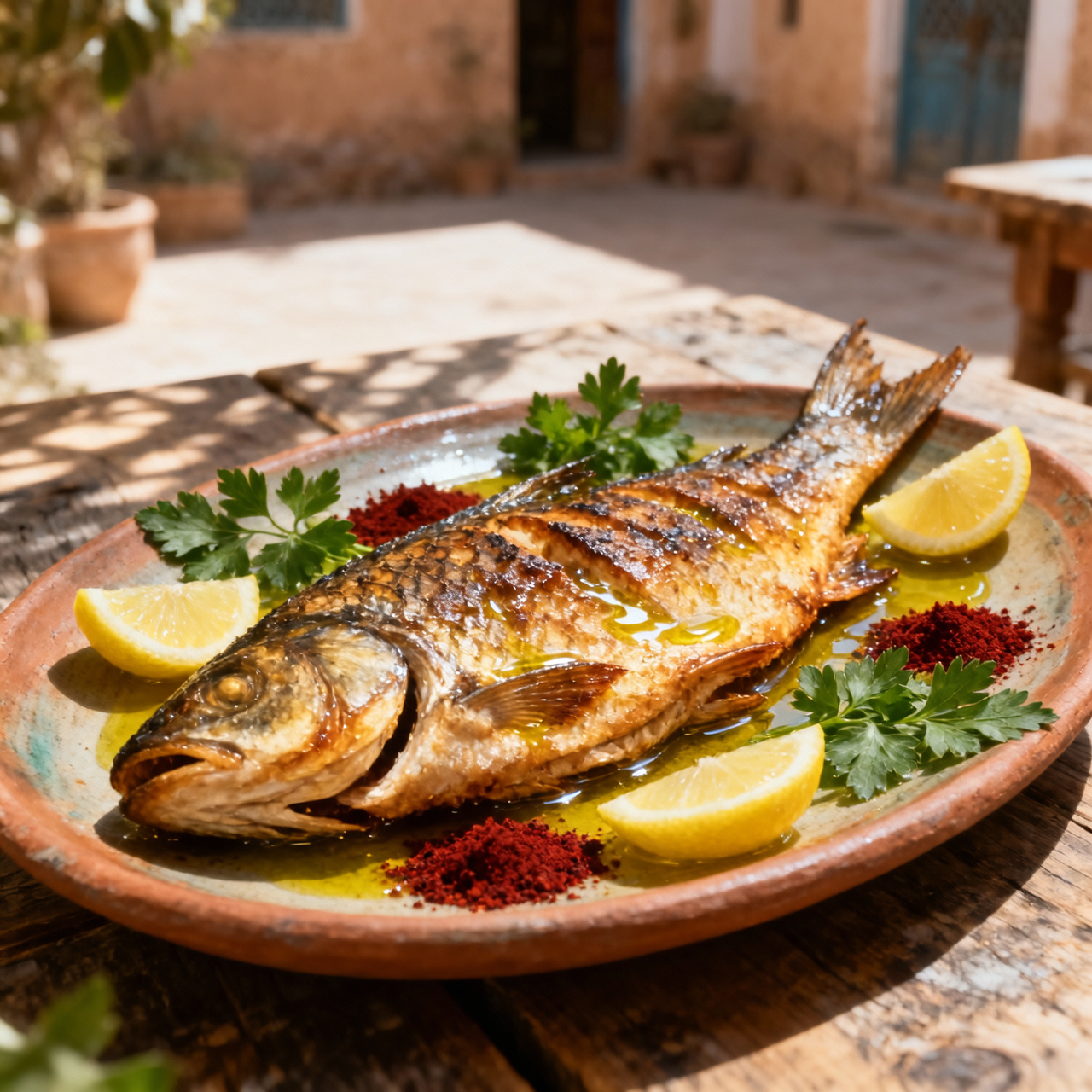
Masgouf
I’ve always believed that to truly understand Mesopotamia, you must stand beside the Tigris with a whole carp splayed open on a wooden stake, letting the smoke from palm fronds and tamarind wood curl around you. Masgouf isn’t just a dish; it’s an ancient rhythm of Iraqi life, a technique passed down from Sumerian riverbank cooks who realized that slow, indirect fire coaxed sweetness from freshwater fish long before modern kitchens existed. What makes it matter today is its stubborn authenticity—it refuses to be rushed or sanitized. The fish is butterflied but never fully detached, skewered vertically, and roasted at a careful distance from the embers. I’ve seen too many well-meaning cooks try to replicate it on a standard grill or under a broiler, and the tragedy is always the same: the flesh dries out, the skin burns, and that signature smoky-tamarind crust never forms. The biggest pitfalls I’ve encountered are impatience and overcrowding the fire. You cannot crowd the coals, and you absolutely cannot flip the fish. It cooks from the radiant heat alone, and turning it breaks the delicate steam pocket that keeps the meat tender. Another common mistake is skipping the tamarind marinade or using acidic substitutes like lemon too early, which turns the delicate carp mushy. True masgouf demands restraint, respect for the wood, and a willingness to let time do the heavy lifting. When you finally tear into that first charred edge, tasting the river, the fire, and centuries of Mesopotamian patience all at once, you understand why this method has survived empires, invasions, and the passage of time.
Nutrition
| Per serving | Calories | Protein | Carbs | Fat | Sat fat | Fibre | Sugar | Sodium |
|---|---|---|---|---|---|---|---|---|
| beginner | 930kcal | 89g | 17g | 55g | 10g | 2g | 7g | 2150mg |
| intermediate | 930kcal | 89g | 17g | 55g | 10g | 2g | 7g | 2150mg |
| expert | 930kcal | 89g | 17g | 55g | 10g | 2g | 7g | 2150mg |
Per serving · Ava-estimated — a guide, not a clinical figure.
- 2000 gcarp— whole, cleaned and butterflied
- 120 mlextra virgin olive oil— high quality
- 20 gfine sea salt
- 10 gground turmeric
- 60 gtamarind paste— concentrated, seedless
- 4 clovegarlic— peeled
- 80 mllemon juice— freshly squeezed
- 5 gblack pepper— freshly cracked
- 15 gsumac— for finishing
- 30 gflat-leaf parsley— fresh, chopped
This version strips away the intimidation factor of traditional riverbank cooking, replacing open flames and vertical stakes with accessible home equipment. You will use a standard charcoal grill or your oven’s broiler, relying on indirect heat to gently cook the butterflied fish without scorching the delicate skin. The marinade comes together in a simple bowl, and I strongly recommend purchasing the carp already cleaned and butterflied by your fishmonger to save time and avoid awkward knife work. The most critical moment is maintaining steady, moderate heat; if your grill runs too hot, the exterior will char before the interior cooks through. Keep a spray bottle of water nearby to tame flare-ups from dripping oil, and resist the urge to flip the fish, which will cause it to fall apart. An instant-read thermometer is your best friend here, guaranteeing the flesh reaches a safe, tender finish without overcooking. By focusing on consistent temperature control and thorough seasoning, you will achieve a reliable, restaurant-style result on your very first attempt. The shortcuts here are intentional, designed to build your confidence while preserving the bright, smoky character that defines this iconic dish.
Equipment
- wire rack and baking sheet— for indirect heat setup
- instant-read thermometer— digital probe recommended
- silicone basting brush— heat resistant
Method
- 1
Preheat your grill or oven broiler to medium-high heat and arrange the rack for indirect cooking.
Keep the heat source to one side.
preheating~ 10 min - 2
Combine the olive oil, salt, turmeric, tamarind paste, garlic, lemon juice, and black pepper in a bowl and whisk until smooth.
Use a fork if you lack a whisk.
emulsifying~ 5 min - 3
Score the skin of the carp lightly with a sharp knife and rub the marinade evenly over both sides and into the cavity.
Let it sit for ten minutes.
marinating~ 10 min - 4
Place the fish skin-side down on a wire rack set over a baking sheet and transfer to the grill or oven.
Close the lid to trap smoke and heat.
indirect_grilling~ 20 minTricky bit - 5
Cook until the internal temperature reaches sixty degrees Celsius and the flesh flakes easily with a fork.
Do not flip the fish.
temperature_checking~ 30 minTricky bit - 6
Transfer the cooked fish to a serving platter and immediately sprinkle with sumac and chopped parsley before serving.
Serve hot with flatbread.
garnishing~ 2 min