
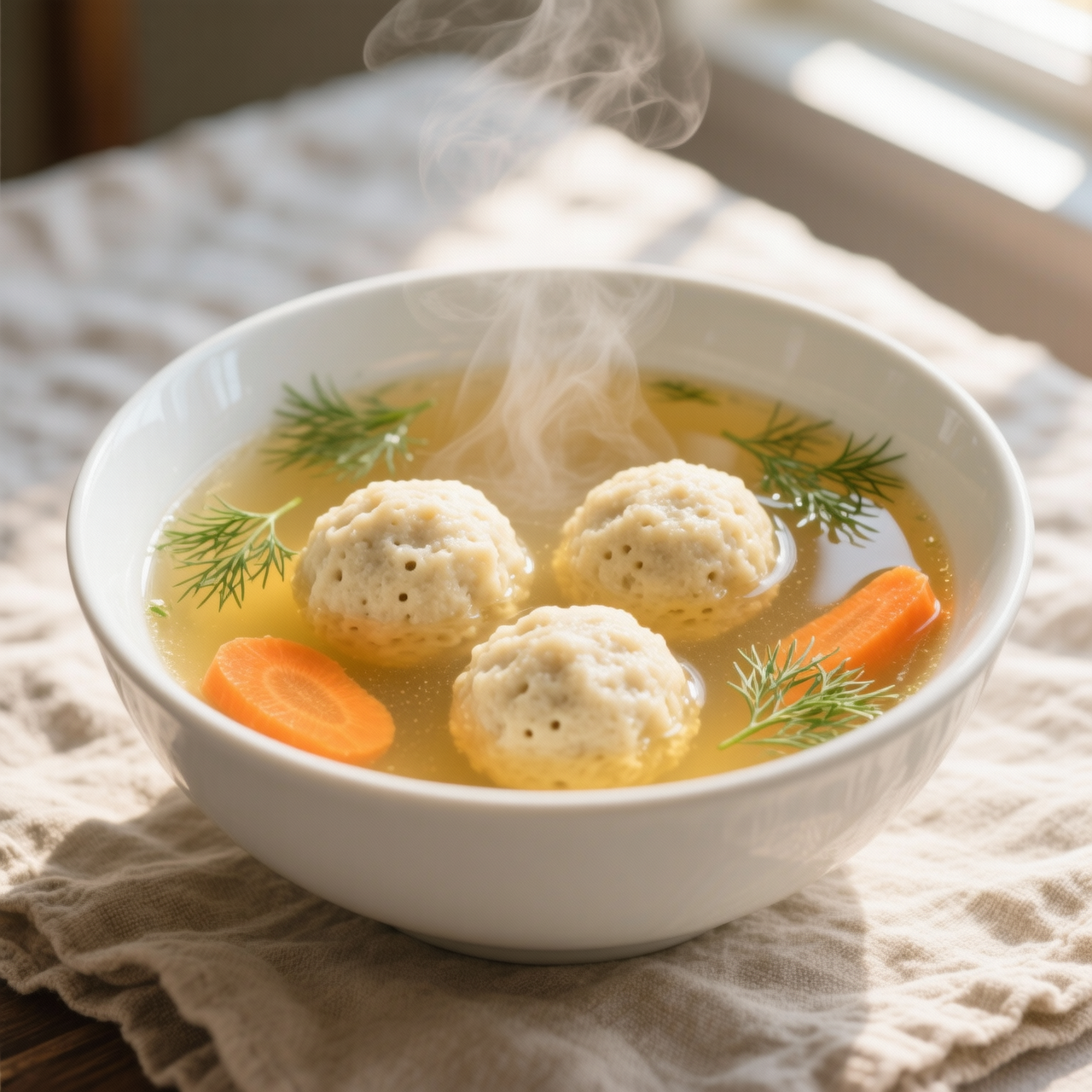
Matzo Ball Soup
I have spent years perfecting the quiet alchemy of matzo ball soup, a dish that carries the weight of generations in a single, steaming bowl. While often celebrated as a Jewish staple, its roots in Eastern European shtetl kitchens and its evolution through Israeli communal tables speak to a deeper story of resilience and adaptation. For me, it is never just about feeding the body; it is about preserving memory. Every time I crack an egg into matzo meal, I am tracing the hands of grandmothers who turned scarcity into comfort. What makes this soup truly sing, though, is understanding where it so often stumbles. The most common pitfall is overworking the dough, which yields dense, leaden dumplings instead of those famously cloud-like spheres. Temperature control is equally unforgiving. If your broth simmers too vigorously, the delicate exterior shatters before it sets. And please, resist the urge to skip the resting period. Letting the batter chill allows the matzo to fully hydrate and the leavening to distribute evenly, a quiet step that separates amateur attempts from heirloom quality. I have learned to treat this dish with reverence, not as a quick fix, but as a slow ritual. When done right, the broth should be clear and deeply savory, the matzo balls tender enough to yield at the gentlest touch. It is humble food that demands precision, yet rewards you with something profoundly comforting. In my kitchen, it is the first dish I turn to when I want to honor the past while nourishing the present.
Nutrition
| Per serving | Calories | Protein | Carbs | Fat | Sat fat | Fibre | Sugar | Sodium |
|---|---|---|---|---|---|---|---|---|
| beginner | 340kcal | 12g | 28g | 20g | 5g | 3g | 4g | 1150mg |
| intermediate | 340kcal | 12g | 28g | 20g | 5g | 3g | 4g | 1150mg |
| expert | 340kcal | 12g | 28g | 20g | 5g | 3g | 4g | 1150mg |
Per serving · Ava-estimated — a guide, not a clinical figure.
- 1000 gchicken carcass— bone-in, preferably with some skin attached
- 1 mediumyellow onion— quartered, skin left on for color
- 200 gcarrot— peeled and cut into thick rounds
- 150 gcelery stalks— roughly chopped
- 100 gmatzo meal— finely ground
- 3 largeeggs— room temperature
- 60 mlchicken fat— rendered schmaltz or neutral oil
- 15 gkosher salt— divided use for broth and dough
- 10 gfresh dill— finely chopped
- 3000 mlwater— cold, filtered
This pathway removes the intimidation factor by leaning on trusted pantry staples that guarantee consistent results. We bypass the long bone simmer and heavy rendering, opting instead for a high-quality jarred chicken base and pre-measured matzo meal. The focus here is entirely on mastering the dough hydration and the gentle poaching technique. You will learn to mix without overworking, to rest the batter just long enough for it to swell, and to drop it into barely bubbling water. The most critical watchpoint is the temperature control during the poach; a vigorous boil will tear the balls apart, while a gentle simmer allows them to expand evenly. I recommend using a wide, heavy pot to give the dumplings room to float freely. Do not rush the resting phase, as this is where the matzo meal absorbs moisture and prevents a dense, gummy center. Taste the broth before adding the balls and adjust your salt accordingly, since the jarred base already contains sodium. By the time you serve this, you will have internalized the fundamental mechanics of dumpling poaching, giving you the confidence to tackle more complex stocks and homemade fats in future iterations. The result is a deeply comforting, reliably light soup that tastes like it took all day, ready in under an hour.
Equipment
- Large stockpot— heavy-bottomed preferred
- Mixing bowls— medium and large sizes
- Whisk— standard balloon style
Method
- 1
Combine the chicken base and cold water in a large pot over medium heat.
Whisk until fully dissolved.
dissolving~ 2 min - 2
Add the quartered onion, carrots, and celery to the pot.
Do not crowd the vegetables.
submerging~ 1 min - 3
Bring the liquid to a gentle simmer and cook uncovered for twenty minutes.
Skim any foam that rises to the surface.
skimming~ 20 min - 4
Whisk together the matzo meal, eggs, chicken fat, salt, and dill in a separate bowl.
Stop mixing as soon as no dry patches remain.
folding~ 3 minTricky bit - 5
Refrigerate the dough mixture for fifteen minutes to fully hydrate.
The mixture will thicken noticeably.
resting~ 15 min - 6
Form the dough into golf-ball-sized spheres and gently lower them into the simmering broth.
Keep the heat low enough that the surface barely ripples.
poaching~ 20 minTricky bit - 7
Cover the pot and cook undisturbed for thirty minutes before serving.
Do not lift the lid during the first twenty minutes.
steaming~ 30 min