
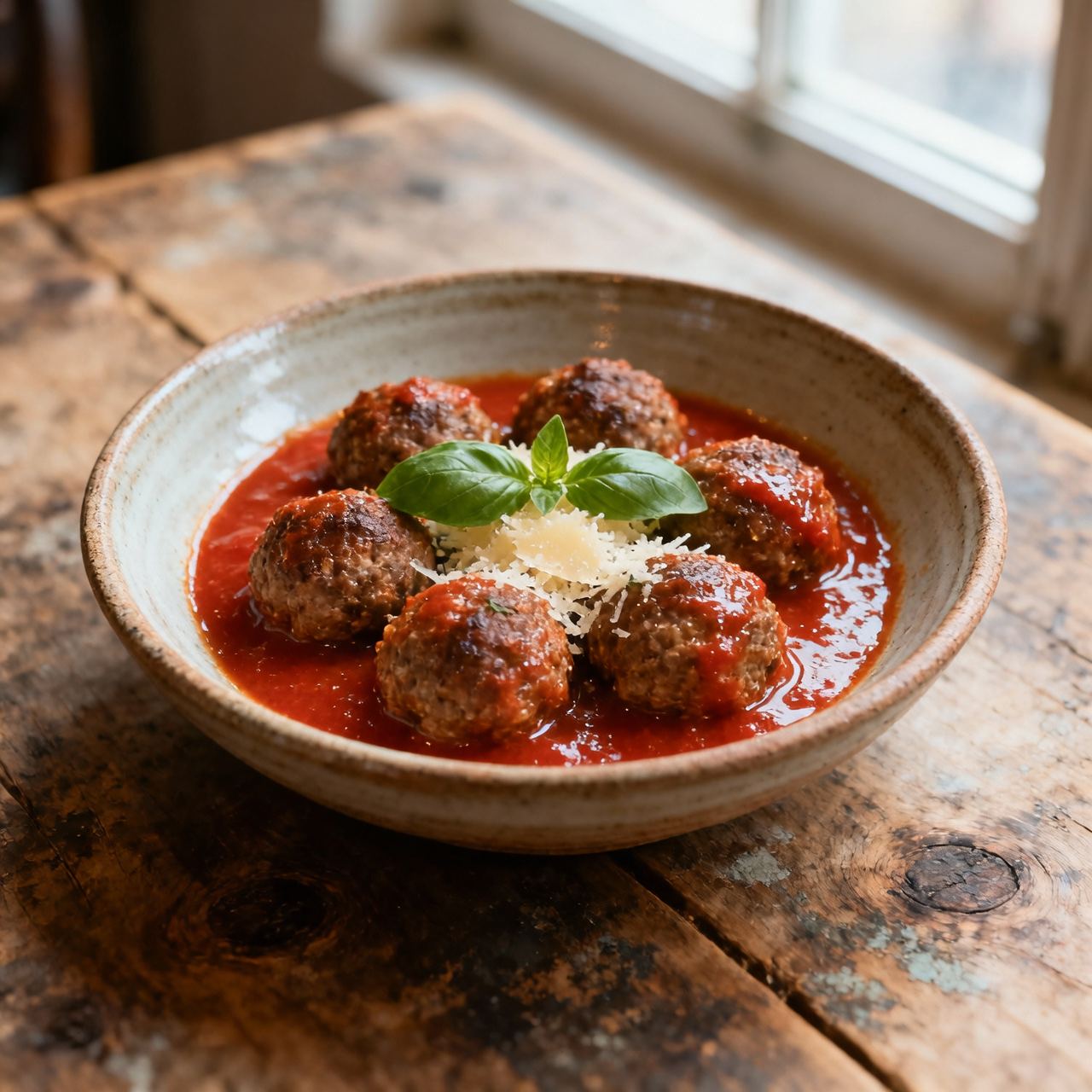
Meatballs
I’ve watched generations of Italian nonne treat meatballs not as a shortcut to stretch cheap meat, but as a deliberate alchemy of texture and restraint. True polpette al sugo begins long before the pan; it starts with the panade, that humble marriage of stale bread and milk that guarantees a tender, yielding crumb rather than a dense hockey puck. The greatest pitfall I see is overworking the mixture—pounding it into submission until the proteins tighten and the meatballs turn tough. Great meatballs are handled like pastry, folded gently until just combined, then rested so the flavors marry before they meet the heat. A proper simmer in a slow-cooked tomato sauce is non-negotiable; the meatballs must drink in the acidity while the sauce absorbs their rendered richness. Shop-bought alternatives promise convenience for roughly six to eight dollars a box, but they trade texture for stabilizers, padding lean meat with soy fillers, sodium-heavy broths, and artificial preservatives that mute the very soul of the dish. You’re paying for a hollow replica that crumbles under scrutiny. Making them from scratch costs less per portion, takes under an hour of active time, and yields a deeply savory, structurally sound result that freezes beautifully. When you control the grind, the fat ratio, and the simmer, you unlock a dish that is both profoundly humble and technically elegant. This recipe gives you the exact framework to master it, whether you need a forgiving first attempt or restaurant-level precision. The ingredients remain constant; only your hands change.
Nutrition
| Per serving | Calories | Protein | Carbs | Fat | Sat fat | Fibre | Sugar | Sodium |
|---|---|---|---|---|---|---|---|---|
| beginner | 520kcal | 34g | 21g | 32g | 11g | 3g | 8g | 750mg |
| intermediate | 520kcal | 34g | 21g | 32g | 11g | 3g | 8g | 750mg |
| expert | 520kcal | 34g | 21g | 32g | 11g | 3g | 8g | 750mg |
Per serving · Ava-estimated — a guide, not a clinical figure.
- 500 gground beef— 80/20 fat ratio preferred
- 80 gstale bread— crusts removed, torn into pieces
- 120 mlwhole milk— full fat for best binding
- 1 pieceegg— large, at room temperature
- 40 gpecorino romano— freshly grated
- 20 gflat-leaf parsley— finely chopped
- 3 piecegarlic clove— peeled
- 150 gyellow onion— peeled
- 12 gfine sea salt— kosher or flaked salt adjusts volume
- 2 gblack peppercorn— freshly ground
- 45 mlextra virgin olive oil— divided for frying and finishing
- 400 gwhole peeled tomato— preferably San Marzano
- 60 gcarrot— peeled
- 60 gcelery stalk— trimmed
This version is designed for your first confident attempt without sacrificing the soul of the dish. Instead of complex equipment or precise temperature control, we rely on tactile cues and forgiving timing. The key difference here is how we handle the panade and the mix: we soak the bread directly in the bowl and fold everything together by hand, stopping the moment the meat just holds its shape. Overmixing is the number one enemy of tender meatballs, so I will guide you to keep your touch light and your movements minimal. We brown in a single heavy skillet rather than a heavy Dutch oven, which makes cleanup easier and reduces the chance of scorching. The sauce builds directly in the same pan, capturing every flavorful fond without requiring extra pots. Watch the heat closely during the browning phase; medium is your friend here, allowing the exterior to seal without burning before the interior cooks. Simmering covered keeps the sauce from reducing too quickly, giving you a reliable, forgiving finish. By the time the meatballs are nestled in the rich tomato base, you will understand exactly why gentle handling yields such a rewarding texture. This approach strips away intimidation while preserving the foundational techniques that make Italian meatballs legendary. Once mastered, you can scale it effortlessly for weeknight dinners or batch freezing.
Equipment
- Heavy-bottomed skillet— cast iron or stainless steel
- Large mixing bowl— stainless steel or glass
Method
- 1
Tear the bread into a bowl and pour the milk over it; let soak until fully softened.
Do not rush this step.
hydration~ 5 min - 2
Finely chop the onion, carrot, celery, and parsley, then mince the garlic.
Keep pieces uniform.
mise en place~ 5 min - 3
Combine the ground beef, soaked bread, egg, grated cheese, herbs, salt, and pepper in the bowl.
Add everything at once.
combining~ 3 min - 4
Gently fold the mixture with your hands just until it holds together.
Stop squeezing immediately.
gentle folding~ 2 minTricky bit - 5
Cover the bowl and refrigerate for fifteen minutes.
Firming prevents crumbling.
resting~ 15 min - 6
Scoop and roll the mixture into twelve equal-sized balls using damp hands.
Keep a bowl of water nearby.
portioning~ 4 min - 7
Heat half the olive oil in a skillet over medium heat and brown the meatballs on all sides.
Turn with tongs, do not crowd.
searing~ 8 minTricky bit - 8
Remove the meatballs, add the remaining oil, and cook the chopped vegetables until soft.
Stir frequently.
sweating~ 5 min - 9
Crush the canned tomatoes by hand, pour them into the pan, and season lightly.
Use your hands for best texture.
sauce base~ 1 min - 10
Nestle the meatballs back into the sauce, cover, and simmer gently for twenty minutes.
Low bubbles only.
simmering~ 20 min
Cooking from frozen
Thaw overnight in the refrigerator, then gently reheat in a covered skillet with a splash of water until piping hot.
Storage times are a guide — always use your judgement and store food safely.