
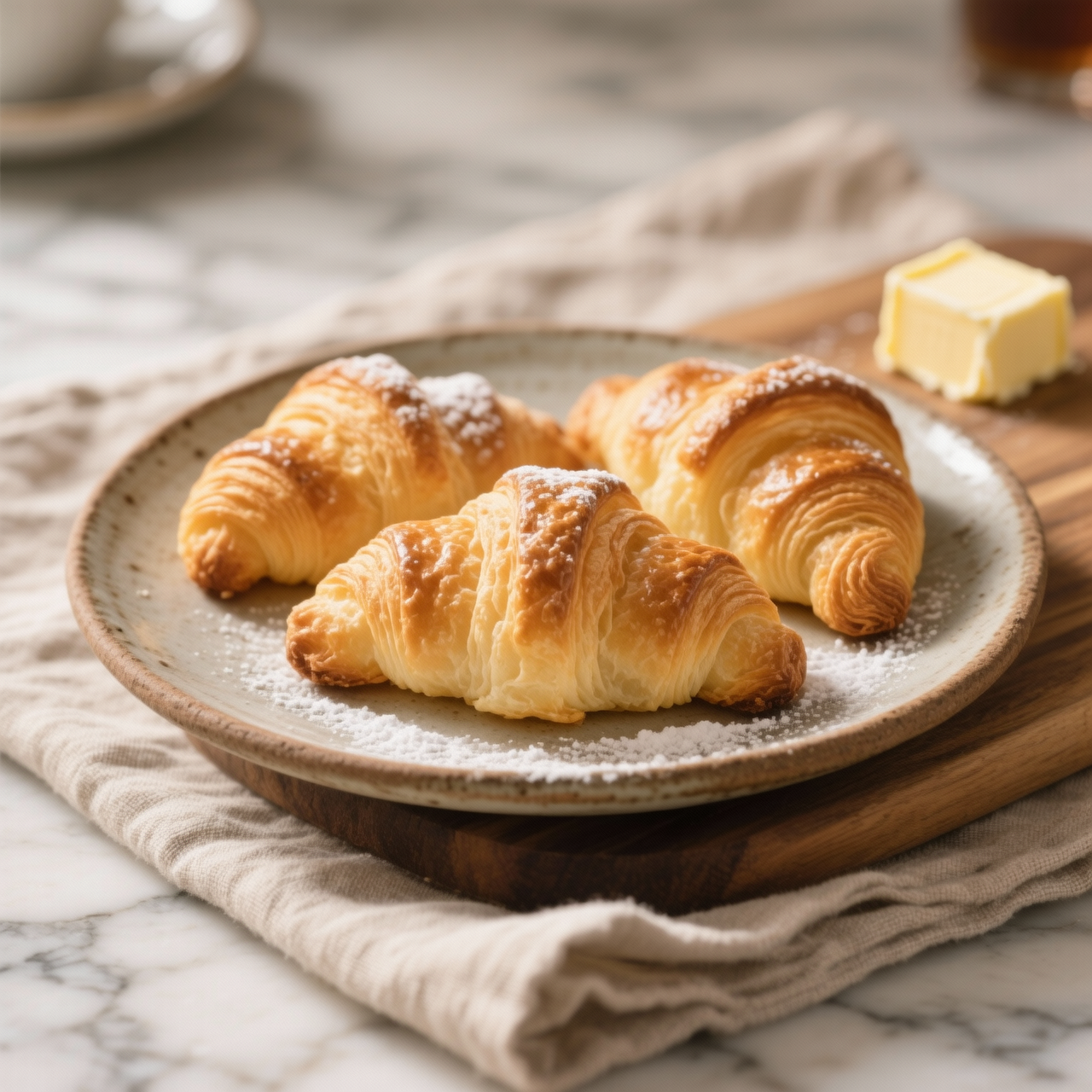
Medialunas
I’m Ava, and today we are tackling the glorious Argentine medialuna de manteca. If you’ve ever bought the supermarket packs of these croissant-like pastries, you know the disappointment: for about five dollars, you get a box of six dense, cakey discs loaded with palm oil, emulsifiers, and preservatives. They taste like sweetened cardboard and completely miss the buttery, laminated soul of the real thing. Making them from scratch is a labor of love, but it is the only way to achieve those shattering, honey-glazed layers. The magic lies in the dough and the butter block; common pitfalls include letting the butter melt into the dough rather than staying in distinct layers, or rushing the proofing process, which kills the flaky structure. Since this is a true batch hero recipe, my advice is to embrace the freeze. You can make the dough, laminate it, shape the beautiful little crescents, and then freeze them raw on a baking sheet. Once solid, transfer them to a bag. This means you can bake a few fresh each morning, letting them proof overnight in the fridge before baking. The result is a warm, fragrant, bakery-quality breakfast that makes the supermarket versions look like a sad imitation. It takes patience, but when you pull that first golden, syrup-brushed medialuna from the oven and smell the caramelized butter, you’ll know every minute of folding and resting was entirely worth it.
Nutrition
| Per serving | Calories | Protein | Carbs | Fat | Sat fat | Fibre | Sugar | Sodium |
|---|---|---|---|---|---|---|---|---|
| beginner | 735kcal | 11g | 76g | 44g | 26g | 3g | 20g | 380mg |
| intermediate | 1140kcal | 28g | 145g | 58g | 36g | 4g | 42g | 1150mg |
| expert | 780kcal | 14g | 75g | 45g | 28g | 2g | 22g | 620mg |
Per serving · Ava-estimated — a guide, not a clinical figure.
- 500 gbread flour— high protein or 000 flour
- 50 gsugar— for the dough
- 10 gsalt— fine sea salt
- 8 ginstant yeast— or 25 g fresh yeast
- 150 gwhole milk— lukewarm
- 50 gwater— lukewarm, for the dough
- 50 gunsalted butter— softened, for the dough
- 250 gunsalted butter— cold, high-fat (82% minimum), for the butter block
- 1 unitegg— lightly beaten, for egg wash
- 100 gsugar— for the sugar syrup glaze
- 100 gwater— for the sugar syrup glaze
Supermarket medialunas typically cost around $1.50 each and are a disappointment; they are often baked with waxy margarine or shortening, resulting in a dense, stale crumb that lacks the signature buttery, flaky layers of a true medialuna de manteca. This beginner version bypasses the intimidating traditional butter block technique, which often breaks and ruins the layers for novices. Instead, we use a simplified 'spread-and-fold' lamination method. You will roll the enriched dough, spread a thin, even layer of cold but pliable butter, and fold it. This forgiving approach guarantees distinct, shattery layers without the stress of encasing a solid butter slab. The key watch-out is temperature control: your butter must be cold enough not to melt into the dough, but soft enough to spread without tearing it. If the butter gets too warm at any point, simply return the dough to the fridge for ten minutes. The result is an authentic, bakery-quality crescent that freezes beautifully for fresh morning baking, completely eclipsing the processed shop-bought alternatives.
Equipment
- Large mixing bowl— for combining and kneading the dough
- Rolling pin— a French tapered pin offers better control for laminated dough
- Baking sheet— lined with parchment paper
- Pastry brush— for applying egg wash and syrup glaze
Method
- 1
Mix flour, sugar, salt, yeast, milk, and egg to form a shaggy dough, then knead on a lightly floured surface until smooth and elastic.
The dough should be soft but not overly sticky; add a dusting of flour if it sticks to your hands.
kneading~ 5 min - 2
Wrap the dough tightly in plastic wrap and chill in the refrigerator to relax the gluten.
Do not skip this rest, or the dough will shrink back when you try to roll it.
resting~ 30 min - 3
Roll the chilled dough into a rectangle, spread a thin, even layer of cold but pliable butter over two-thirds of the dough, then fold the unbuttered third over the middle, and the remaining third over that.
Ensure the butter is spreadable but still cold; if it melts, the layers will be lost.
laminating~ 5 minTricky bit - 4
Chill the folded dough for 20 minutes, then roll it out into a large circle about 5mm thick.
Roll gently to avoid squeezing out the air pockets created by the butter layers.
rolling~ 5 min - 5
Cut the circle into triangles, roll each triangle up from the wide base to the point, and curve the ends inward to form a crescent.
Roll them snugly but do not stretch or tear the dough.
shaping~ 10 min - 6
Proof the shaped medialunas on a baking sheet until puffy, brush generously with egg wash, and bake until deeply golden.
They should feel light and airy before going into the oven.
proofing~ 60 min - 7
Brush the hot baked medialunas immediately with a simple sugar syrup glaze.
The residual heat will set the glaze into a shiny, tacky finish.
glazing~ 2 min
Cooking from frozen
Thaw at room temperature and refresh in a hot oven for five minutes to restore the flaky crust.
Storage times are a guide — always use your judgement and store food safely.