
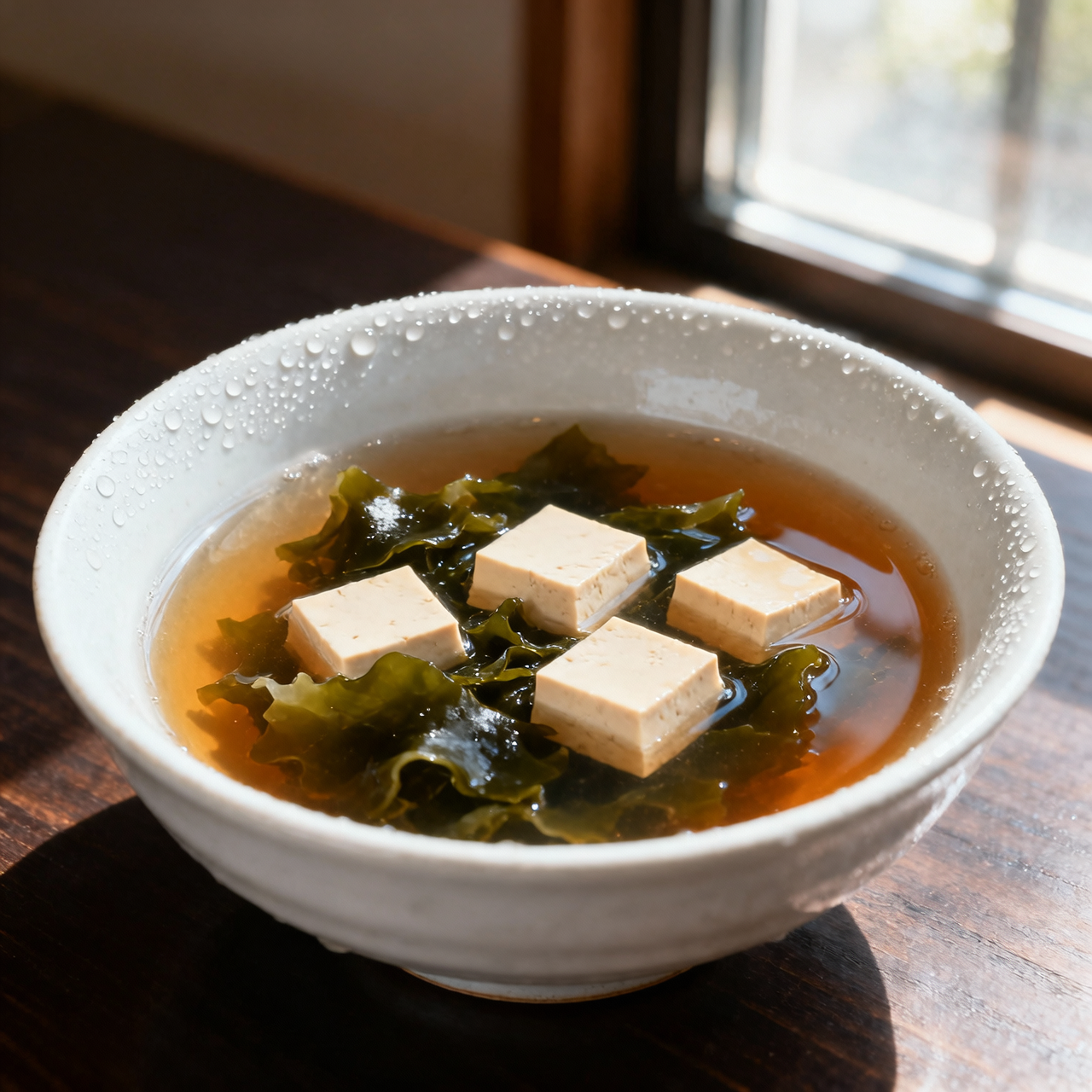
Miso Soup
When I first learned to whisk miso into warm broth, I quickly discovered that this humble bowl is far more than a quick starter. Miso soup traces its roots back over a millennium, evolving from ancient Chinese fermented pastes into a cornerstone of Japanese daily nourishment. For me, it represents the quiet rhythm of Japanese home cooking, where patience and balance outweigh complexity. I love how a single spoonful of fermented soybean paste can transform simple dashi into something deeply restorative, carrying the umami-rich history of generations. Yet, I often see cooks stumble over the same pitfalls. The most frequent mistake is boiling the miso, which scorches its delicate enzymes and strips away its nuanced flavor profile. Another is rushing the dashi, treating it as mere hot water rather than the foundational soul of the dish. When preparing this vegan version, I rely entirely on kombu and shiitake mushrooms to build that essential savory depth, proving you never need bonito flakes to achieve authentic comfort. I always remind myself to remove the pot from the heat before whisking in the paste, using a ladle and strainer to dissolve every clump smoothly. Temperature control is everything. The soup should be served immediately, never simmered, allowing the miso to shine exactly as the artisans who aged it intended. Every bowl I pour is a quiet tribute to that careful balance, a reminder that true nourishment rarely needs to shout to be heard.
Nutrition
| Per serving | Calories | Protein | Carbs | Fat | Sat fat | Fibre | Sugar | Sodium |
|---|---|---|---|---|---|---|---|---|
| beginner | 70kcal | 5g | 10g | 2g | 1g | 3g | 2g | 625mg |
| intermediate | 70kcal | 5g | 10g | 2g | 1g | 3g | 2g | 625mg |
| expert | 70kcal | 5g | 10g | 2g | 1g | 3g | 2g | 625mg |
Per serving · Ava-estimated — a guide, not a clinical figure.
- 1000 mlwater— filtered, cold
- 15 gkombu— unwashed, lightly wiped
- 20 gdried shiitake mushroom— whole caps, not sliced
- 10 gwakame seaweed— dried, not pre-soaked
- 60 gmiso paste— rice or barley variety
- 150 gsilken tofu— drained and cubed
- 2 stalksscallion— finely sliced
This version prioritizes confidence and speed without sacrificing the fundamental character of the dish. You will rely on readily available jarred miso and a simplified broth extraction that eliminates guesswork. The primary goal is learning how to protect the delicate fermentation from thermal shock, which is the most common beginner mistake. Watch your pot like a hawk during the heating phase; the moment you see tiny bubbles clinging to the edges, the extraction is complete and you must lower the heat. Never let the liquid reach a rolling boil once the miso enters the pot, as high temperatures instantly kill the beneficial cultures and mute the complex umami notes. Keep your movements gentle when folding in the tofu to preserve its delicate structure. This approach strips away traditional friction points while maintaining the essential flavor architecture. You will gain muscle memory for temperature management and learn how to properly suspend the paste without clumps. By the end of this session, you will understand that great miso soup relies less on complicated technique and more on disciplined restraint.
Equipment
- Small saucepan— non-stick is fine here
- Fine mesh strainer— stainless steel preferred
- Silicone whisk— heat-resistant
Method
- 1
Pour the cold water into a small saucepan and add the kombu and dried shiitake mushrooms.
Do not rinse the kombu, as the white powder contains essential glutamates.
infusion~ 10 min - 2
Heat the pot over medium-low heat until small bubbles form around the edges.
Remove the solids immediately before the water reaches a full boil.
temperature control~ 7 minTricky bit - 3
Remove the solids with a strainer and whisk the miso paste into a small ladle of the warm broth until completely dissolved.
Never add the paste directly to the main pot to prevent clumping.
tempering~ 2 minTricky bit - 4
Stir the dissolved miso back into the pot along with the silken tofu and wakame seaweed, then heat gently for one minute.
Turn off the heat immediately to preserve the live cultures.
blooming~ 1 min