
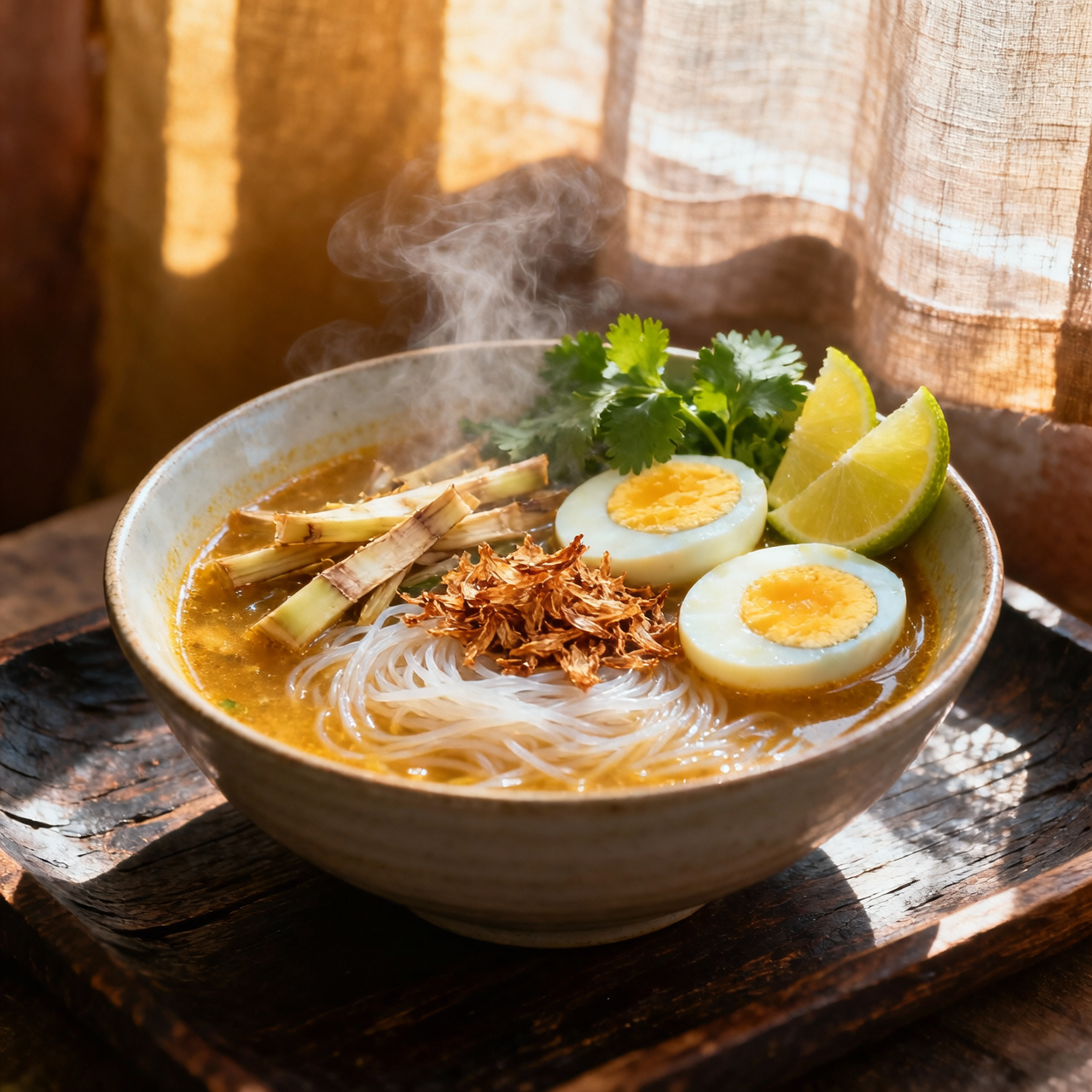
Mohinga
I’ve always believed that if you want to understand Myanmar, you don’t start in a temple or a palace, but at a roadside stall before dawn, where the steam from a simmering pot of mohinga carries the soul of the country. This humble fish-and-rice-noodle soup is our unofficial national breakfast, born from the riverine traditions of the Irrawaddy Delta where catfish were abundant and rice paddies dictated daily life. For me, it’s more than a morning meal; it’s a quiet ritual of patience and balance that has anchored generations through changing seasons and shifting tides. The magic lies in the broth, which demands respect. Too often, I see well-meaning cooks rush the process, boiling the aromatics instead of gently coaxing their flavors, or grinding the toasted chickpea flour too finely until it clumps and turns the soup into glue. Others drown the delicate lemongrass and galangal in heavy chili, forgetting that mohinga should whisper rather than shout. The biggest mistake, however, is treating the rice noodles as an afterthought. They must be rinsed, warmed, and added at the last possible moment to preserve their silkiness. When done right, the first spoonful tastes like river water, toasted earth, and home. It’s a dish that refuses to be rushed, and that’s precisely why it endures.
Nutrition
| Per serving | Calories | Protein | Carbs | Fat | Sat fat | Fibre | Sugar | Sodium |
|---|---|---|---|---|---|---|---|---|
| beginner | 724kcal | 34g | 86g | 26g | 4g | 6g | 5g | 1154mg |
| intermediate | 724kcal | 34g | 86g | 26g | 4g | 6g | 5g | 1154mg |
| expert | 724kcal | 34g | 86g | 26g | 4g | 6g | 5g | 1154mg |
Per serving · Ava-estimated — a guide, not a clinical figure.
- 450 gCatfish fillet— skinless, boneless
- 300 gRice vermicelli— thin dried noodles
- 150 gBanana stem— tender inner core, thinly sliced
- 60 gChickpea flour— finely sifted
- 100 gYellow onion— roughly chopped
- 30 gGarlic cloves— peeled
- 40 gFresh ginger— peeled
- 30 gLemongrass stalk— bruised, tough outer leaves removed
- 25 gFresh galangal— sliced
- 5 gGround turmeric
- 45 mlFish sauce
- 15 gFermented shrimp paste
- 10 gDried red chilies— seeds removed
- 60 mlNeutral cooking oil
- 2 wholeLimes— cut into wedges
- 15 gFresh cilantro— chopped
- 4 wholeHard-boiled eggs— peeled and halved
- 1500 mlWater
This version prioritizes confidence and accessibility by leaning on a high-quality pre-mixed mohinga base or jarred curry paste to handle the complex spice grinding for you. The goal here is not to reinvent tradition, but to build reliable intuition around broth consistency and noodle timing. You will focus heavily on proper tempering of the paste, careful straining to remove any tough fibers, and gentle simmering to coax out the flavors without scorching the bottom. Watch closely when adding the chickpea flour slurry; it must be whisked continuously to prevent lumps, and you will know the broth is ready when it coats a wooden spoon with a glossy, velvet-like sheen. Keep your noodles submerged in hot water only until just pliable, then drain thoroughly to avoid diluting the final soup. This approach removes the intimidation of balancing raw aromatics while still delivering an authentic, deeply satisfying bowl. Treat the first attempt as a calibration run, adjust salt and acid at the very end, and trust that the foundation you build here will carry you toward more hands-on methods.
Equipment
- Heavy-bottomed pan— non-stick is fine here
- Whisk— for smooth slurry
- Large pot— for noodle hydration
Method
- 1
Heat neutral cooking oil in a heavy-bottomed pan over medium heat until shimmering.
Oil should ripple but not smoke.
heating~ 2 min - 2
Add jarred paste and cook until fragrant and oil begins to separate at the edges.
Stir constantly to prevent scorching.
blooming~ 3 minTricky bit - 3
Pour in water and bring to a steady simmer, stirring occasionally to dissolve the base completely.
Bubbles should break gently, not violently.
simmering~ 5 min - 4
Whisk chickpea flour with a splash of cold water until smooth, then slowly drizzle into the simmering broth while whisking constantly.
Pour in a thin stream to avoid clumping.
thickening~ 3 minTricky bit - 5
Add sliced banana stem and catfish pieces, reducing heat to low and covering until the fish flakes easily with a fork.
Fish should be opaque throughout.
poaching~ 10 min - 6
Remove fish, flake it finely with two forks, and return it to the broth, discarding any visible bones or tough skin.
Use a fork for uniform texture.
shredding~ 2 min - 7
Soak rice vermicelli in hot tap water until flexible but firm, then drain thoroughly and divide among four serving bowls.
Do not boil the noodles yet.
hydrating~ 5 min