
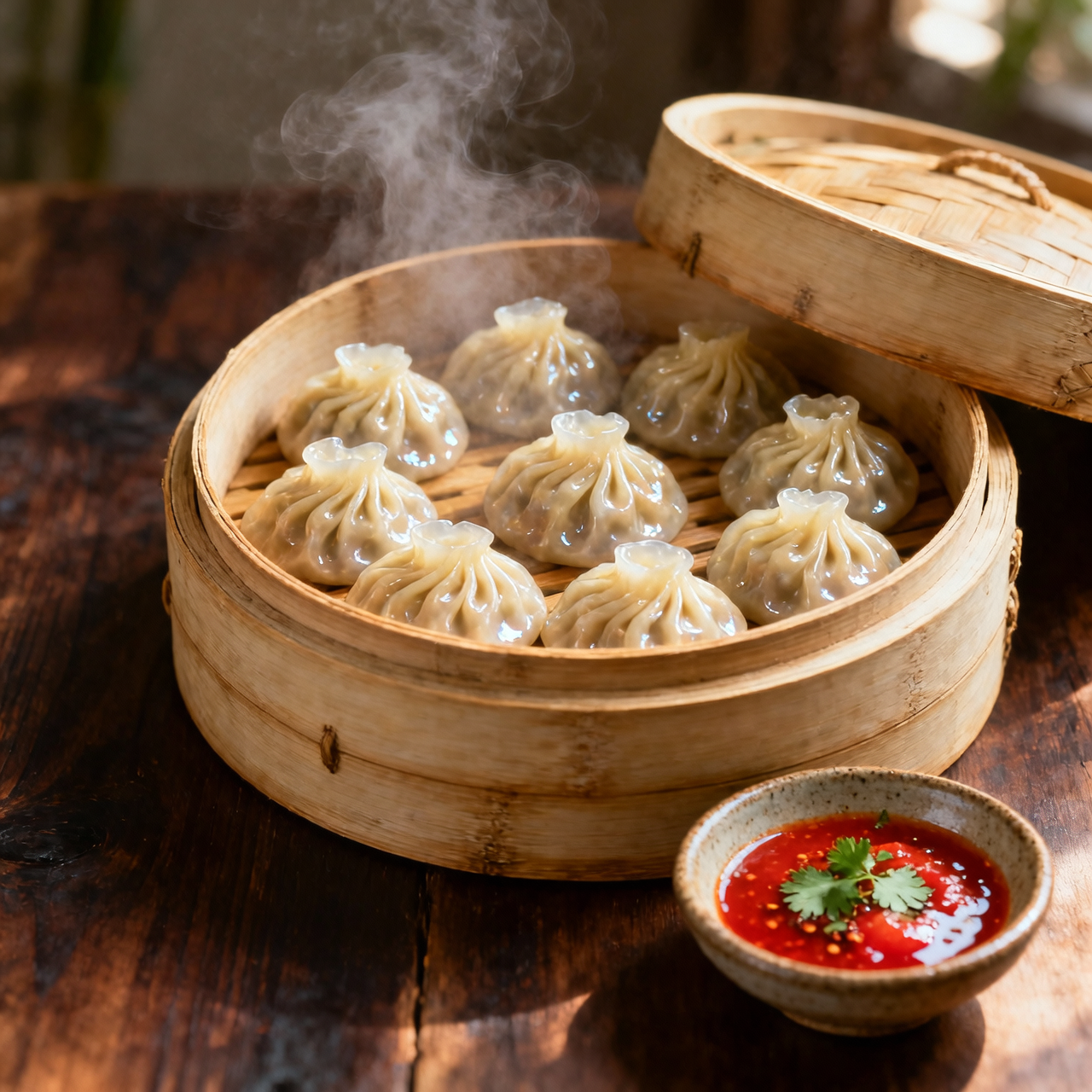
Momo
I’ve always believed that the true heart of Himalayan cooking beats strongest in the quiet, flour-dusted corners where hands learn to fold time into dough. Momo didn’t just arrive on my table; it walked through mountain passes, carried by Tibetan traders and Nepalese families who understood that food is both sustenance and sanctuary. When I first tried making them, I treated the process like a race, rushing through the dough and overstuffing the wrappers, only to end up with torn skins and dry, dense fillings. That’s the first lesson momo teaches: patience is the real ingredient. The beauty of these dumplings lies in their deceptively simple architecture—a supple, slightly chewy wrapper encasing a spiced meat or vegetable core, all transformed by gentle steam. But the pitfalls are everywhere if you aren’t paying attention. Too much water in the dough makes it gummy; too little and it cracks under pressure. Overworking the filling turns it tough, while under-seasoning leaves it tasting hollow. I’ve learned to let the dough rest like a sleeping breath, to knead just until it feels like an earlobe, and to trust the slow, steady heat of the steamer rather than forcing it. Momo matters because it’s a quiet testament to community; every pleat is a small act of care, every bite a shared memory around a low wooden table. When you finally master the rhythm of the fold, you aren’t just making a snack—you’re holding a centuries-old conversation in your hands.
Nutrition
| Per serving | Calories | Protein | Carbs | Fat | Sat fat | Fibre | Sugar | Sodium |
|---|---|---|---|---|---|---|---|---|
| beginner | 585kcal | 26g | 67g | 24g | 5g | 5g | 4g | 790mg |
| intermediate | 585kcal | 26g | 67g | 24g | 5g | 5g | 4g | 790mg |
| expert | 585kcal | 26g | 67g | 24g | 5g | 5g | 4g | 790mg |
Per serving · Ava-estimated — a guide, not a clinical figure.
- 300 gAll-purpose flour— sifted, room temperature
- 160 mlWarm water— around 35°C
- 350 gBoneless chicken thigh— finely minced
- 150 gYellow onion— finely minced
- 30 gFresh ginger— peeled and grated
- 4 unitGarlic clove— peeled and grated
- 20 gFresh cilantro— finely chopped
- 15 mlSoy sauce— fermented, standard
- 10 mlSesame oil— toasted
- 3 gGround cumin
- 3 gGround coriander
- 1 gSichuan peppercorn— or timur, toasted
- 5 gSalt
- 250 gTomato— ripe, peeled
- 3 unitDried red chili— seeds adjusted to heat preference
- 15 mlLemon juice— freshly squeezed
- 30 mlVegetable oil— neutral, for cooking
This version prioritizes success over tradition, using reliable shortcuts to remove the intimidation factor from your first dumpling attempt. Instead of kneading dough by feel, you will follow a precise hydration ratio that guarantees a pliable, tear-resistant wrapper every time. The filling relies on pre-measured aromatics and a ready-made paste to streamline prep, while the dipping sauce is simplified into a quick simmer that requires zero guesswork. Pleating is the most daunting step for newcomers, so this guide breaks it down into a simple half-moon fold with basic crimps that hold together beautifully. Watch the moisture level in your filling closely; if it looks wet, chill it for ten minutes before wrapping to prevent soggy bottoms. Steam the dumplings in a single, uncrowded layer to ensure even heat distribution, and resist the urge to open the lid mid-cook, as sudden temperature drops will deflate the dough. The goal here is not perfection, but confidence. Once you master the rhythm of scooping, sealing, and steaming, you will naturally begin experimenting with tighter pleats and bolder spice blends. Trust the process, keep your hands lightly floured, and enjoy the deeply satisfying result of your very first homemade batch.
Equipment
- Bamboo steamer— metal colander works as substitute
- Rolling pin— standard kitchen size
- Steaming parchment— lightly oiled to prevent sticking
- Mixing bowls— two medium sizes
Method
- 1
Combine the flour and warm water in a large bowl until a shaggy mass forms.
Mix with a spatula first.
hydrating~ 2 min - 2
Turn the dough onto a clean surface and press it until smooth and elastic.
Add a teaspoon of water if dry.
kneading~ 5 min - 3
Cover the dough with a damp towel and let it rest while you prepare the filling.
Resting relaxes gluten.
resting~ 10 min - 4
Mix the minced chicken, onion, ginger-garlic paste, spices, soy sauce, and sesame oil in a bowl until uniform.
Use a fork for quick blending.
folding~ 3 min - 5
Divide the dough into equal portions, roll each into a thin circle, and place a tablespoon of filling in the center.
Keep edges thinner than center.
portioning~ 7 minTricky bit - 6
Bring the edges together and pinch firmly to create a secure half-moon shape.
Dip fingers in water to seal.
pleating~ 10 minTricky bit - 7
Arrange the momos on oiled parchment, place in the steamer, cover, and cook until the wrappers turn translucent.
Maintain steady simmer.
steaming~ 15 min - 8
Simmer the tomatoes, chilies, and lemon juice in a small pan until thickened, then serve alongside.
Blend if smooth texture preferred.
simmering~ 5 min