
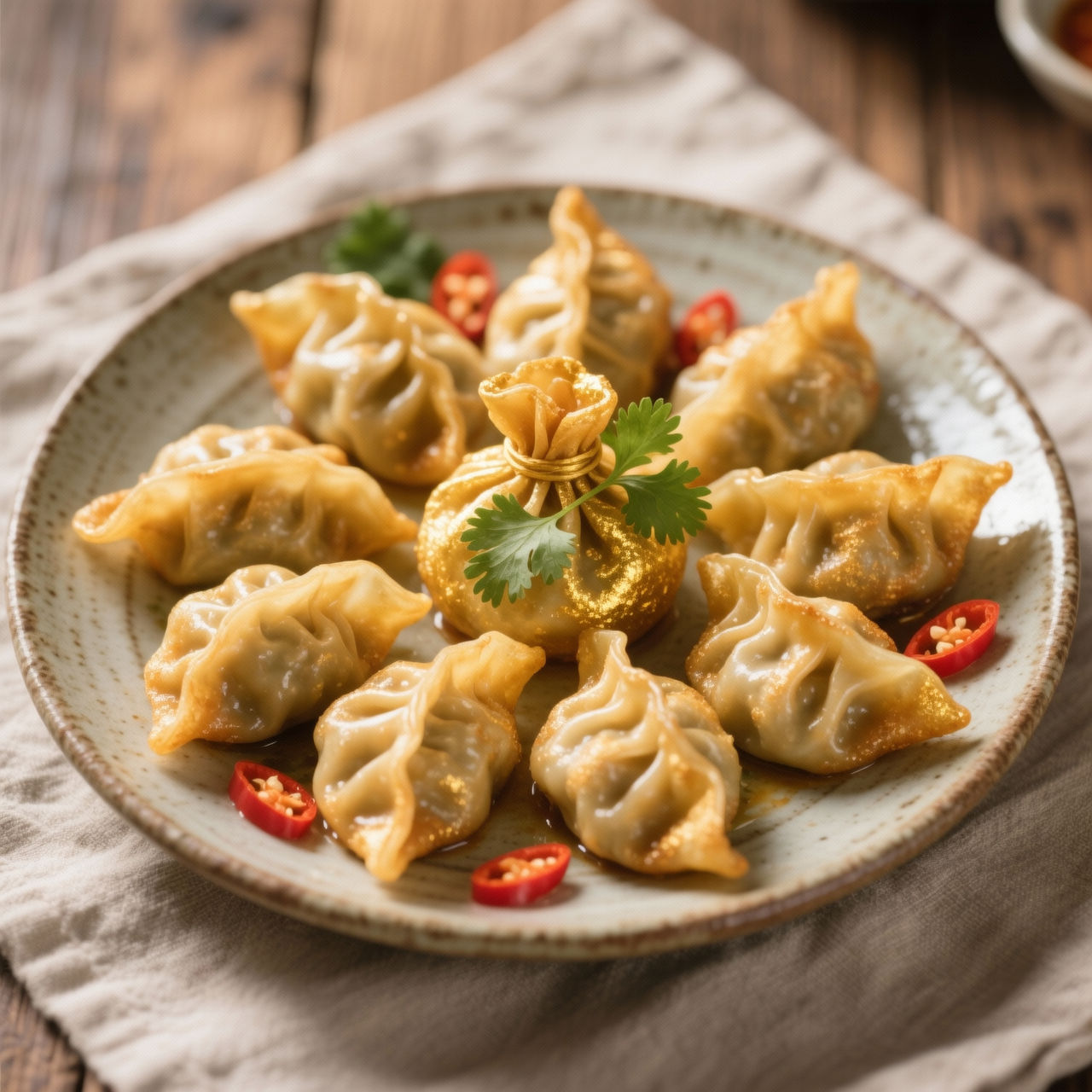
Money Bags (Thung Thong)
I first fell for Thung Thong at a bustling night market in Chiang Mai, where vendors sold these delicate golden pouches tied at the neck like tiny silk purses. Traditionally, they are a celebratory Thai snack, their shape symbolizing wealth and good fortune. Yet, the frozen, supermarket versions you find today are a far cry from that heritage. A typical shop-bought pack costs around four dollars, but you pay for a soggy, pre-formed shell stuffed with a bland, gelatinous pork-and-MSG paste that shatters into oily crumbs the moment it hits the fryer. That’s why I insist on building these entirely from scratch. Real money bags demand fresh ground pork, fragrant white pepper, crushed garlic, and a whisper of coriander root, all gently folded into a thin, pliable wrapper that you tie yourself with a chive or spring onion strand. The magic lies in the balance: overworking the pork filling makes it dense and rubbery, while under-seasoning leaves it tasting like wet cardboard. Many cooks rush the wrapping stage, using cheap, overly thick wonton skins that turn leathery instead of crisp, or they tie the knots too tightly, causing the pouches to burst when the oil hits. By taking the time to rest your seasoned filling, hand-cutting your wrappers if you can, and sealing them with just a light dab of water, you transform a simple snack into something luminous and deeply aromatic. When you fry them from raw, the steam trapped inside gently cooks the pork while the exterior shatters into delicate, golden layers. It’s a quiet, meditative process that rewards patience with every bite, proving that true culinary wealth isn’t bought in a plastic box, but woven by hand.
Nutrition
| Per serving | Calories | Protein | Carbs | Fat | Sat fat | Fibre | Sugar | Sodium |
|---|---|---|---|---|---|---|---|---|
| beginner | 280kcal | 16g | 22g | 14g | 4g | 2g | 2g | 520mg |
| intermediate | 260kcal | 14g | 24g | 13g | 4g | 2g | 2g | 520mg |
| expert | 285kcal | 16g | 22g | 15g | 4g | 1g | 2g | 580mg |
Per serving · Ava-estimated — a guide, not a clinical figure.
- 300 gGround pork— 80/20 fat to lean ratio preferred
- 30 gGarlic— Finely minced
- 15 gCoriander root— Cleaned and finely pounded
- 5 gWhite pepper— Freshly ground
- 30 mlFish sauce
- 15 mlLight soy sauce
- 10 gGranulated sugar
- 50 gCarrot— Peeled and finely diced
- 15 gWood ear mushroom— Dried, soaked until soft, finely chopped
- 30 gGlass noodle— Dried, soaked in warm water, cut short
- 24 pieceWonton wrapper— Round or square, brought to room temperature
- 12 stalkGarlic chive— Blanched briefly until pliable for tying
- 1000 mlVegetable oil— For deep frying
This beginner-friendly version focuses on a forgiving, assembly-line approach to Thung Thong without relying on any processed pastes or pre-made fillings. While frozen restaurant-style money bags can cost upwards of eight dollars per bag and often mask stale pork with heavy preservatives and excess sodium, making them at home yields a brighter, cleaner flavor and lets you control the fat ratio. We simplify the traditional paste-making by hand-mincing fresh aromatics and using a quick pan-simmer to meld flavors before filling, skipping the labor-intensive mortar work. The key to success here is managing moisture in the pork mixture; patting the soaked glass noodles and mushrooms completely dry prevents soggy wrappers during frying. Watch your oil temperature closely—it should hover around three hundred fifty degrees so the delicate wonton skins crisp evenly without splitting at the tied necks. Use blanched chives instead of kitchen twine for an authentic, edible knot that holds securely. Once assembled, these freeze beautifully raw on a tray before transferring to a bag, giving you a ready-to-fry appetizer that outperforms any store-bought equivalent in both texture and taste.
Equipment
- Heavy-bottomed pan— non-stick works well for simmering
- Candy thermometer— critical for maintaining oil heat
- Spider skimmer(optional)— makes flipping and removal easier
Method
- 1
Finely mince the garlic, coriander roots, and white peppercorns using a sharp chef’s knife on a wooden board.
Uniform pieces ensure even cooking and prevent wrapper punctures.
mincing~ 5 min - 2
Combine the minced pork, aromatics, oyster sauce, light soy sauce, and rehydrated glass noodles in a large mixing bowl until evenly distributed.
Work quickly to keep the meat cold and firm.
folding~ 2 min - 3
Simmer the mixture in a dry skillet over medium heat until the pork turns opaque and any released liquid evaporates completely.
A dry filling prevents steam from bursting the wrappers during frying.
reducing~ 8 minTricky bit - 4
Place a level teaspoon of the cooled filling into the center of each wonton wrapper, gather the edges upward, and tie securely with a blanched chive.
Leave just enough headspace so the bag puffs without tearing.
pouching~ 10 minTricky bit - 5
Deep-fry the assembled bags in neutral oil at three hundred fifty degrees until the wrappers turn golden and crisp, then drain thoroughly on a wire rack.
Fry in small batches to maintain stable oil temperature.
deep-frying~ 5 minTricky bit
Cooking from frozen
Reheat directly from frozen in a 180°C oven or air fryer for 12-15 minutes until crisp and piping hot.
Storage times are a guide — always use your judgement and store food safely.