
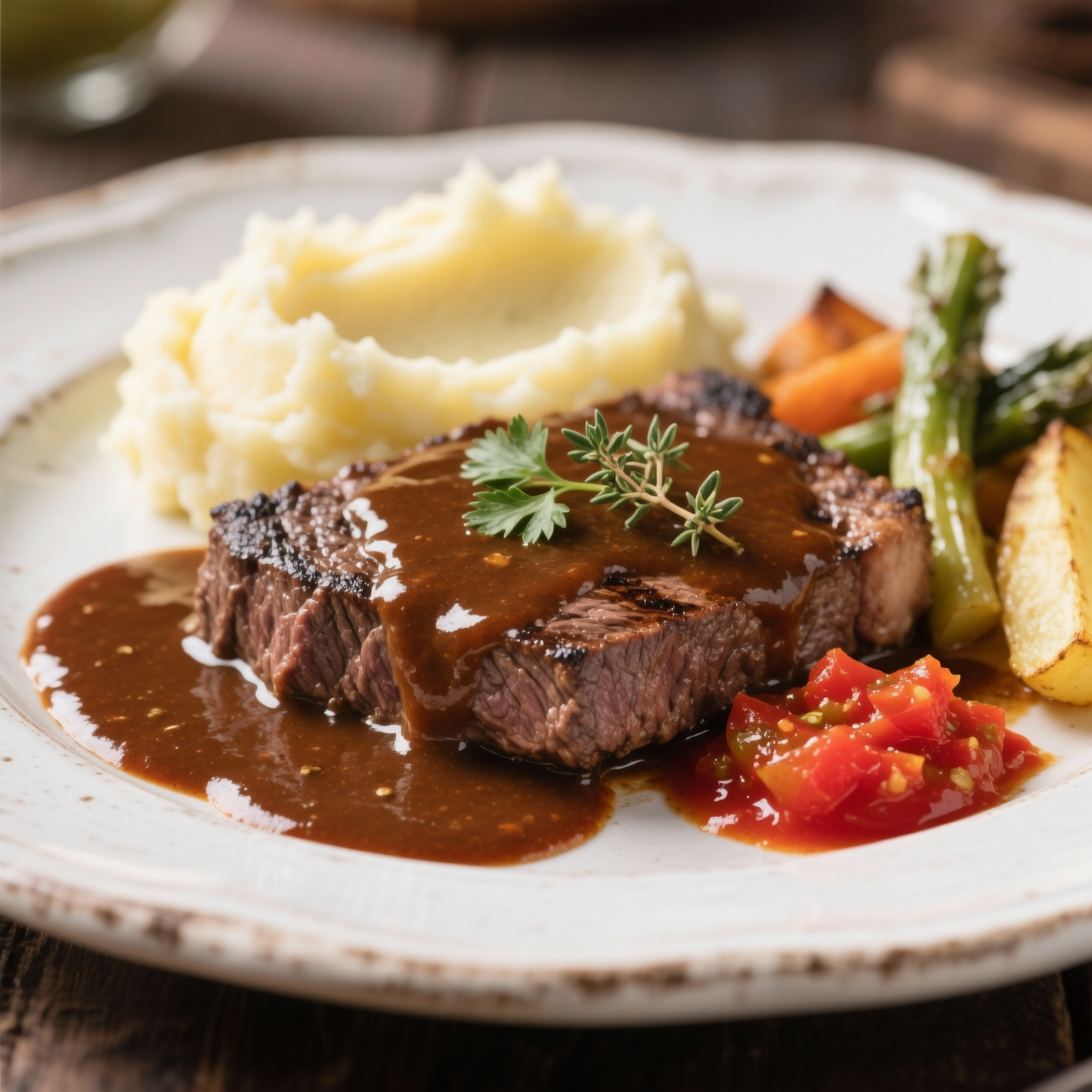
Monkeygland sauce
When I first encountered the name, I’ll admit I was braced for something decidedly unappetizing. Yet Monkeygland sauce remains one of South Africa’s most quietly brilliant culinary inventions, born in the 1920s Johannesburg dining scene during a brief, bizarre global obsession with glandular rejuvenation therapies. Chefs playfully co-opted the macabre moniker for a brilliantly balanced condiment that actually contains no primate whatsoever. To me, this sauce matters because it captures the exact moment where colonial pantry staples met local palates to create something entirely its own. It is the golden thread tying together boerewors, charcoal-grilled steaks, and humble chip trays across the country. As a vegan adaptation, it simply requires thoughtful swaps: a robust tomato base, a high-quality fruit chutney, and a plant-based Worcestershire alternative. The real magic happens when you coax these elements into harmony. The most common pitfall I see is rushing the simmer, which leaves the acidity sharp and the fruit notes disjointed. Another frequent mistake is treating it like a quick pour-over rather than a proper reduction, resulting in a cloyingly sweet syrup that clings too heavily to the plate. I always stress low, steady heat and constant tasting. Let the vinegar mellow, let the tomato deepen, and let the spices bloom slowly. When done right, it strikes that elusive equilibrium between tang, sweetness, and umami that makes it indispensable. It’s not just a sauce; it’s a living archive of South African adaptability, proving that the most unlikely names often guard the most comforting flavors.
Nutrition
| Per serving | Calories | Protein | Carbs | Fat | Sat fat | Fibre | Sugar | Sodium |
|---|---|---|---|---|---|---|---|---|
| beginner | 105kcal | 1g | 24g | 2g | 0g | 1g | 19g | 420mg |
| intermediate | 165kcal | 1g | 34g | 4g | 0g | 2g | 26g | 520mg |
| expert | 95kcal | 1g | 21g | 1g | 0g | 2g | 16g | 580mg |
Per serving · Ava-estimated — a guide, not a clinical figure.
- 250 gtomato sauce— Use a plain, smooth variety
- 125 gfruit chutney— Verify vegan status; avoid honey-based varieties
- 30 mlvegan Worcestershire sauce— Anchovy-free version required
- 15 gbrown sugar
- 10 gyellow mustard
- 15 mlapple cider vinegar(optional)
- 2 ggarlic powder(optional)
This beginner-friendly approach strips away the traditional slow-cooked complexities of South African Monkeygland sauce, relying on high-quality jarred apricot chutney and ready-made tomato sauce as your flavor foundation. You will simply sauté finely diced onions until translucent, then stir in the remaining ingredients to let them gently bubble into a glossy, cohesive glaze. The key here is low-and-slow simmering; keep the heat at medium-low to prevent the natural sugars in the chutney and tomato base from caramelizing too quickly and sticking to the pan. Stir frequently with a wooden spoon to scrape the bottom and ensure even reduction. Because traditional Worcestershire sauce contains fish, this version explicitly calls for a vegan Worcestershire alternative to keep the dish fully plant-based while preserving that signature tangy, umami depth. Watch the consistency closely—once it coats the back of a spoon and leaves a clear trail when dragged, it is perfectly thickened. Remove it from the heat and let it rest for ten minutes; this crucial cooling step allows the sharp vinegar notes to mellow and the sweet-tangy balance to fully integrate.
Equipment
- Heavy-bottomed saucepan— prevents scorching the sugary base
- Wooden spoon— gentle on non-stick coatings
- Measuring cups and spoons— for accurate liquid and chutney ratios
Method
- 1
Finely dice one medium yellow onion and mince two cloves of garlic.
Uniform pieces ensure even cooking without burning.
chopping~ 3 min - 2
Heat a tablespoon of neutral oil in a heavy-bottomed saucepan over medium heat and add the onions.
Listen for a gentle sizzle rather than a loud pop.
sweating~ 5 min - 3
Add the minced garlic and cook for one minute until fragrant.
Garlic burns quickly, so do not walk away.
toasting~ 1 minTricky bit - 4
Stir in the jarred apricot chutney, tomato sauce, vegan Worcestershire sauce, and brown sugar until fully combined.
Break up any thick chutney clumps with the back of your spoon.
combining~ 2 min - 5
Reduce the heat to low and simmer uncovered, stirring every three minutes until the sauce thickens.
The mixture is ready when it coats the back of a spoon.
reducing~ 15 minTricky bit - 6
Remove the pan from the heat and let the sauce rest for ten minutes before serving.
Resting allows the sharp acidity to mellow and flavors to harmonize.
resting~ 10 min
Cooking from frozen
Thaw overnight in the refrigerator, then gently warm on the stove with a splash of water or vegetable broth to loosen the texture.
Storage times are a guide — always use your judgement and store food safely.