
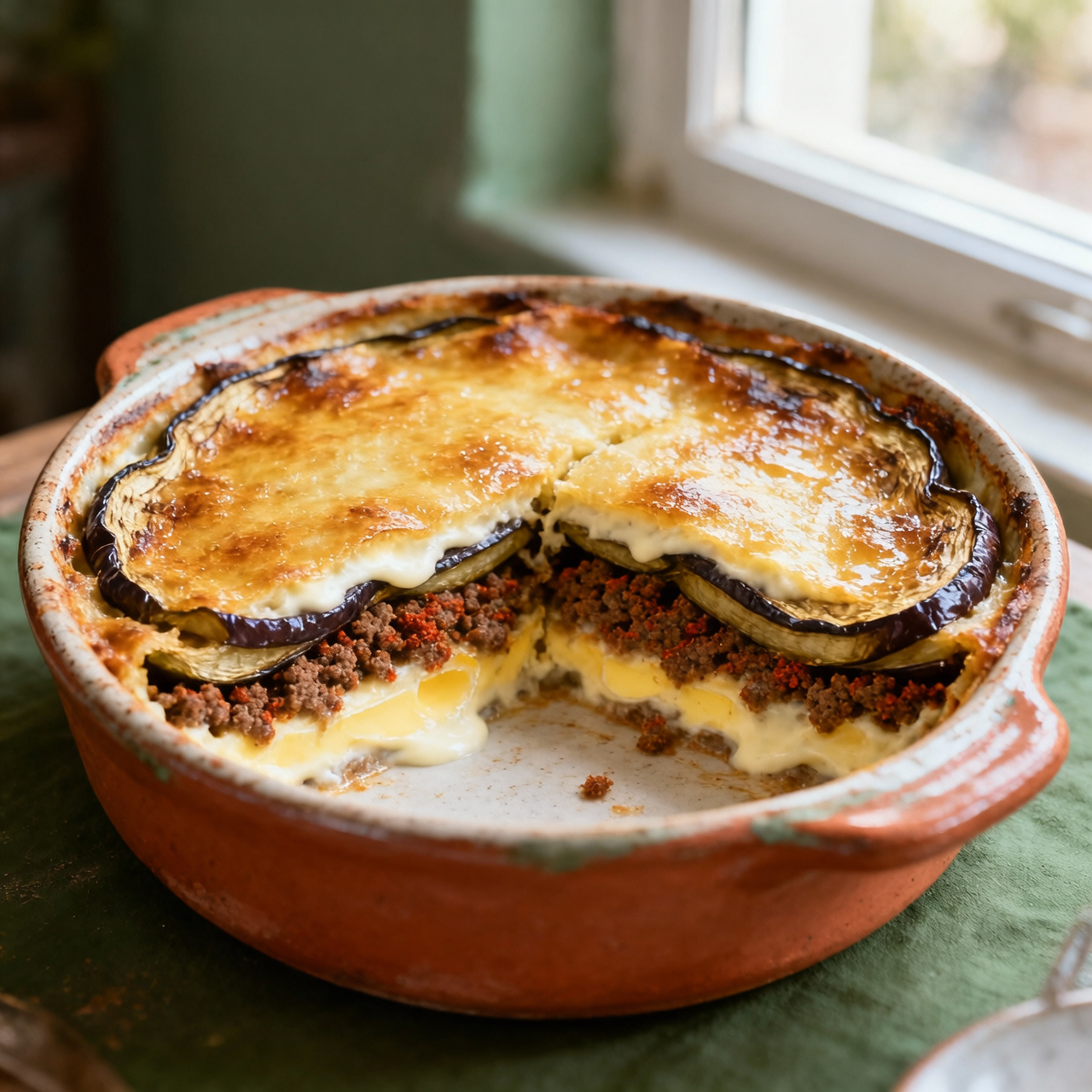
Moussaka
When I first encountered moussaka in a quiet Athenian kitchen, I realized it was never meant to be rushed. This dish carries centuries of culinary migration, tracing its roots from the spiced meat casseroles of the Ottoman Empire to the refined, béchamel-crowned masterpiece that defines modern Greek tables. I see it as more than a layered casserole; it is a testament to how food evolves through patience and cultural exchange. The moment I learned that chef Nikolaos Tselementes introduced French techniques to elevate it in the early twentieth century, I understood why this recipe demands respect. What makes moussaka so vital to me is its quiet insistence on balance. Every layer tells a story: the bitter sweetness of properly treated eggplant, the rich, slow-simmered spiced lamb or beef, and the velvety custard that binds it all together. Yet, so many cooks stumble at the same hurdles. I have watched too many moussakas collapse under their own moisture, usually because the eggplant was not salted and roasted ahead of time. Others fall apart when the meat sauce is too thin, or when the béchamel splits from overheating. The greatest mistake, though, is slicing it straight from the oven. This dish needs to rest, to let the layers settle and the flavors marry into something cohesive. When you honor that waiting period, you are rewarded with a slice that holds its shape, rich with history and deeply, unapologetically Greek.
Nutrition
| Per serving | Calories | Protein | Carbs | Fat | Sat fat | Fibre | Sugar | Sodium |
|---|---|---|---|---|---|---|---|---|
| beginner | 980kcal | 43g | 50g | 65g | 24g | 11g | 23g | 1600mg |
| intermediate | 980kcal | 43g | 50g | 65g | 24g | 11g | 23g | 1600mg |
| expert | 980kcal | 43g | 50g | 65g | 24g | 11g | 23g | 1600mg |
Per serving · Ava-estimated — a guide, not a clinical figure.
- 1000 gEggplant— firm and glossy, about three medium
- 500 gGround lamb— eighty twenty fat ratio preferred
- 200 gYellow onion— finely diced
- 15 gGarlic— freshly minced
- 60 gTomato paste— double concentrated
- 400 gCrushed tomatoes— canned, no added basil
- 120 mlDry red wine— Agioritiko or similar Greek varietal
- 3 gGround cinnamon— freshly ground preferred
- 5 gDried oregano— wild Greek variety
- 80 mlOlive oil— extra virgin
- 60 gUnsalted butter— European style
- 60 gAll-purpose flour— sifted
- 600 mlWhole milk— warmed to room temperature
- 50 gEgg yolk— about three large, separated
- 2 gGround nutmeg— freshly grated
- 15 gSalt— kosher
- 3 gBlack pepper— freshly cracked
- 10 gFresh parsley(optional)— for garnish
This version prioritizes confidence and clarity over perfection, stripping away the most intimidating variables while preserving the essential flavor profile. You will rely on a reliable jarred tomato sauce base and a simplified béchamel method that eliminates the stress of tempering eggs. The eggplant is roasted at a higher temperature to guarantee rapid moisture loss without constant monitoring, and the meat ragù simmers only until the flavors meld, not until it reduces to a paste. Watch the oven closely during the final bake, as shortcut dairy blends can brown faster than traditional preparations. Keep your layers uniform, press gently to remove air pockets, and trust that a slightly rustic appearance does not diminish the result. The goal here is to understand how heat transforms each component, building your intuition for timing and seasoning. If the top crust forms too quickly, tent it loosely with foil. This approach guarantees a cohesive, comforting bake on your very first attempt, proving that technique can be simplified without sacrificing the soul of the dish.
Equipment
- Nine by thirteen baking dish— glass or ceramic preferred
- Heavy skillet— nonstick is fine here
- Whisk— standard balloon
- Baking sheet— two sheets needed
Method
- 1
Preheat oven to four hundred twenty five degrees Fahrenheit and slice eggplant into half-inch rounds.
Use a sharp chef knife for even cuts.
slicing~ 3 min - 2
Toss slices with olive oil and salt on two sheet pans, then roast until edges brown and centers yield.
Rotate pans halfway through.
roasting~ 20 min - 3
Brown ground lamb in a heavy skillet, drain excess fat, and stir in onion, garlic, and tomato sauce until fragrant.
Break meat into small crumbles.
browning~ 10 min - 4
Whisk butter, flour, milk, and nutmeg in a saucepan over medium heat until thick and smooth.
Keep stirring to prevent scorching.
roux~ 5 min - 5
Assemble layers in a greased baking dish, alternating eggplant and meat, then pour béchamel evenly over the top.
Spread gently to avoid disturbing layers.
layering~ 4 minTricky bit - 6
Bake at three hundred seventy five degrees until golden and bubbling, then rest for twenty minutes before slicing.
Resting is nonnegotiable for clean cuts.
resting~ 20 min