
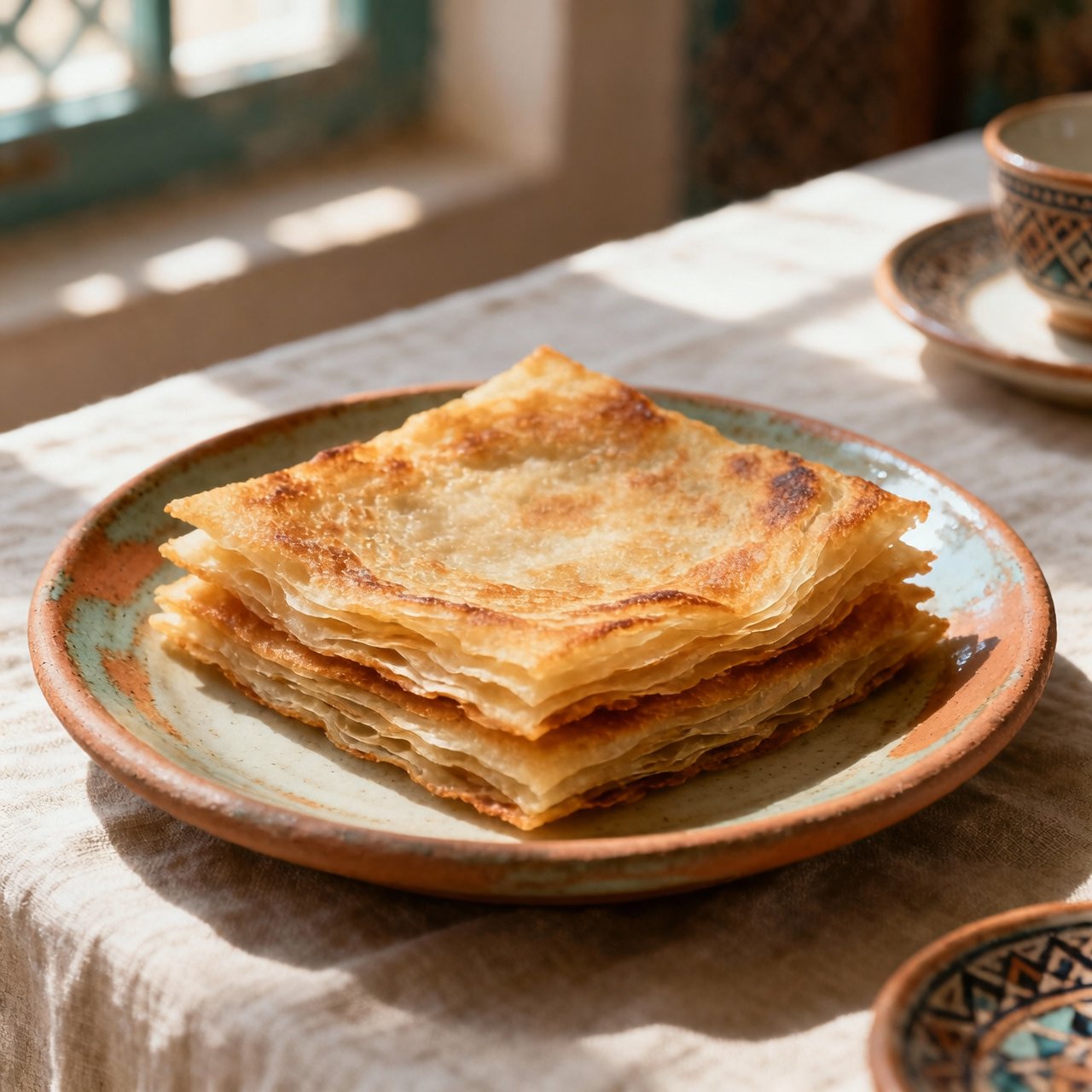
Msemen (square pancakes)
I first learned to fold msemen in a sunlit courtyard in Marrakech, watching hands move like origami artists over a canvas of dough. This laminated flatbread is more than a Moroccan breakfast staple; it is a testament to patience, where layers of semolina and flour are stretched thin, brushed with oil, and folded into precise squares that crisp into honeycomb perfection. I love making it at home because it replaces those sad, vacuum-sealed supermarket packets that sit in the freezer aisle for around four pounds. Those commercial versions taste like cardboard soaked in cheap palm oil, rely on emulsifiers to fake a flaky texture, and fall apart the moment you try to warm them. Making msemen from scratch is an act of culinary reclamation. The process is deceptively simple but unforgiving if rushed. The most common pitfall is overworking the dough, which develops too much gluten and turns your delicate layers into tough, chewy leather. Another mistake is using too much oil during lamination, which causes the squares to fuse together into a greasy brick rather than separating into distinct, shattering sheets. You must rest the dough thoroughly, stretch it until you can almost see the light through it, and keep your folds crisp. When done right, each square puffs beautifully on the pan, offering a rich, nutty aroma that no factory could ever replicate. It freezes beautifully, making it a true batch hero for busy mornings. I always stack cooled squares with parchment between them, because sharing this bread should feel effortless, not like a chore.
Nutrition
| Per serving | Calories | Protein | Carbs | Fat | Sat fat | Fibre | Sugar | Sodium |
|---|---|---|---|---|---|---|---|---|
| beginner | 430kcal | 9g | 68g | 14g | 2g | 3g | 1g | 550mg |
| intermediate | 520kcal | 12g | 78g | 18g | 2g | 3g | 1g | 310mg |
| expert | 415kcal | 11g | 66g | 13g | 2g | 4g | 1g | 720mg |
Per serving · Ava-estimated — a guide, not a clinical figure.
- 300 gall-purpose flour— sifted for easier handling
- 150 gfine semolina
- 350 mlwarm water— add gradually until a soft dough forms
- 80 mlneutral oil— use a high-smoke point oil for laminating
- 8 gfine salt
- 5 ginstant yeast(optional)— activates faster in warm water
- 5 gbaking powder
This beginner-friendly approach strips away the intimidating hand-stretching traditionally required for msemen, replacing it with a simple rolling and folding method that delivers the same flaky, layered interior without the tear-prone dough. Unlike store-bought frozen flatbreads that cost nearly double per serving and rely on stabilizers, preservatives, and cheap refined oils to mimic texture, this version uses only pantry staples to build authentic layers from scratch. The key difference here is the extended resting period, which relaxes the gluten naturally, making the dough forgiving and easy to roll thin without springing back. Watch your pan temperature closely; medium-low heat is essential to cook the interior layers through without scorching the exterior. Brushing each layer with a thin film of oil rather than a thick coating prevents greasiness while ensuring separation. Once cooked, stack them between parchment sheets and freeze immediately for a reliable batch-ready breakfast that reheats beautifully in a dry pan or toaster, preserving that crisp, honeycomb crumb.
Equipment
- Large mixing bowl— wide enough for easy kneading
- Rolling pin— standard or tapered works fine
- Heavy-bottomed skillet— cast iron or non-stick
- Pastry brush(optional)— for even oil application
- Wire cooling rack— prevents sogginess during cooling
- Freezer bags— heavy-duty for long-term storage
Method
- 1
Whisk flour, fine semolina, salt, and sugar in a large bowl, add lukewarm water, and knead by hand for two minutes until a smooth, elastic dough forms.
Lukewarm water hydrates evenly without overheating the dough.
kneading~ 2 min - 2
Coat the dough lightly with vegetable oil, cover tightly, and rest at room temperature for thirty minutes to allow the gluten network to fully relax.
Resting prevents tearing during later rolling.
gluten relaxation~ 30 min - 3
Divide the dough into six equal balls, roll each in a teaspoon of oil, and rest them under a damp cloth for fifteen minutes.
Keep covered to prevent surface drying.
dividing~ 15 min - 4
Roll one ball into a thin rectangle, brush the entire surface with a light film of oil, and fold the left and right thirds over the center to form a square.
Use a light hand with oil to avoid pooling.
tri-folding~ 1 minTricky bit - 5
Repeat the rolling, oil-brushing, and tri-fold technique one more time per packet to establish visible laminated layers, then press each square flat.
Press evenly to maintain uniform thickness.
laminating~ 1 minTricky bit - 6
Cook each square in a dry heavy-bottomed pan over medium-low heat for two minutes per side until crisp and golden, pressing gently to encourage puffing.
Adjust heat if browning happens too quickly.
dry-toasting~ 4 min - 7
Cool the finished pancakes completely on a wire rack, interleave with parchment paper, and seal in freezer bags for long-term batch storage.
Freeze while fully cooled to prevent condensation.
batch-freezing~ 2 min
Cooking from frozen
Warm directly from frozen on a medium-low dry skillet for two minutes per side until crisp and layered.
Storage times are a guide — always use your judgement and store food safely.