
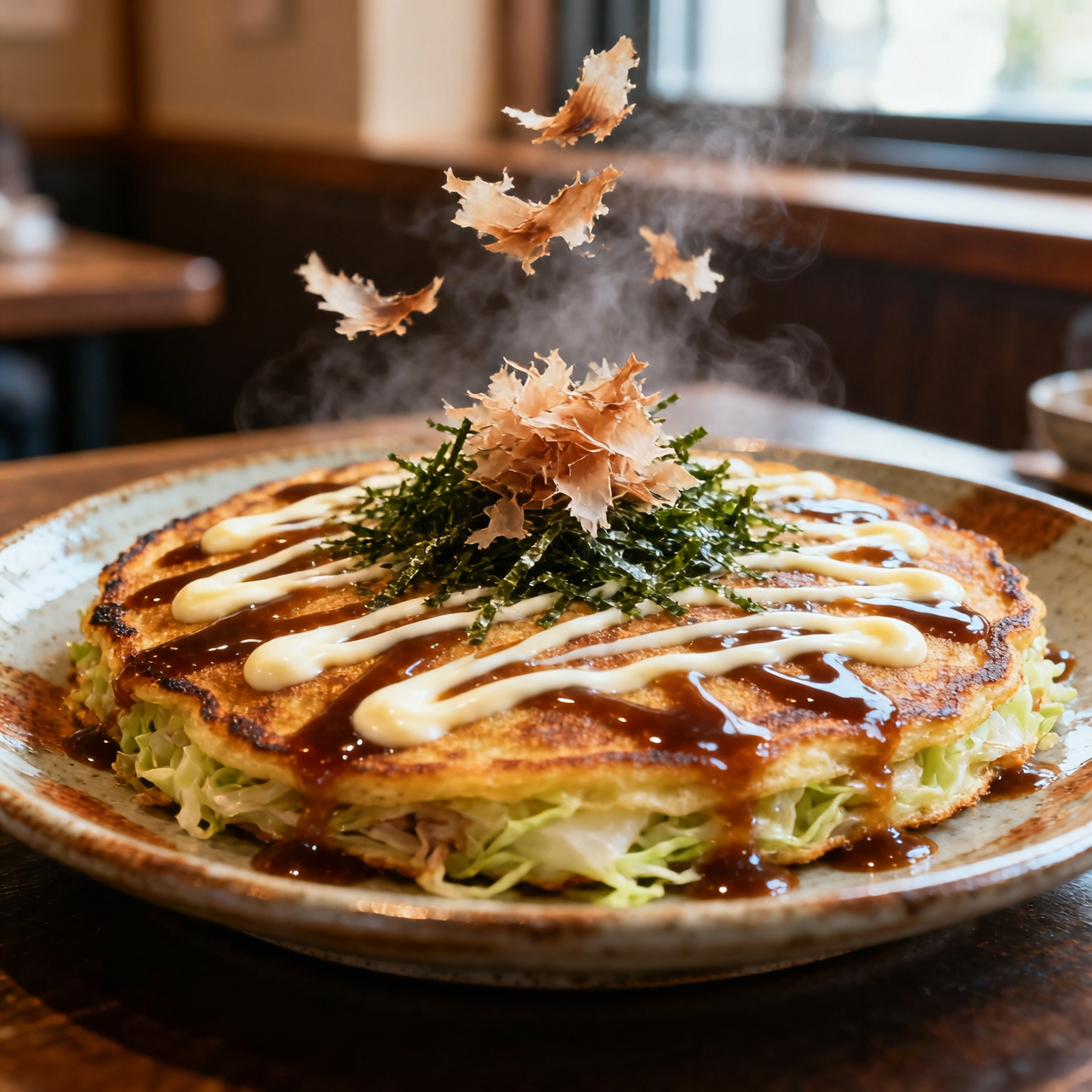
Okonomiyaki
I have always been drawn to okonomiyaki because it embodies a quiet kind of culinary democracy. Born in the bustling postwar streets of Osaka and Hiroshima, its name literally translates to grilled as you like it, and that philosophy still guides my approach to the dish. It is not merely a pancake; it is a canvas for resourcefulness, forged during times when stretching ingredients was a daily necessity, and it eventually blossomed into a beloved street food that celebrates individual taste. When I stand over the griddle, I am constantly reminded why this dish matters: it teaches patience and presence. The batter must rest, the cabbage must be finely shredded to release its natural sweetness, and the cooking surface must be precisely heated to coax a delicate crust without scorching the tender interior. Yet, so many home cooks stumble over the exact same pitfalls. They pack the batter too thick, transforming it into a heavy, doughy brick. They flip it too soon, tearing the fragile structure apart, or they drown it in sauce and mayonnaise before it has even set, completely masking the subtle umami of dashi and the clean crunch of vegetables. I have learned that the true magic lies in restraint and timing. Let the edges firm up before you attempt a confident flip, trust your spatula, and apply your toppings only after the pancake has earned its golden sheen. When executed with care, okonomiyaki becomes more than sustenance. It transforms into a moment of shared warmth, a savory memory pressed into every single bite.
Ingredients
- 400 gcabbage— finely shredded
- 150 gall-purpose flour— unbleached
- 200 mldashi stock— chilled
- 3 largeegg— room temperature
- 50 gtenkasu— crispy tempura scraps
- 150 gpork belly— thinly sliced
- 100 gshrimp— peeled and deveined
- 30 gscallion— finely chopped
- 60 gokonomiyaki sauce— bottled or homemade
- 30 gjapanese mayonnaise— kewpie style
- 5 gbonito flake— dried
- 2 gaonori— dried green seaweed
Method
Pick a skill levelThis version removes friction by embracing reliable shortcuts without sacrificing flavor. You will use a pre-mixed okonomiyaki flour blend and bottled sauce, which guarantees the correct hydration ratio and balanced sweetness every time. The focus here is entirely on pan management and confidence-building. Watch the heat closely; medium-low is your safest zone, allowing the interior to steam through while the bottom develops a golden crust. Do not rush the flip. Use two spatulas to support the entire pancake, and let it rest undisturbed for a full minute before turning. The batter will look lumpy, but that is exactly what you want. Overmixing at this stage is the only real danger. When you see the edges firm and the top surface lose its glossy wetness, it is time to commit to the flip. The toppings are applied straight from the squeeze bottle or shaker, giving you a fast, forgiving finish. Trust the visual cues rather than the clock, and you will achieve a cohesive, restaurant-presentable result on your very first attempt.
Method
- 1
Whisk the pre-mixed flour blend with cold water and eggs until just combined.
Leave small lumps intact.
folding~ 1 min - 2
Fold the shredded cabbage, tenkasu, and scallions into the batter until evenly distributed.
Do not overwork the mixture.
folding~ 1 min - 3
Heat a lightly oiled non-stick pan over medium-low heat.
Pan should sizzle gently when water flicked in.
tempering~ 2 min - 4
Pour the batter into the pan and shape it into a thick, even circle.
Smooth the top lightly with a spatula.
portioning~ 1 min - 5
Arrange the pork belly and shrimp on top of the uncooked surface.
Press lightly so they adhere to the batter.
nesting~ 1 min - 6
Cook undisturbed until the bottom is golden and edges look set.
Lift a corner to check color.
searing~ 5 minTricky bit - 7
Slide two spatulas underneath and execute a confident flip.
Keep wrists loose and commit fully.
flipping~ 0 minTricky bit - 8
Transfer to a plate and drizzle with sauce and mayonnaise before garnishing.
Apply toppings while the pancake is hot.
finishing~ 1 min
Here we strip away the convenience shortcuts to build the dish from its essential components. You will whisk your own dashi-based batter, which requires careful attention to hydration and resting time. Allowing the flour to hydrate fully for fifteen minutes relaxes the gluten network and yields a noticeably lighter crumb. Technique shifts from simple assembly to active temperature management. You will cook the pancake in stages, adding the protein midway to ensure it renders properly without overcooking. The critical moment arrives during the flip; you must move with a fluid, decisive motion to preserve the structural integrity. Watch for the telltale bubbles forming across the surface and the subtle firming of the cabbage edges. Topping application becomes an exercise in balance, drizzling sauce and mayonnaise to create contrasting ribbons rather than a heavy blanket. This level rewards patience and spatial awareness on the stovetop. The result is a deeply layered, texturally complex pancake that honors the home-cook standard. You will learn to listen to the sizzle and read the pan, transforming basic ingredients into a cohesive, satisfying centerpiece.
Method
- 1
Whisk the flour, dashi, and eggs in a bowl until smooth, then let rest for fifteen minutes.
Resting relaxes gluten for a tender crumb.
resting~ 15 min - 2
Toss the shredded cabbage with a pinch of salt and drain excess liquid.
Prevents a soggy interior.
wilting~ 10 min - 3
Fold the drained cabbage, tenkasu, and scallions into the rested batter.
Mix gently to maintain aeration.
folding~ 2 min - 4
Heat a cast-iron skillet over medium heat and add a neutral oil.
Oil should shimmer but not smoke.
heating~ 2 min - 5
Pour the batter into the pan and immediately arrange the pork and shrimp on top.
Press protein gently into the batter.
nesting~ 1 min - 6
Cook until bubbles form across the surface and the bottom is deeply caramelized.
Listen for a steady, gentle sizzle.
searing~ 6 minTricky bit - 7
Execute a single, fluid flip using two wide metal spatulas.
Support the full diameter to prevent tearing.
flipping~ 0 minTricky bit - 8
Reduce heat slightly, cover, and cook until the interior is firm to the touch.
A gentle press should spring back.
steaming~ 4 min - 9
Slide onto a serving plate and apply sauce and mayonnaise in deliberate, intersecting lines.
Balance richness with acidity.
garnishing~ 1 min
This iteration demands restaurant-grade precision and an uncompromising respect for traditional methodology. You will grind your own tempura scraps, extract fresh kombu dashi, and prepare a custom sauce base from reduced fruits and fermented soy. The batter undergoes a controlled rest to develop optimal starch gelatinization, while the cabbage is massaged with salt to draw out excess moisture before incorporation. Heat control is absolute; you will maintain a consistent medium-high temperature, using the residual thermal mass of a seasoned carbon steel griddle to caramelize the exterior without scorching. The flip is executed with a single, confident toss, requiring practiced wrist mechanics and spatial timing. You will monitor the Maillard reaction closely, adjusting the flame to manage the internal steam pressure. Toppings are applied with surgical precision, layered to enhance umami rather than mask it. This version is about mastering the micro-adjustments that separate good execution from exceptional craft. Every element is intentional, from the precise fold of the pork belly to the final dusting of toasted seaweed. The result is a profoundly balanced, structurally perfect pancake that speaks of discipline and deep culinary understanding.
Method
- 1
Extract kombu and bonito dashi, then strain through a fine-mesh sieve to clarify the stock.
Stock should be clear and deeply umami.
infusing~ 20 min - 2
Whisk the clarified dashi into the flour and eggs until a smooth, thin batter forms.
Strain once more to remove any lumps.
straining~ 5 min - 3
Massage the cabbage with salt and let it rest to draw out water, then pat completely dry.
Dry cabbage ensures maximum crispness.
dehydrating~ 15 minTricky bit - 4
Fold the dry cabbage, freshly crushed tenkasu, and scallions into the rested batter.
Maintain a light, airy consistency.
folding~ 2 min - 5
Heat a seasoned carbon steel griddle to a steady medium-high and oil lightly.
Griddle should hold consistent thermal mass.
tempering~ 3 min - 6
Pour the batter, shape into a uniform disc, and nest the scored pork belly into the top.
Score fat to render evenly.
scoring~ 1 min - 7
Cook until a rigid crust forms, then flip with a single, practiced wrist motion.
Use momentum, not force, to preserve structure.
tossing~ 0 minTricky bit - 8
Lower the flame, cover with a dome lid, and steam until the center reaches optimal set.
Internal temperature should read eighty-two degrees Celsius.
steaming~ 4 min - 9
Transfer to a heated ceramic plate and finish with precise, layered applications of custom sauce and fresh garnishes.
Allow the heat to bloom the toppings.
finishing~ 1 min