
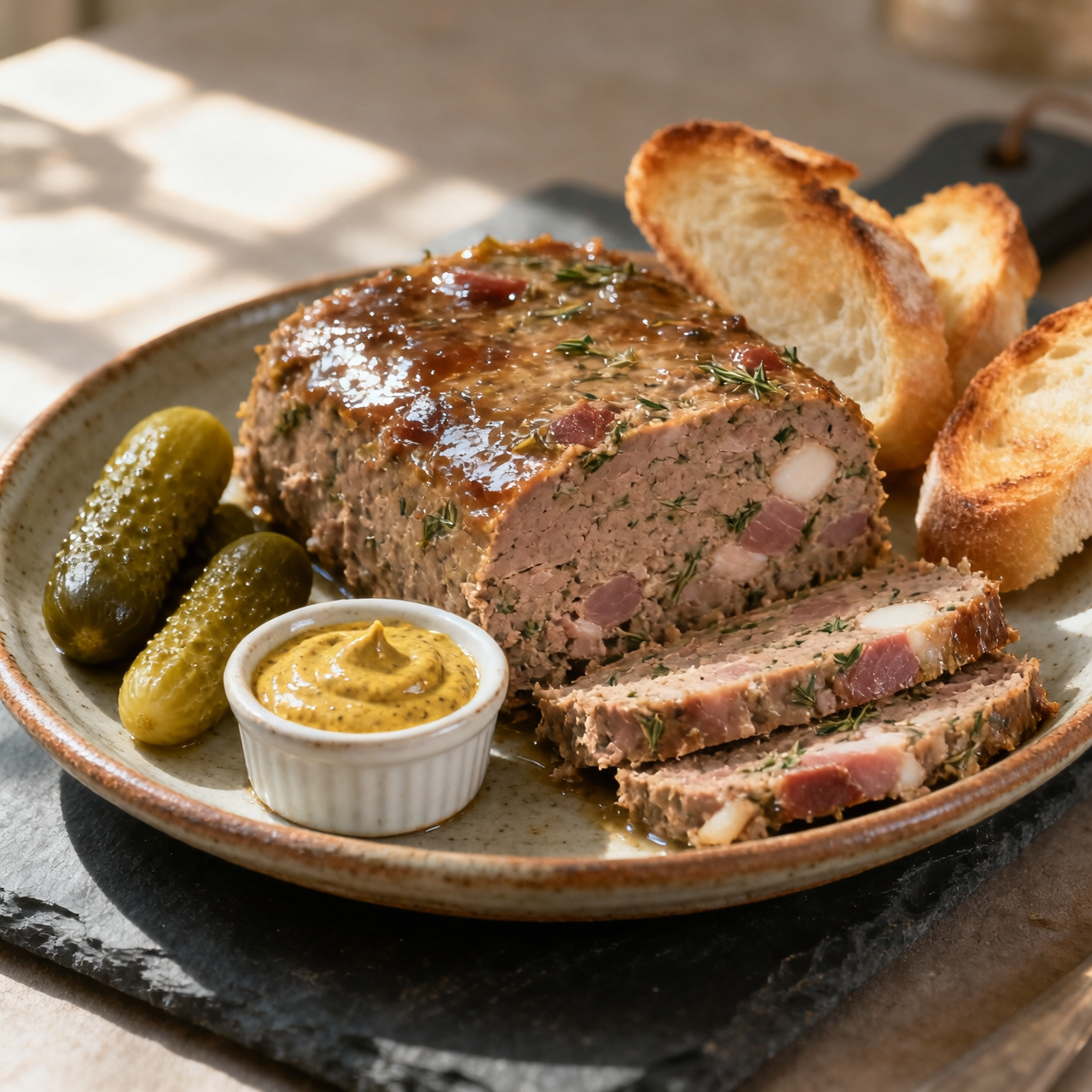
Pâté de campagne (country pâté)
I’ve always believed that true French country cooking begins with respect for the pig, and pâté de campagne is the quiet masterpiece that proves it. Long before it graced rustic charcuterie boards, this humble terrine was born in farmhouses across France as a practical, deeply flavorful way to preserve every cut of pork, from tender shoulder to rich liver, before winter set in. Making it from scratch isn’t just about avoiding the sterile, gelatin-heavy tubs you find at the supermarket—those usually run you around six pounds for barely eight ounces and rely on stabilizers, artificial smoke, and pre-cooked meats that mask poor sourcing. When you take the time to grind your own meat, gently poach a mirepoix in butter, and season by instinct, you unlock a texture that’s coarse, deeply savory, and impossibly rich. The biggest pitfalls I see home cooks stumble into are rushing the bind and overbaking the terrine. If you don’t chill the meat thoroughly before mixing, the fat will separate in the oven; if you push the internal temperature past seventy-five degrees, you’ll end up with a dry, crumbly brick instead of a sliceable, spreadable delight. I always wrap the tin tightly in foil and bake it low and slow in a water bath, letting residual heat finish the job. Once cooled under a gentle weight, it rests in the fridge for at least two days so the flavors marry properly. This isn’t a dish for shortcuts or powdered mixes; it’s a celebration of patience, real pork, and the kind of honest cooking that outlasts trends.
Nutrition
| Per serving | Calories | Protein | Carbs | Fat | Sat fat | Fibre | Sugar | Sodium |
|---|---|---|---|---|---|---|---|---|
| beginner | 350kcal | 22g | 3g | 28g | 10g | 1g | 1g | 820mg |
| intermediate | 385kcal | 24g | 3g | 29g | 10g | 1g | 1g | 740mg |
| expert | 350kcal | 20g | 3g | 28g | 11g | 0g | 1g | 620mg |
Per serving · Ava-estimated — a guide, not a clinical figure.
- 500 gPork shoulder— Partially frozen for easier grinding
- 200 gPork liver— Veins and membranes removed
- 200 gFatback— Partially frozen for easier grinding
- 2 pieceShallot— Finely minced
- 2 pieceGarlic clove— Minced to a paste
- 10 gFresh thyme— Leaves stripped from stems
- 2 pieceBay leaf— Ground or finely crumbled
- 2 gQuatre épices— Traditional French spice blend
- 12 gFine sea salt— Approximately 1.5 percent of total meat weight
- 2 gBlack pepper— Freshly cracked
- 30 mlCognac— Can substitute with brandy or dry white wine
- 1 pieceEgg— Large, lightly beaten
- 50 gStale baguette— Crust removed, soaked in milk
This beginner-friendly approach strips away the intimidating butchery and long curing times of traditional charcuterie, focusing instead on a reliable food-processor method that yields a rustic, sliceable loaf without sacrificing authenticity. Unlike shop-bought terrines, which typically cost £4–£6 and rely heavily on stabilizers, cheap fillers, and excessive sodium to mask low meat content, this from-scratch version lets you control the quality, texture, and seasoning while costing significantly less per portion. The key difference here is using a pulse technique to achieve the classic coarse grind rather than hand-mincing, paired with a simple water-bath bake that guarantees even cooking without drying out. Watch closely for the internal temperature—pulling it at exactly 75°C is the difference between a succulent, spreadable centre and a crumbly, overcooked brick. Once baked, the pâté must rest and chill thoroughly; skipping this step will cause it to fall apart when sliced. Serve it straight from the fridge with crusty bread, cornichons, and mustard for a classic French snack that keeps beautifully for a week or freezes perfectly in thick slices for later.
Equipment
- Food processor— sharp blades ensure clean cuts without turning meat to paste
- 9x5 inch loaf pan— metal or ceramic, lightly buttered
- Deep roasting tray— must comfortably fit the loaf pan for water bath
- Instant-read thermometer— calibrated for accuracy at lower meat temperatures
Method
- 1
Chill all pork shoulder, pork liver, and fatback until firm, then cut into uniform one-inch cubes.
Cold ingredients prevent the fat from smearing during processing.
chilling~ 5 min - 2
Pulse the cubed meat and fat in the processor until coarsely chopped, then fold in beaten eggs, fresh breadcrumbs, finely diced shallots, and herbs.
Stop pulsing as soon as the mixture resembles coarse ground meat to preserve the traditional rustic texture.
pulsing~ 3 min - 3
Pack the seasoned mixture firmly into the prepared loaf pan, pressing down continuously to eliminate trapped air.
A tight pack prevents the pâté from shrinking or cracking during the gentle bake.
tamping~ 2 minTricky bit - 4
Place the loaded pan into the deep roasting tray and carefully pour boiling water around it until the water reaches halfway up the pan sides.
This gentle bain-marie ensures the edges cook at the same rate as the dense centre.
bain-marie~ 4 minTricky bit - 5
Bake until an instant-read thermometer inserted into the thickest part reads exactly 75°C.
Carryover heat will add a few degrees; pulling it early prevents dryness.
temperature checking~ 80 minTricky bit - 6
Remove the pan from the water, place a sheet of parchment directly on the surface, cover with a lighter pan, and refrigerate overnight.
Chilling sets the natural gelatin and fat, guaranteeing clean, professional slices.
setting~ 720 min
Cooking from frozen
Thaw slices overnight in the fridge and serve at room temperature; reheating ruins the texture.
Storage times are a guide — always use your judgement and store food safely.