
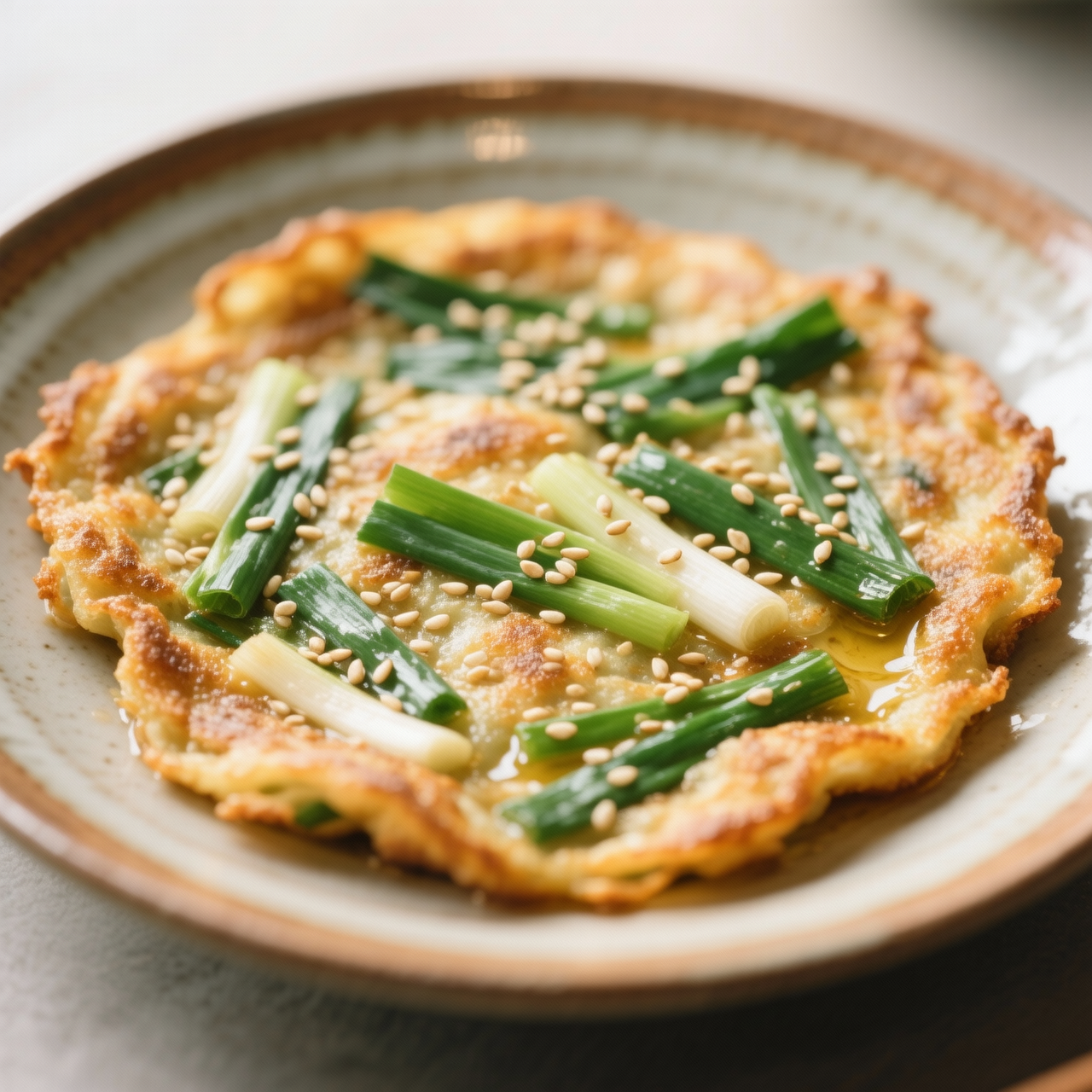
Pajeon (Scallion Pancake)
I’ve always believed that true Korean street food magic happens when you stop chasing perfection and start listening to the pan. Pajeon, or scallion pancake, began as a humble rainy-day dish in Korea, born from the practical need to use up abundant spring scallions and pantry staples before they spoiled. What matters most isn’t the exact batter ratio, but the rhythm of how you treat the ingredients. The real victory here is trading those four-pound frozen packs from the supermarket aisle for something alive and crackling. Those shop-bought discs are padded with stabilisers, heavy oils, and artificial umami pastes that leave you with a rubbery, greasy aftertaste and zero of that bright, grassy scallion punch. Making it from scratch means you control the crisp. The most common pitfall is overworking the batter; you only want a gentle stir, leaving small lumps so gluten doesn’t toughen the crumb. Another mistake is crowding the pan or flipping too early. Give the batter time to set into a golden lace before turning, and keep the heat steady at medium. I always rest the mixed batter for ten minutes so the flour hydrates evenly, which guarantees a tender interior against that shattering crust. Whether you fold in a handful of fresh prawns or keep it strictly pescatarian with just scallions and sesame, the secret is patience. Let the edges brown, press gently with a spatula, and serve it immediately with a sharp soy-dipping sauce. It’s not about complexity; it’s about letting simple ingredients do their work.
Nutrition
| Per serving | Calories | Protein | Carbs | Fat | Sat fat | Fibre | Sugar | Sodium |
|---|---|---|---|---|---|---|---|---|
| beginner | 285kcal | 9g | 36g | 10g | 2g | 2g | 1g | 440mg |
| intermediate | 330kcal | 9g | 46g | 12g | 1g | 2g | 1g | 460mg |
| expert | 245kcal | 10g | 28g | 11g | 2g | 3g | 3g | 450mg |
Per serving · Ava-estimated — a guide, not a clinical figure.
- 150 gAll-purpose flour— Sifted for a lighter batter
- 200 mlIce water— Keeps the batter cold for crispier results
- 200 gScallion— Trimmed and cut into 7 cm lengths
- 1 largeEgg— Lightly beaten before mixing into batter
- 3 gSea salt— Divided between batter and seasoning scallions
- 100 gMedium shrimp(optional)— Peeled, deveined, and halved lengthwise
- 45 mlVegetable oil— Neutral high-heat oil for pan-frying
While frozen supermarket pajeon costs around £4 for two and arrives soggy, overly salty, and packed with stabilizers that dull the fresh scallion bite, this from-scratch beginner version uses simple pantry staples to deliver a reliably crisp, savoury pancake with zero shortcuts. The technique focuses on a forgiving, low-stress approach: mix a loose, easily pourable batter using standard flour and cold water, ensuring the scallions stay bright rather than wilting prematurely. Watch your pan temperature closely—medium heat is essential, as too low will steam the dough into a rubbery disc, while too high scorches the exterior before the interior sets. The batter should coat a spoon lightly; if it resists, whisk in a tablespoon of cold water. When frying, pour a thin, even layer into well-oiled cookware, press the edges down gently with a spatula, and wait patiently for a deep golden crust to form. Only flip once the pancake releases cleanly from the surface. This straightforward method removes the intimidation factor, guaranteeing a satisfying crunch and tender interior on your very first try without demanding professional timing or specialised gear.
Equipment
- Heavy-bottomed skillet— 10 to 12 inch diameter provides ideal surface area
- Silicone spatula— flexible thin edge helps with clean flipping
- Mixing bowl— medium capacity for comfortable whisking
Method
- 1
Whisk all-purpose flour, rice flour, cold water, and a pinch of salt in a bowl until the batter is completely smooth and lump-free.
Cold water keeps gluten development low for a tender bite.
whisking~ 2 min - 2
Fold trimmed scallion segments and optional diced squid or shrimp gently into the batter until evenly distributed.
Do not overmix, or the vegetables will bruise and leak water.
folding~ 2 min - 3
Heat a generous layer of neutral oil in a heavy skillet over medium heat until it shimmers and lightly ripples.
Test with a single scallion piece; it should sizzle immediately.
tempering~ 2 minTricky bit - 4
Pour the batter into the hot oil and immediately spread it into a thin, uniform circle using a spatula.
A thinner pancake guarantees a crispier crust.
spreading~ 1 min - 5
Cook undisturbed until the edges turn deep golden and the bottom releases cleanly from the pan.
Patience here prevents tearing and ensures proper structure.
searing~ 4 minTricky bit - 6
Slide a wide spatula underneath, support the top with your hand or a second spatula, and flip confidently.
Quick, decisive movements keep the pancake intact.
flipping~ 0 minTricky bit - 7
Press the edges down gently, cook until the second side is equally crisp, then transfer to a wire rack to rest before slicing.
Resting preserves the crunch while the interior sets.
resting~ 2 min
Cooking from frozen
Reheat directly in a dry skillet over medium heat until crisp; avoid microwaving to prevent sogginess.
Storage times are a guide — always use your judgement and store food safely.