
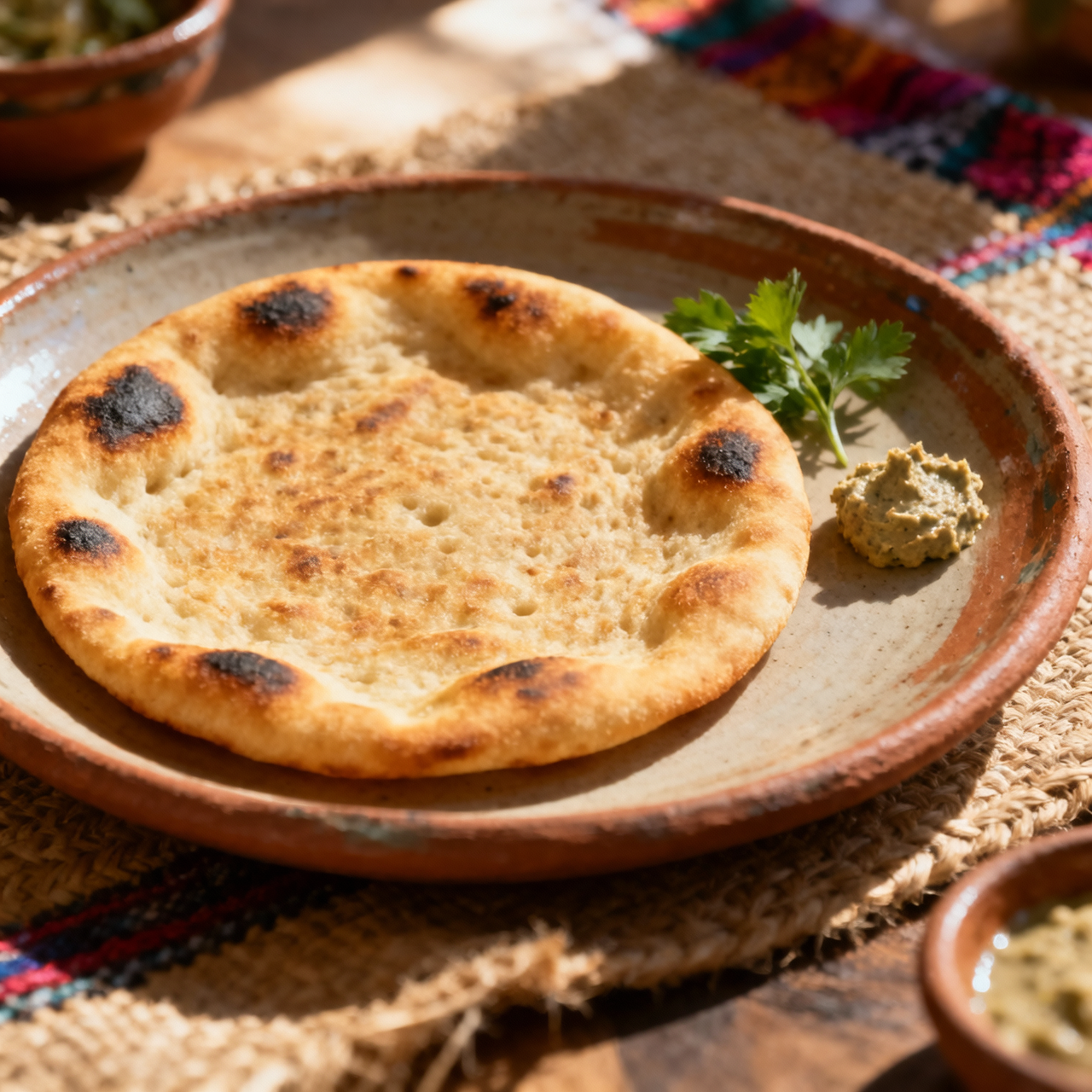
Pan Chapla (Andean Flatbread)
I first encountered Pan Chapla in the high Andes of Peru, where it’s been baked on clay griddles for generations. This rustic, vegan flatbread is a beautiful, dense counterpart to the airy breads we often take for granted, traditionally made with simple wheat flour, water, salt, and often flavored with a hint of anise. When you buy a standard supermarket loaf, you’re paying around three to four dollars for a highly processed sponge filled with dough conditioners, preservatives, and emulsifiers that leave you feeling bloated and unsatisfied. Making Pan Chapla entirely from scratch reclaims that daily staple. You control every ingredient, achieving a deeply satisfying, chewy crumb and a beautifully blistered crust without a single artificial additive. The most common pitfall when making this griddle bread is rushing the dough or using a pan that isn't sufficiently hot. The dough needs a generous rest to relax the gluten, and the griddle must be properly preheated to create those signature charred spots without drying out the interior. It matters because mastering this simple technique frees you from the commercial bread aisle entirely. Once you taste the nutty, slightly sweet depth of a freshly baked Chapla, you will never look at a plastic-wrapped shop loaf the same way again. It’s not just a side dish; it’s a return to real, honest baking, proving that the best everyday foods are the ones we make ourselves.
Nutrition
| Per serving | Calories | Protein | Carbs | Fat | Sat fat | Fibre | Sugar | Sodium |
|---|---|---|---|---|---|---|---|---|
| beginner | 480kcal | 12g | 85g | 8g | 1g | 5g | 4g | 750mg |
| intermediate | 250kcal | 7g | 45g | 4g | 1g | 3g | 1g | 480mg |
| expert | 240kcal | 8g | 44g | 3g | 1g | 3g | 1g | 380mg |
Per serving · Ava-estimated — a guide, not a clinical figure.
- 500 gwheat flour— plus extra for dusting
- 300 mlwater— lukewarm
- 7 gactive dry yeast
- 10 gsalt— fine sea salt
- 15 mlvegetable oil— plus extra for greasing the griddle
Shop-bought rustic loaves often cost upwards of $7 and are frequently pumped with dough conditioners, preservatives, and artificial crust enhancers, only to go stale within hours. Pan Chapla is a fresh, rustic Andean griddle bread that perfectly replaces these shop loaves with a superior, authentic crumb. This beginner version simplifies the traditional hot-stone baking process into a forgiving stovetop griddle method, skipping complex pre-ferments while keeping the signature corn-wheat texture. Because it uses simple, real ingredients, the technique is straightforward: mix, rest, shape, and cook. Watch for dough hydration closely; cornmeal absorbs water more slowly than wheat flour, so allow the initial dough to rest for ten minutes before judging its stickiness. If it feels too dry after resting, add water a teaspoon at a time. The griddle heat must be medium-low to ensure the thick flatbreads cook through without burning the exterior, yielding a beautifully blistered, flexible bread. This approach guarantees a wholesome, additive-free staple that tastes infinitely better than anything wrapped in plastic.
Equipment
- Heavy-bottomed pan— Cast iron or thick steel works best for even heat distribution.
- Large mixing bowl— Wide enough to allow vigorous kneading if needed.
Method
- 1
Dissolve the sugar in warm water, sprinkle the yeast over the top, and let it sit until foamy.
Water should be around 105°F (40°C) to avoid killing the yeast.
blooming~ 5 min - 2
Whisk the wheat flour, fine cornmeal, and salt together in a large mixing bowl.
Ensure the cornmeal is finely ground for the best texture.
mixing~ 1 min - 3
Pour the yeast mixture and oil into the dry ingredients, stirring until a shaggy dough forms.
Use a wooden spoon to incorporate all the dry bits.
mixing~ 2 min - 4
Turn the dough onto a lightly floured surface and knead until smooth and elastic.
Add a dusting of flour only if it is excessively sticky.
kneading~ 8 minTricky bit - 5
Place the dough in a lightly oiled bowl, cover with a damp cloth, and let it rest until slightly puffed.
A warm, draft-free spot speeds up this resting phase.
proofing~ 20 min - 6
Punch down the dough, divide it into equal portions, and roll each piece into a smooth ball.
Keep the unused dough covered to prevent a dry skin from forming.
dividing~ 3 min - 7
Flatten each ball into a thick disc, about half an inch thick, using your hands or a rolling pin.
Prick the center of each disc with a fork to prevent excessive puffing.
shaping~ 5 min - 8
Heat the heavy-bottomed pan over medium-low heat and cook each flatbread until deeply blistered and browned on both sides.
Adjust the heat if the bread is browning before the center is cooked.
griddle_baking~ 15 minTricky bit
Cooking from frozen
Thaw at room temperature and refresh on a hot dry griddle for a minute per side.
Storage times are a guide — always use your judgement and store food safely.