
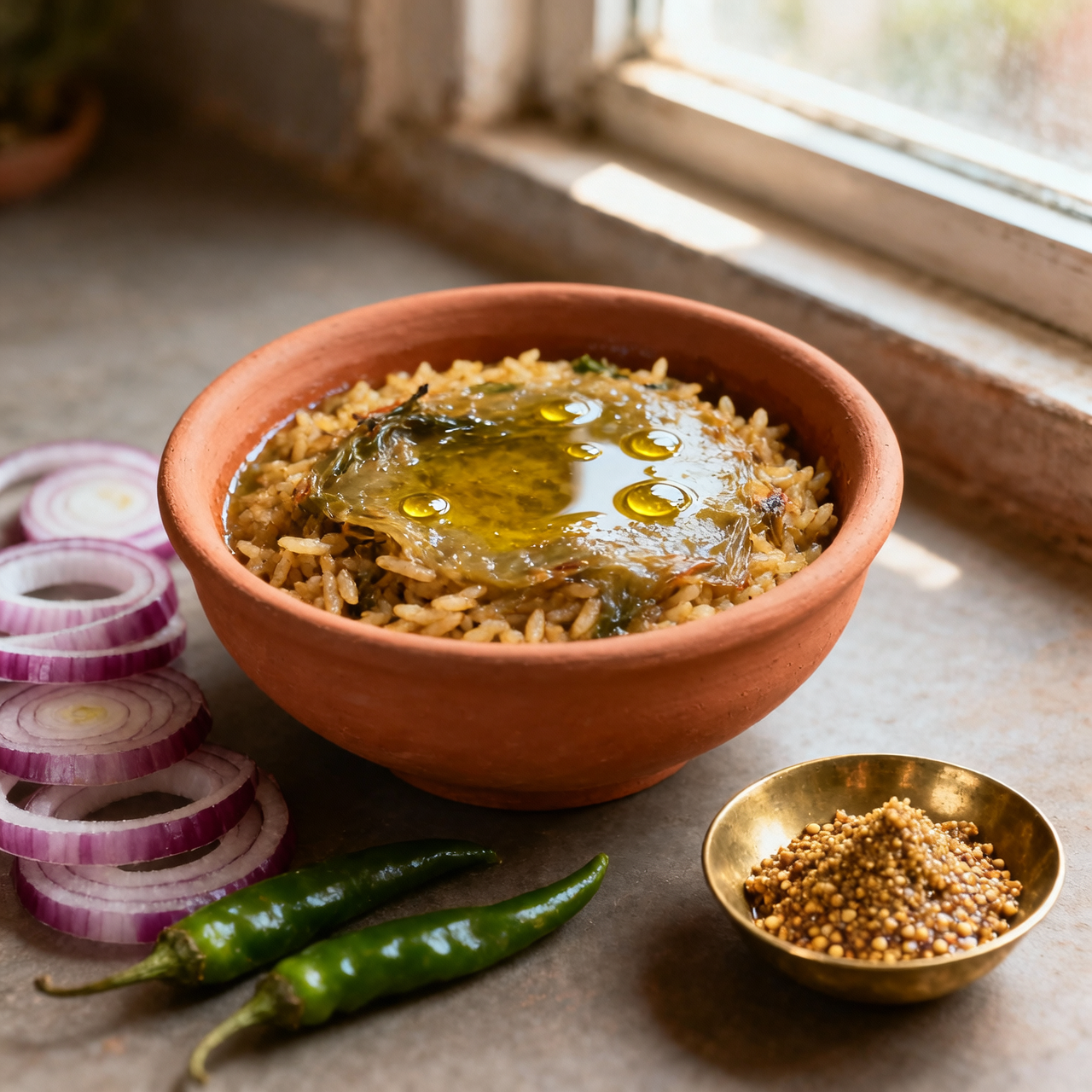
Panta Bhat
I first encountered Panta Bhat not as a mere breakfast dish, but as a quiet testament to survival and resourcefulness in rural Bangladesh. Born from the simple necessity of preserving leftover rice by soaking it overnight, this fermented staple has weathered centuries of monsoons, harvests, and shifting seasons. When I prepare it now, I am not just mixing water with cooked rice; I am participating in a lineage of frugality that refuses to let nourishment go to waste. What makes Panta Bhat so profoundly meaningful is its unpretentious honesty. It requires no fire at the moment of eating, only patience and the gentle alchemy of time. The fermentation softens the grains, unlocks subtle tangy notes, and transforms yesterday dinner into tomorrow cooling comfort, especially vital during the sweltering Bengali summers. Yet, for all its simplicity, I have watched many stumble at the very first step. The most common pitfall lies in rushing the soak or using water that is too warm, which invites unwanted bacteria instead of the gentle lactic fermentation we seek. Others mistakenly believe the dish needs heavy seasoning or dairy to be satisfying, completely missing the point that its beauty lies in restraint. A proper Panta Bhat should be light, slightly effervescent, and paired with nothing more aggressive than raw onions, green chilies, and a drizzle of mustard oil. I always remind myself that the magic happens in the waiting. When you rush it, you lose the soul of the dish. Let it rest in a cool, shaded corner of your kitchen, and trust the quiet transformation. It is a humble breakfast that teaches us how to honor leftovers, respect time, and find abundance in simplicity.
Nutrition
| Per serving | Calories | Protein | Carbs | Fat | Sat fat | Fibre | Sugar | Sodium |
|---|---|---|---|---|---|---|---|---|
| beginner | 180kcal | 3g | 25g | 8g | 1g | 1g | 2g | 540mg |
| intermediate | 180kcal | 3g | 25g | 8g | 1g | 1g | 2g | 540mg |
| expert | 180kcal | 3g | 25g | 8g | 1g | 1g | 2g | 540mg |
Per serving · Ava-estimated — a guide, not a clinical figure.
- 300 gcooked short-grain rice— cooled to room temperature, not frozen
- 500 mlfiltered water— room temperature, chlorine-free
- 5 gsea salt— fine grain, non-iodized preferred
- 30 mlmustard oil— cold-pressed, pungent grade
- 45 gmustard paste— finely ground, yellow or black mustard
- 120 gred onion— firm, thinly sliced
- 4 piecesgreen chilies— fresh, slit lengthwise
This version prioritizes accessibility and confidence. By utilizing a high-quality jarred mustard paste and pre-measured mustard oil, you bypass the most intimidating preparation steps while still capturing the dish’s essential character. The primary focus here is managing the hydration and soak. Watch closely for the moment the rice grains soften and the water becomes slightly cloudy; this visual cue indicates the starches have begun their gentle breakdown. Avoid over-stirring during the initial soak, as excessive agitation can break the grains into a mushy paste rather than preserving their individual texture. Since commercial pastes often contain thickeners or wheat-based stabilizers, verify your label if you require strict gluten avoidance. Keep the resting vessel in a consistently cool spot to prevent rapid, unpredictable souring. When combining your components, fold them gently to distribute the condiments evenly without crushing the softened rice. Taste before adding extra salt, as jarred preparations frequently carry hidden sodium. This streamlined approach guarantees a reliable, comforting result on your very first attempt, proving that simplicity and tradition can comfortably coexist.
Equipment
- Large glass mixing bowl— transparent walls help monitor water absorption
- Clean kitchen towel— breathable cotton for loose covering
Method
- 1
Combine the cooked rice, filtered water, and sea salt in a large glass bowl.
Water should just cover the rice surface.
hydration~ 1 min - 2
Cover the bowl loosely with a clean kitchen towel and let it rest at room temperature.
Do not seal airtight to allow gas escape.
soaking~ 480 minTricky bit - 3
Drain any excess standing water and gently fold in the jarred mustard paste and mustard oil.
Use a silicone spatula to prevent grain breakage.
folding~ 2 min - 4
Plate the soaked rice and arrange sliced onion and slit green chilies on top.
Serve immediately at cool room temperature.
garnishing~ 1 min