
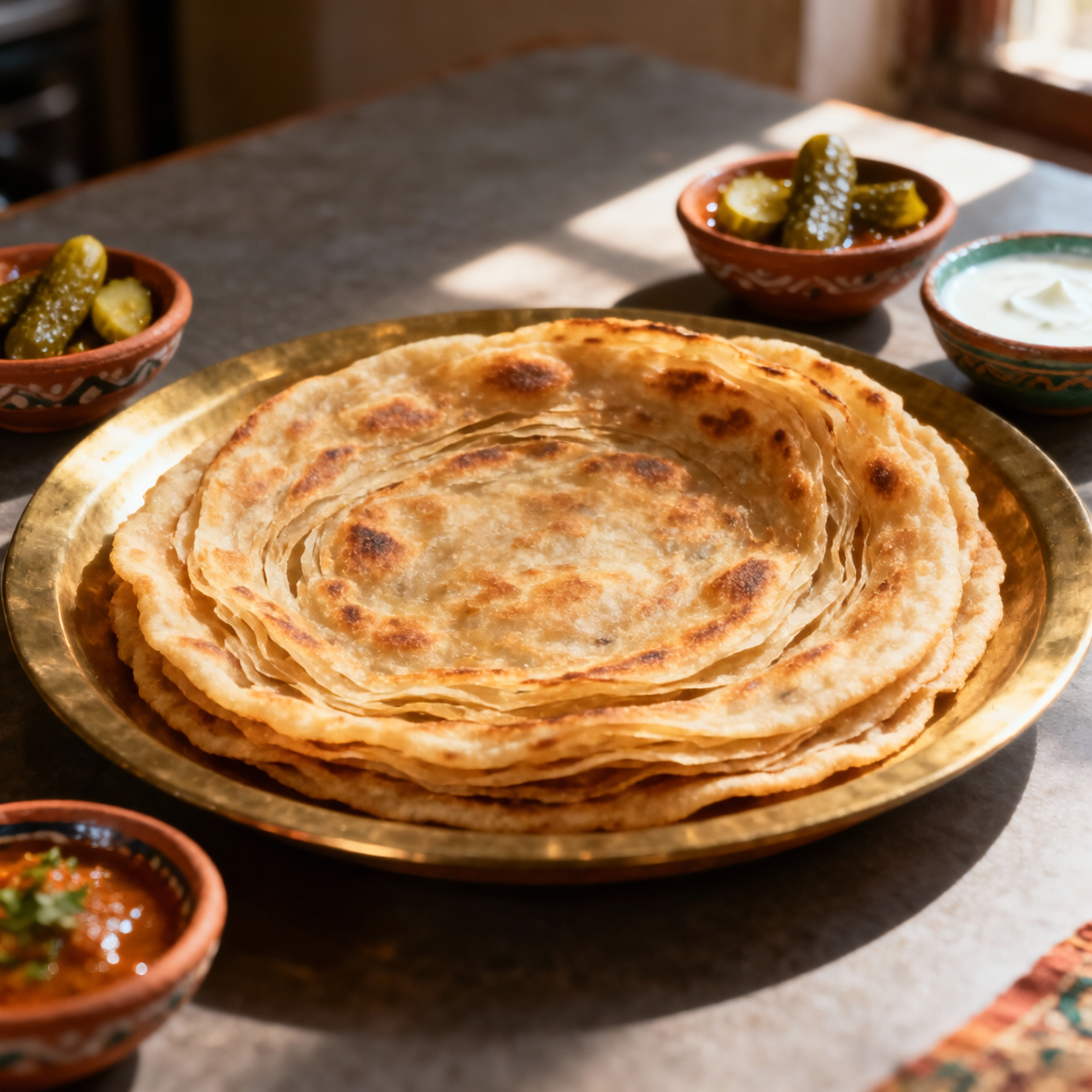
Paratha
I’ve always believed that the best breakfasts are born from patience, and nothing proves that quite like a proper paratha. Originating in the Punjab region, this layered flatbread has been a staple across South Asia for centuries, traditionally cooked over an open flame to coax out a crisp, buttery exterior while keeping the interior tender and flaky. In my kitchen, making it from scratch isn’t just about tradition; it’s a quiet rebellion against the sterile, shelf-stable versions that now line supermarket aisles. Those pre-packaged parathas cost roughly a pound or two for a pack of four, but they’re loaded with hydrogenated oils, preservatives, and artificial dough conditioners that leave them tasting like cardboard wrapped in wax paper. When you make it yourself, you’re trading chemical shortcuts for flour, water, a pinch of salt, and ghee—ingredients you actually recognize. The real secret lies in the lamination. Too many home cooks skip the resting phase or roll the dough too aggressively, which shatters the gluten network and turns your carefully folded layers into dense, chewy discs. You need a soft, pliable dough, generous but measured fat between the folds, and a hot, dry tawa to coax out that signature blistered surface. It’s a rhythmic process: fold, rest, roll, cook, brush. Once you get the cadence down, you’ll see why generations have treated it as a daily ritual. This isn’t a quick fix; it’s a craft. And when you bite into a warm, golden paratha made entirely by hand, the difference is immediate. It’s food that breathes, flakes, and actually tastes like what it’s supposed to be.
Nutrition
| Per serving | Calories | Protein | Carbs | Fat | Sat fat | Fibre | Sugar | Sodium |
|---|---|---|---|---|---|---|---|---|
| beginner | 280kcal | 8g | 42g | 9g | 4g | 5g | 0g | 160mg |
| intermediate | 380kcal | 7g | 42g | 18g | 10g | 6g | 0g | 480mg |
| expert | 340kcal | 8g | 44g | 14g | 6g | 3g | 0g | 260mg |
Per serving · Ava-estimated — a guide, not a clinical figure.
- 240 gwhole wheat flour— Finely milled Indian atta preferred
- 120 mlwater— Room temperature
- 5 gsalt
- 30 gghee— Clarified butter, divided for dough and cooking
- 15 mlvegetable oil— For dusting rolling surface and pan
This beginner-friendly paratha recipe strips away the intimidation of laminated dough while keeping every ingredient completely from scratch. Store-bought frozen parathas typically cost nearly a dollar each but rely heavily on refined palm oils, chemical preservatives, and industrial dough conditioners that leave the layers tough and the flavor distinctly flat. Here, you will build flaky, tender flatbreads using just whole wheat flour, water, a pinch of salt, and pure ghee. Instead of chasing perfect origami folds, we use a straightforward spiral method: roll the dough into a thin circle, brush it generously with fat, roll it into a tight rope, and coil it into a neat bun. Resting the dough fully relaxes the gluten, making it incredibly forgiving to roll out without springing back. Watch your pan temperature closely; steady medium heat is the sweet spot. Too hot and the outside scorches before the inside cooks through; too low and the bread turns leathery. You will know it is ready when golden-brown blisters appear and the layers visibly separate. These freeze beautifully stacked with parchment, delivering a wholesome breakfast anytime.
Equipment
- Heavy-bottomed pan— non-stick or cast iron works well
- Rolling pin— standard wooden or metal
- Pastry brush(optional)— silicone or natural bristle
Method
- 1
Combine whole wheat flour and salt in a large bowl, then gradually add warm water while mixing with a fork until a shaggy dough forms.
Add water slowly; whole wheat absorbs moisture differently depending on humidity.
kneading~ 5 min - 2
Turn the dough onto a clean surface and knead firmly for five minutes until it becomes smooth and springs back when poked.
A well-developed dough prevents tearing during the rolling stage.
gluten development~ 5 min - 3
Cover the dough tightly with a damp cloth and let it rest at room temperature for thirty minutes.
Resting relaxes the gluten strands so the dough rolls out without fighting back.
resting~ 30 min - 4
Divide the dough into four equal balls, roll each into a six-inch circle, and brush the entire surface lightly with melted ghee.
Even fat distribution is the key to visible flaky layers later.
laminating~ 4 min - 5
Roll each oiled circle tightly into a long rope, then spiral the rope into a tight disc and flatten it gently.
Keep the coil snug so the layers stay distinct during cooking.
coiling~ 2 min - 6
Roll each coiled disc back out into a flat circle roughly eight inches wide, applying gentle, even pressure from the center outward.
Dust lightly with flour if sticking, but avoid heavy coating which dries out the bread.
rolling~ 3 min - 7
Place the flatbread onto a preheated heavy pan over medium heat and cook until the bottom shows light brown spots.
Flip only once the edges begin to dry slightly.
dry-roasting~ 2 minTricky bit - 8
Flip the paratha, cook the second side for another minute, press gently with a spatula to puff the layers, then remove to a rack.
Pressing traps steam inside, forcing the laminated sheets to separate and crisp.
steaming~ 2 min
Cooking from frozen
Thaw at room temperature for 15 minutes, then crisp in a dry skillet or toaster oven over medium heat until the layers puff and the edges brown.
Storage times are a guide — always use your judgement and store food safely.