
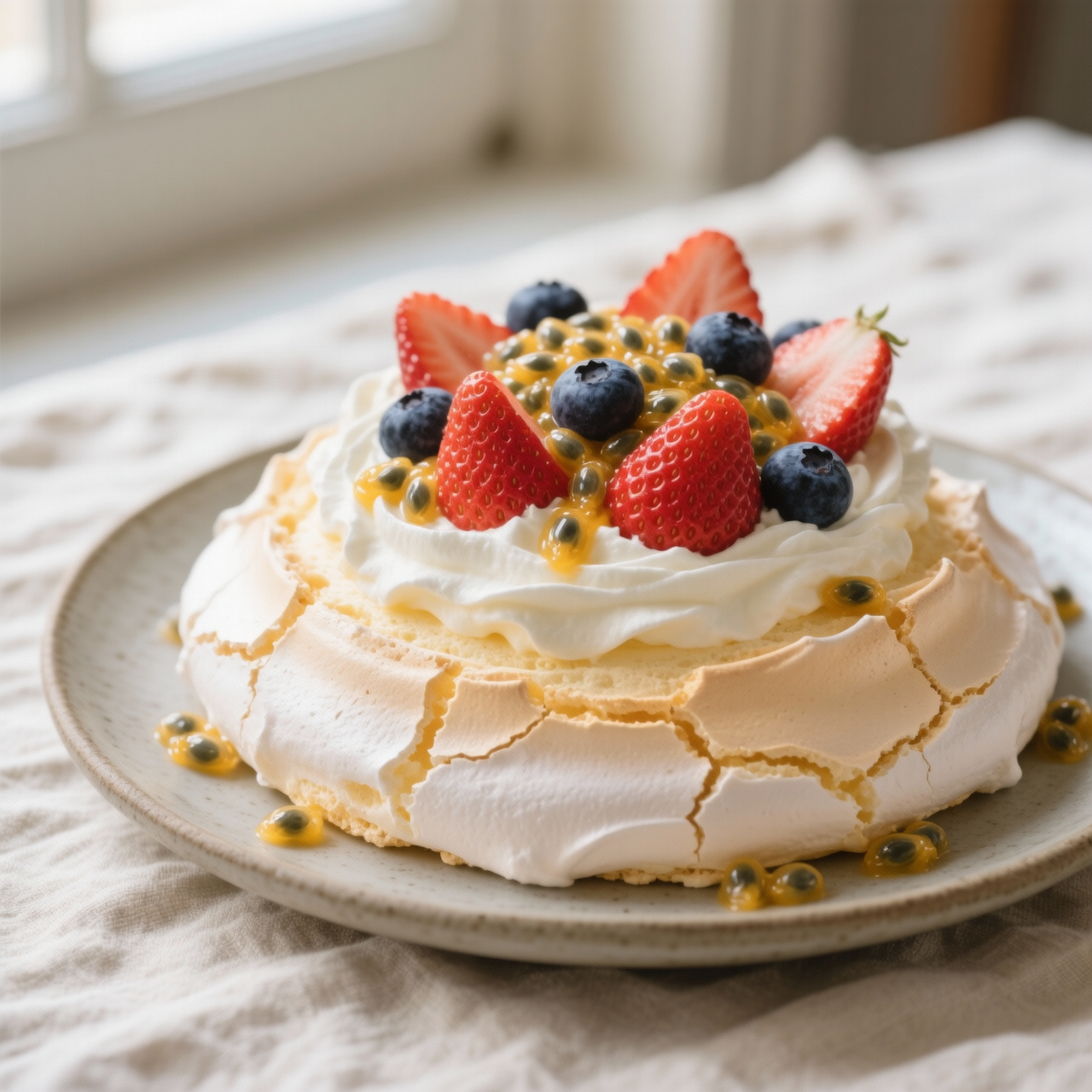
Pavlova
When I first cracked into a pavlova, I was immediately struck by its deceptive simplicity. It is a dessert that feels like a quiet argument between two nations, with both Australia and New Zealand fiercely claiming its origin in the 1920s, supposedly named after the Russian ballerina Anna Pavlova. That historical tug-of-war only adds to its charm, because regardless of who baked it first, it has become an undeniable symbol of summer gatherings, backyard barbecues, and the shared joy of a perfectly executed sweet. To me, it matters precisely because it demands patience and precision in a culinary world that often rewards speed. The magic lies in the meringue shell: crisp enough to shatter at the touch, yet yielding to a soft, marshmallow-like interior that cradles whipped cream and seasonal fruit. Yet, so many home bakers stumble at the first hurdle. The most common pitfall is rushing the process. You cannot skip the gradual incorporation of sugar, nor can you ignore the low-and-slow bake followed by a complete cool-down inside the turned-off oven. Even a drop of grease or a trace of yolk in the egg whites will sabotage the entire structure. Humidity is another silent enemy, turning a proud dome into a weeping mess. But when you respect the chemistry, you are rewarded with a dessert that looks as delicate as it tastes. It is not just a recipe; it is a lesson in restraint, a celebration of texture, and a reminder that some of life finest things require time to properly set. I have spent years perfecting the technique, learning that true mastery comes not from complex ingredients, but from honoring the quiet science of sugar and air.
Nutrition
| Per serving | Calories | Protein | Carbs | Fat | Sat fat | Fibre | Sugar | Sodium |
|---|---|---|---|---|---|---|---|---|
| beginner | 360kcal | 4g | 43g | 19g | 12g | 2g | 39g | 46mg |
| intermediate | 360kcal | 4g | 43g | 19g | 12g | 2g | 39g | 46mg |
| expert | 270kcal | 3g | 32g | 14g | 9g | 1g | 29g | 34mg |
Per serving · Ava-estimated — a guide, not a clinical figure.
- 120 gegg white— room temperature, completely free of yolk
- 200 gcaster sugar— superfine, divided into two equal portions
- 10 gcornflour— sifted to remove lumps
- 10 mlwhite wine vinegar— acid stabilizes the foam
- 5 mlvanilla bean paste— use pure extract or scraped pod if preferred
- 300 mldouble cream— well chilled
- 150 gstrawberry— hulled and halved
- 100 gblueberry— fresh and dry
- 2 wholepassionfruit— halved, pulp reserved
This version is engineered for absolute confidence, stripping away the intimidation factor while preserving the iconic texture. We rely on a reliable jarred vanilla paste and pre-sifted cornflour to eliminate measurement guesswork, and we use a visual cue system rather than strict timer reliance for the whipping stage. The meringue is built in a single bowl with a standard electric hand mixer, guiding you through soft peaks to glossy stiffness without risking overbeating. Baking happens at a steady, forgiving temperature, and I strongly recommend using a silicone baking mat to prevent sticking. Watch for the telltale signs of a stable foam: the mixture should hold sharp peaks when the beaters are lifted, and the sugar must feel completely smooth between your fingers. Do not rush the cooling phase; the oven door stays shut until the interior temperature drops naturally, which prevents the dreaded cracking. This approach guarantees a crisp exterior and a tender, marshmallow-like center on your very first try.
Equipment
- mixing bowl— glass or ceramic works best
- electric hand mixer— standard beaters included
- baking tray— lined with silicone mat or parchment
Method
- 1
Preheat the oven to 120 degrees Celsius and line a baking sheet with parchment paper.
Oven must be fully stabilized before mixing begins.
preheating~ 10 min - 2
Whip room-temperature egg whites in a clean bowl until frothy peaks form.
Ensure zero grease or yolk traces remain in the bowl.
aerating~ 2 minTricky bit - 3
Gradually add half the caster sugar one tablespoon at a time while mixing continuously.
Add slowly to prevent graininess in the foam.
creaming~ 5 minTricky bit - 4
Fold in the remaining sugar, cornflour, vinegar, and vanilla paste until completely uniform.
Stop mixing the moment no white streaks remain.
folding~ 1 min - 5
Spoon the mixture onto the prepared tray and shape a twenty-centimeter disc with raised edges.
A spatula dipped in warm water smooths the surface easily.
shaping~ 3 min - 6
Bake for seventy-five minutes, then turn off the heat and leave the door closed for one hour.
Never open the oven door during the cooling period.
carryover cooking~ 90 minTricky bit