
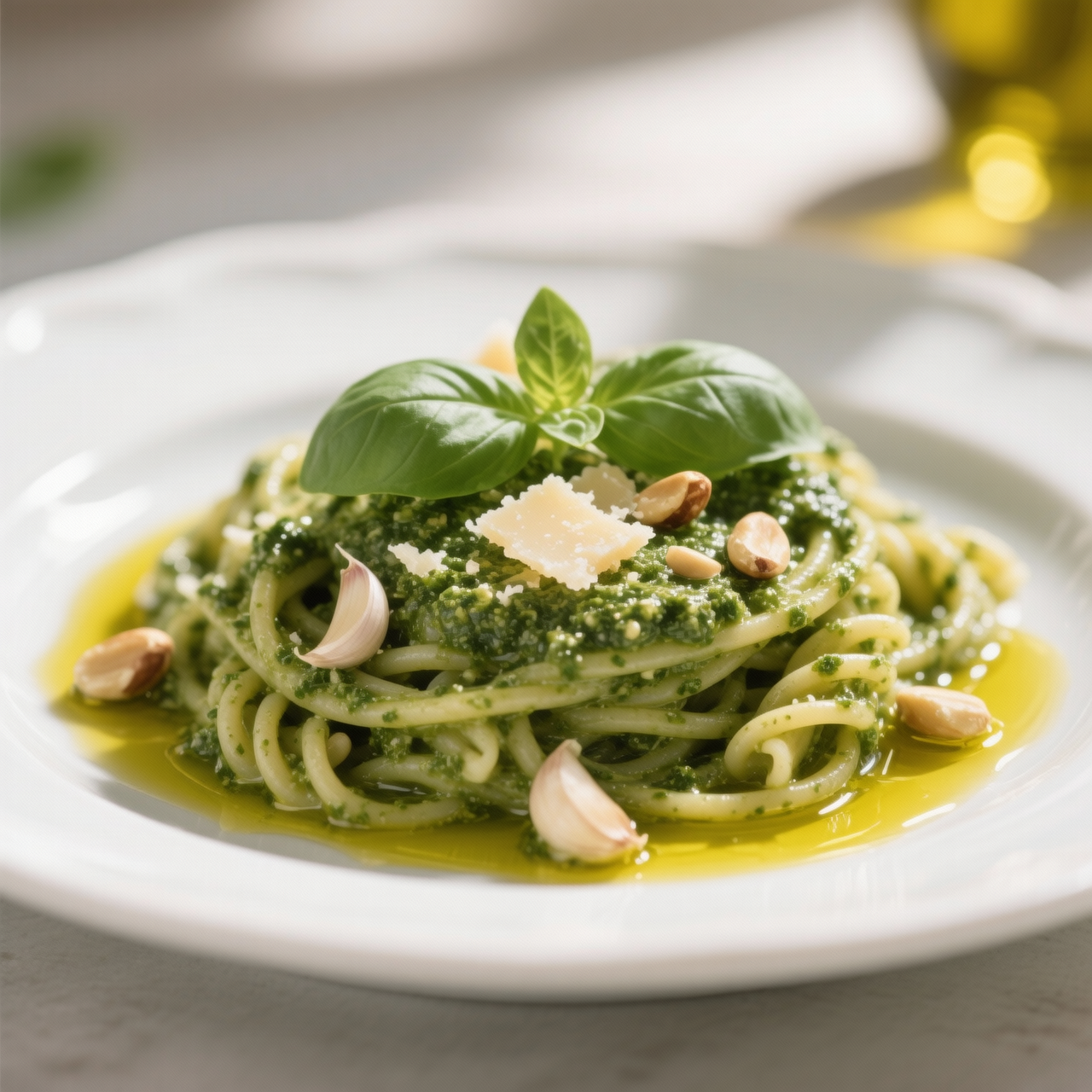
Pesto genovese
When I first learned to make pesto genovese, I quickly realized it’s less of a recipe and more of a meditation on patience and provenance. Born in the sun-baked hills of Liguria, this emerald sauce was traditionally crafted in a heavy marble mortar with a slow, circular motion that gently coaxes the oils from young Genovese basil without bruising the leaves into bitterness. That rhythm matters. In our rush to modernize, we often toss everything into a high-speed food processor, but the violent friction heats the basil, oxidizes the olive oil, and leaves you with a dull, metallic paste instead of a vibrant condiment. The true magic lies in restraint: toasting pine nuts just until fragrant, balancing sharp Parmigiano-Reggiano with a touch of Pecorino Sardo, and folding in extra-virgin olive oil only after the garlic and nuts have been crushed into a rough emulsion. Too much garlic will dominate, and cheap oil will mask the delicate floral notes of the basil. I always remind myself that pesto isn’t meant to be cooked; it’s a raw, living sauce that should be stirred into hot pasta off the heat, using a splash of starchy cooking water to coax it into a silky coating. When done right, it tastes exactly like a Ligurian coastal breeze. When rushed, it’s just green sludge. Respect the ingredients, keep your tools cool, and let the mortar do the heavy lifting. The difference between a decent condiment and a transcendent one is measured in seconds, not degrees.
Nutrition
| Per serving | Calories | Protein | Carbs | Fat | Sat fat | Fibre | Sugar | Sodium |
|---|---|---|---|---|---|---|---|---|
| beginner | 260kcal | 5g | 3g | 24g | 4g | 1g | 1g | 320mg |
| intermediate | 190kcal | 5g | 3g | 18g | 5g | 1g | 1g | 260mg |
| expert | 340kcal | 6g | 3g | 34g | 6g | 1g | 1g | 380mg |
Per serving · Ava-estimated — a guide, not a clinical figure.
- 60 gfresh basil leaf— Genovese variety preferred, washed and completely dried
- 30 gpine nut— lightly toasted
- 5 ggarlic clove— peeled
- 50 gParmigiano-Reggiano— freshly grated
- 100 mlextra virgin olive oil— cold-pressed
- 3 gcoarse sea salt— to taste
This beginner-friendly approach swaps the traditional mortar and pestle for a modern food processor or high-speed blender, dramatically cutting down prep time while still delivering a vibrant, fresh flavor. The key difference at this level is prioritizing consistency and ease over artisanal grinding techniques. You will rely on quick machine pulses rather than slow manual grinding, and the cheese is added late to prevent over-processing into a gummy paste. Watch the oil stream carefully as you blend; pouring it in a slow, steady ribbon while the blades run creates a smooth, stable emulsion rather than a separated, greasy mess. Keep your basil leaves completely dry before adding them to the bowl, as even a drop of water will cause the pesto to oxidize and turn dull brown quickly. If the mixture looks too thick or clumpy while blending, simply drizzle in an extra tablespoon of olive oil and pulse again until glossy. This version is designed for confident first attempts, yielding a bright condiment that freezes beautifully in standard ice-cube trays for quick weeknight pasta tosses.
Equipment
- Food processor— standard size works best; pulse carefully
- Small dry skillet— for quick pine nut toasting
- Silicone spatula— flexible tip for scraping bowl sides
- Silicone ice cube tray(optional)— makes freezer portions easy to pop out
Method
- 1
Pat the fresh basil leaves completely dry with clean paper towels.
Any residual moisture will cause rapid oxidation and break the emulsion.
drying~ 1 min - 2
Toast the pine nuts in a dry skillet over medium heat until golden and fragrant.
Stir constantly; they transition from perfect to burnt in seconds.
toasting~ 2 minTricky bit - 3
Combine the toasted pine nuts, garlic cloves, and coarse salt in the food processor bowl.
Use short pulses to avoid turning the mixture into a smooth paste.
pulsing~ 1 min - 4
Add the dried basil leaves and pulse in quick bursts until the foliage is coarsely chopped.
Stop the machine immediately once the leaves break down to prevent heat buildup.
pulsing~ 1 min - 5
With the processor running on low, slowly stream in the olive oil, then fold in the grated parmesan and pulse to combine.
The slow oil stream is critical for forming a stable, glossy emulsion.
emulsifying~ 1 minTricky bit
Cooking from frozen
Thaw in the fridge overnight or drop a cube directly into hot pasta with a splash of cooking water to melt and emulsify.
Storage times are a guide — always use your judgement and store food safely.