
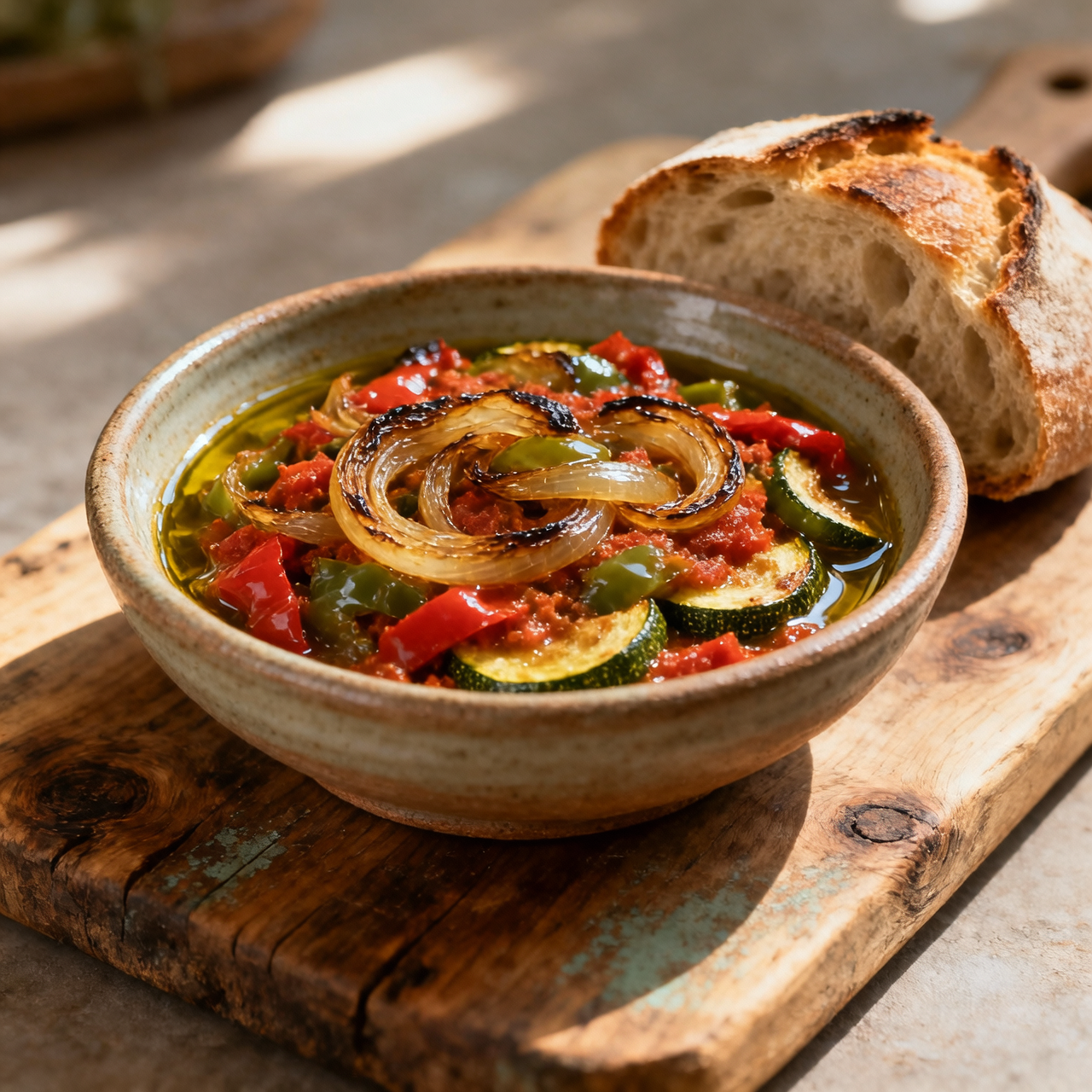
Pisto Manchego
When I first learned to make Pisto Manchego, I quickly realized it was never meant to be a complicated affair. Born in the sun-baked plains of Castilla-La Mancha, this rustic stew shares a humble lineage with ratatouille and shakshuka, yet it carries the distinct, earthy heartbeat of central Spain. I have always cherished it because it transforms the most basic summer harvest into something deeply nourishing without demanding a single animal product. In my kitchen, it stands as a quiet testament to how simplicity, when respected, can outshine extravagance. What matters most to me about this dish is its patience. It refuses to be rushed. I have seen countless home cooks fall into the same trap of cranking the heat to speed up the sauté, only to end up with scorched edges and a raw, acidic undertone. The true magic happens over a gentle flame, allowing the vegetables to slowly surrender their moisture and concentrate their natural sugars. Another frequent misstep I warn against is overcrowding the pan, which steams the ingredients rather than coaxing out that essential caramelized depth. If you want the authentic experience, peel your tomatoes after a quick blanch, slice your peppers into uniform strips, and let the olive oil work as a slow conductor rather than a quick fry. When you finally stir in a pinch of smoked paprika and a handful of fresh basil, the kitchen fills with a perfume that feels like a warm Spanish afternoon. I cook it because it reminds me that great food does not need to shout to be heard.
Nutrition
| Per serving | Calories | Protein | Carbs | Fat | Sat fat | Fibre | Sugar | Sodium |
|---|---|---|---|---|---|---|---|---|
| beginner | 240kcal | 4g | 17g | 19g | 3g | 4g | 9g | 505mg |
| intermediate | 240kcal | 4g | 17g | 19g | 3g | 4g | 9g | 505mg |
| expert | 240kcal | 4g | 17g | 19g | 3g | 4g | 9g | 505mg |
Per serving · Ava-estimated — a guide, not a clinical figure.
- 80 mlextra virgin olive oil— high-quality, fruity Spanish blend
- 200 gyellow onion— peeled and thinly sliced
- 30 ggarlic clove— crushed, skins removed
- 250 ggreen bell pepper— seeds removed, cut into thin strips
- 500 gripe tomato— cored and roughly chopped
- 250 gzucchini— halved lengthwise, sliced into half-moons
- 5 gfine sea salt
- 2 gblack peppercorn
- 5 gsmoked paprika— Spanish pimentón de la vera
This version is designed for your very first encounter with the dish, prioritizing consistency over tradition. We lean heavily on time-saving shortcuts without sacrificing the core flavor profile. You will use a pre-mixed roasted pepper and tomato base instead of building the foundation from scratch, which eliminates the guesswork around moisture control and simmering time. The focus here is on managing heat and learning the visual cues of a proper vegetable sweat without the risk of burning. Pay close attention to the pan temperature; a medium-low setting is your best friend. If the mixture begins to splatter or stick aggressively, reduce the heat immediately and add a splash of water. The goal is to achieve a glossy, cohesive texture where the vegetables are tender but still hold their shape. I have structured the steps to walk you through each stage of incorporation, ensuring you understand why we layer ingredients in a specific order. Do not rush the initial sauté, as this is where the foundational sweetness develops. Once combined, a brief simmer will marry the flavors. This approach guarantees a confident, restaurant-passable result while you build your muscle memory.
Equipment
- non-stick skillet— 10-inch diameter works best for even heating
- silicone spatula— flexible edge prevents scratching
Method
- 1
Heat the olive oil in a non-stick skillet over medium-low heat until shimmering.
Do not let the oil smoke.
tempering~ 1 min - 2
Add the sliced onion and pre-mixed roasted pepper base to the pan.
Spread evenly across the surface.
sweating~ 2 min - 3
Stir gently every two minutes until the onions soften and become translucent.
Reduce heat if edges begin to brown.
sweating~ 5 min - 4
Fold in the chopped tomatoes, zucchini, and crushed garlic.
Resist stirring for the first minute.
layering~ 3 min - 5
Sprinkle the smoked paprika, salt, and black pepper over the surface.
Stir to coat all vegetables evenly.
blooming~ 2 min - 6
Cover the pan and simmer on low heat until the zucchini yields to a fork.
Check moisture and add a splash of water if dry.
simmering~ 15 minTricky bit