
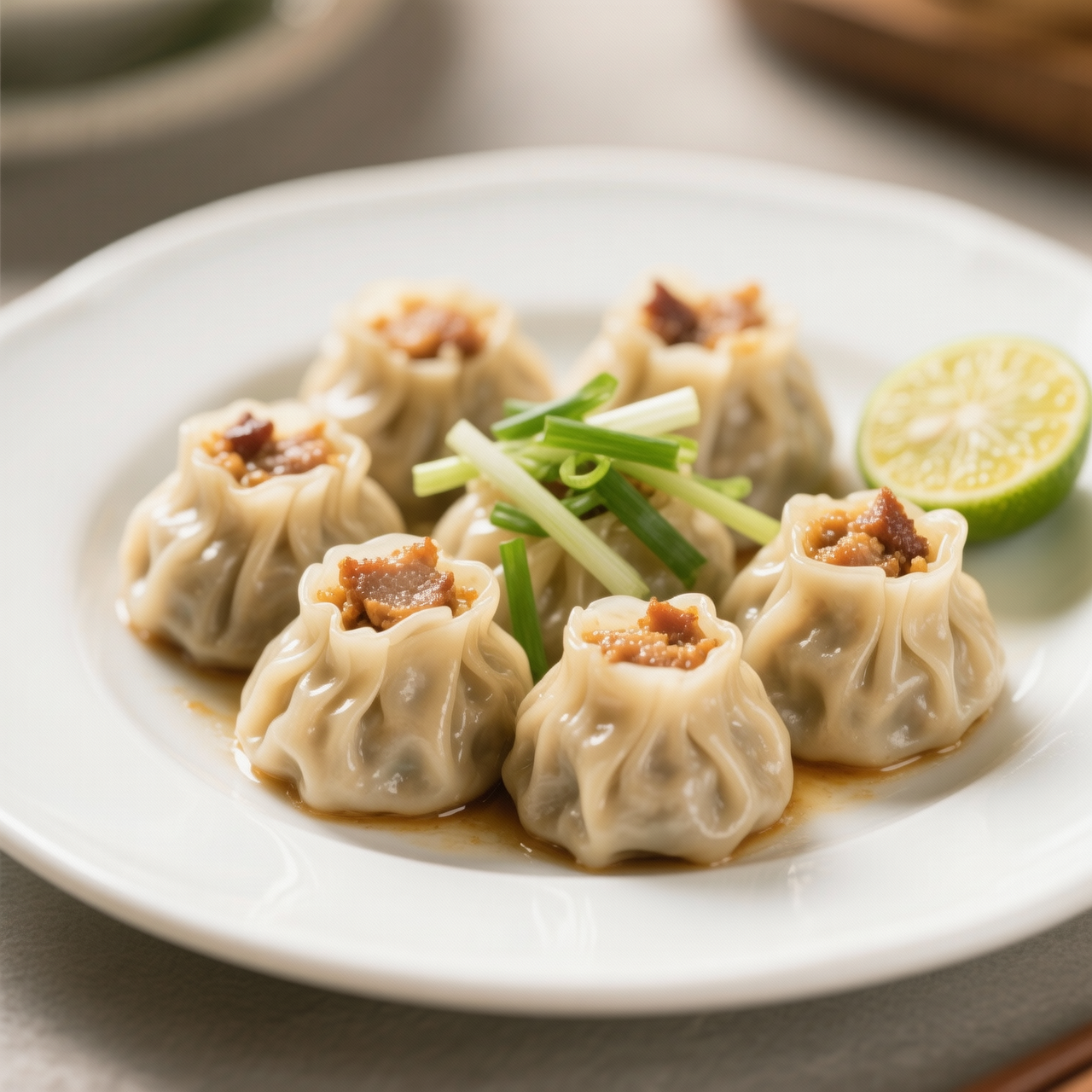
Pork Siomai
I still remember the first time I watched a tita in Quezon City pleat siomai with such rhythmic precision that her hands barely seemed to touch the dough. Filipino pork siomai began as a humble adaptation of Chinese dim sum, reshaped by local palates into the bright, garlicky street snack we know today. It matters because it proves how a simple dumpling can carry generations of neighborhood memory, yet today’s supermarket freezers are packed with mass-produced packs that cost barely a hundred pesos but taste like compressed sawdust and stabilizers. Those factory versions rely on cheap pork extenders, excessive phosphates, and rubbery casings that steam into a uniform, flavorless mush. When you make it from scratch, you reclaim that lost texture and sweetness. I always start with properly chilled, hand-minced pork shoulder, folding it with fresh garlic, toasted sesame oil, and just enough crushed black pepper to wake it up. The biggest pitfall I see home cooks face is overworking the filling until it turns pasty, which squeezes out the natural juices and leaves you with dense pellets instead of tender bites. Another common mistake is skipping the crucial rest in the fridge; without that chill, the fat melts too fast during steaming, causing the delicate wrappers to split open. You also have to handle the pleating with a light touch, leaving just enough breathing room at the top so the pork expands. Once you master that balance of patience and restraint, you will never go back to those sad, frozen blocks again.
Nutrition
| Per serving | Calories | Protein | Carbs | Fat | Sat fat | Fibre | Sugar | Sodium |
|---|---|---|---|---|---|---|---|---|
| beginner | 380kcal | 24g | 32g | 16g | 5g | 1g | 3g | 650mg |
| intermediate | 295kcal | 22g | 34g | 9g | 3g | 1g | 3g | 690mg |
| expert | 415kcal | 25g | 30g | 20g | 7g | 1g | 1g | 710mg |
Per serving · Ava-estimated — a guide, not a clinical figure.
- 500 gground pork— use a 70/30 lean-to-fat ratio for optimal juiciness
- 24 sheetwonton wrapper— round or square, keep covered to prevent drying
- 150 gshrimp(optional)— peeled, deveined, and finely chopped
- 6 clovegarlic— finely minced
- 1 tbspginger— freshly grated
- 2 tbspsoy sauce— light or regular
- 1 tspsesame oil— toasted
- 2 tbspcornstarch— acts as a binder for the filling
- 1 tspgranulated sugar
- 0.5 tspblack pepper— freshly ground
- 50 gcarrot— peeled and finely diced
- 3 tbspwater— ice cold for better emulsion
- 2 stalkgreen onion— finely sliced
Skip the expensive, preservative-heavy frozen boxes that cost nearly ten dollars and taste like salty, rubbery meat paste. This beginner-friendly approach strips away the complexity of traditional pleating and delicate dough work, replacing them with a forgiving, hand-mixed filling and a straightforward assembly method. You will combine fresh ground pork with finely minced garlic, ginger, and scallions, binding everything with a simple cornstarch slurry rather than relying on commercial emulsifiers. The key is keeping your ingredients thoroughly chilled before mixing; this guarantees a bouncy, cohesive texture without needing specialized tools or hours of kneading. Watch for the filling’s consistency—it should feel sticky and glossy, not dry or crumbly. If it resists holding together, add a splash of cold water. We skip the intimidating traditional folds, opting instead for a simple gathered pouch that seals securely with a light dab of water. Steam them gently until the wrappers turn translucent and the pork registers safely at 165°F. This method delivers authentic flavor and satisfying snap, proving that skipping the supermarket freezer aisle is both cheaper and vastly superior.
Equipment
- Bamboo steamer basket— line with parchment or cabbage leaves to prevent sticking
- Heavy rolling pin— a clean glass bottle works as a substitute
- Large mixing bowl— keep chilled in the freezer before use
- Pastry cutter(optional)— a small bowl rim works for cutting circles
Method
- 1
Mince garlic, ginger, and scallions until very fine, then fold them into the ground pork with soy sauce, sesame oil, and cornstarch.
Keep everything cold to prevent the fat from melting too early.
folding~ 3 min - 2
Mix the filling vigorously with one hand until it becomes tacky and glossy, then refrigerate for twenty minutes.
The cornstarch and agitation create a natural protein binder.
binding~ 5 min - 3
Combine flour and warm water, knead briefly until smooth, rest for ten minutes, then roll thinly and cut into three-inch circles.
A rolling pin or clean glass bottle works perfectly for flattening.
rolling~ 10 minTricky bit - 4
Place a tablespoon of chilled filling onto each wrapper, dampen the rim with water, and gather the sides upward into a loose pouch.
Press the gathered edges gently to seal without tearing the dough.
pleating~ 8 minTricky bit - 5
Arrange the siomai in a single layer inside a lined steamer basket, cover tightly, and steam over medium heat for twelve minutes.
Ensure the water boils steadily but never touches the dumplings.
steaming~ 12 min - 6
Verify the meat is opaque and firm, then transfer to a parchment-lined tray and freeze uncovered for one hour before bagging.
Flash freezing prevents the dumplings from sticking together in storage.
freezing~ 60 min
Cooking from frozen
Steam directly from frozen for 15 to 18 minutes until the filling is piping hot and the wrapper is fully translucent.
Storage times are a guide — always use your judgement and store food safely.