
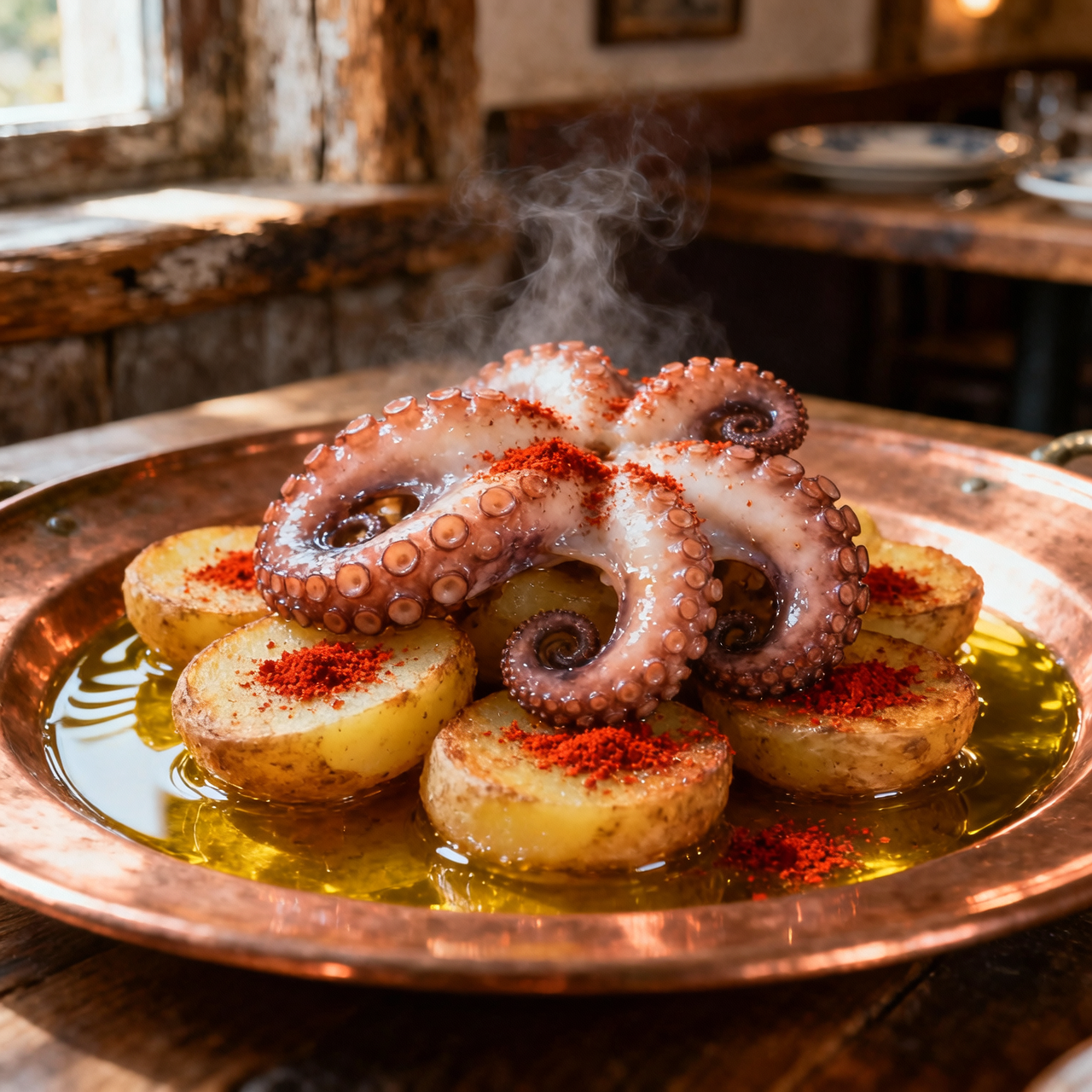
Pulpo a la Gallega
When I first encountered pulpo a la gallega on a rain-slicked plaza in Ourense, I realized it wasn't merely a dish but a quiet declaration of coastal identity. Born in Galicia, Spain's windswept northwestern corner, this octopus preparation has anchored generations of ferias and family gatherings. Its magic lies in absolute restraint: tenderized tentacles resting on thick potato slices, kissed by coarse sea salt, a measured pour of fruity olive oil, and the unmistakable crimson dust of sweet pimentón. I've come to cherish it because it demands patience and rewards precision, teaching me that the ocean's bounty doesn't need embellishment. Too often, home cooks treat the octopus as an obstacle to conquer rather than a living ingredient to coax. The most persistent pitfall is rushing the simmer, which instantly guarantees a rubbery, unforgiving bite. Others skip the crucial resting period, slicing the meat while it remains tense, or drown the platter in oil until it becomes heavy rather than luminous. Even the paprika matters deeply, as using smoked or spicy varieties overpowers the delicate brine, erasing centuries of culinary intuition. When I prepare it, I listen closely to the water, watch for the exact moment the thickest tentacles yield to gentle pressure, and trust that restraint will always outperform complication. This is why the tradition endures in my kitchen: it proves that mastery is simply the discipline of knowing exactly when to stop.
Nutrition
| Per serving | Calories | Protein | Carbs | Fat | Sat fat | Fibre | Sugar | Sodium |
|---|---|---|---|---|---|---|---|---|
| beginner | 585kcal | 60g | 36g | 18g | 2g | 5g | 2g | 480mg |
| intermediate | 585kcal | 60g | 36g | 18g | 2g | 5g | 2g | 480mg |
| expert | 585kcal | 60g | 36g | 18g | 2g | 5g | 2g | 480mg |
Per serving · Ava-estimated — a guide, not a clinical figure.
- 1500 goctopus— whole cleaned, preferably frozen and thawed for tenderization
- 800 gwaxy potato— firm flesh, skin intact
- 60 mlextra virgin olive oil— robust, fruity Spanish or Portuguese variety
- 10 gsmoked paprika— Spanish pimentón de la Vera, dulce or agridulce
- 15 gcoarse sea salt— flaky or coarse grain for seasoning and boiling
This pathway prioritizes reliability and speed, stripping away the intimidation factor often associated with cooking cephalopods. Instead of the traditional scare method and long simmer, you will use a rapid poach in a covered pot, which guarantees tenderness without constant monitoring. The paprika and oil are combined into a quick, pre-bloomed emulsion using a convenient jarred paste to prevent raw spice bitterness, and the potatoes are cooked alongside the octopus in a single vessel to minimize cleanup. Watch the water temperature closely; a rolling boil will toughen the tentacles, so maintain a gentle, steady simmer. The goal here is to build confidence with timing and plating, ensuring your first attempt delivers the expected texture and flavor balance. You will learn to recognize when the octopus is fully cooked by testing a thick tentacle with a paring knife. Keep your workspace dry when handling the hot potatoes, and dust the seasoning generously but evenly. This version teaches you the core flavor architecture while removing the guesswork, giving you a restaurant-quality result on your very first attempt.
Equipment
- large stockpot— at least six liters capacity
- sharp paring knife— for testing tenderness
- wooden cutting board— stable surface for slicing
- small mixing bowl— for combining oil and paste
Method
- 1
Fill a large pot with water and bring to a rolling boil.
Add half the coarse salt.
boiling~ 5 min - 2
Submerge the octopus tentacles and immediately cover the pot.
Maintain a gentle simmer, never a vigorous boil.
simmering~ 30 min - 3
Add the whole potatoes to the same pot halfway through cooking.
They will finish exactly when the octopus does.
poaching~ 15 min - 4
Whisk the jarred paprika paste and olive oil in a small bowl until smooth.
Let it rest to mellow the raw spice edge.
emulsifying~ 2 min - 5
Remove the octopus and potatoes, then drain thoroughly.
Pat dry to help the seasoning adhere.
draining~ 1 min - 6
Slice the octopus tentacles into uniform half-inch medallions.
Use a sharp knife for clean edges.
slicing~ 5 min - 7
Cut the potatoes into thick coins and arrange them on a serving plate.
Overlap slightly to form a base.
plating~ 2 min - 8
Scatter the octopus over the potatoes and drizzle the paprika oil evenly.
Finish with a light sprinkle of remaining coarse salt.
seasoning~ 1 min