
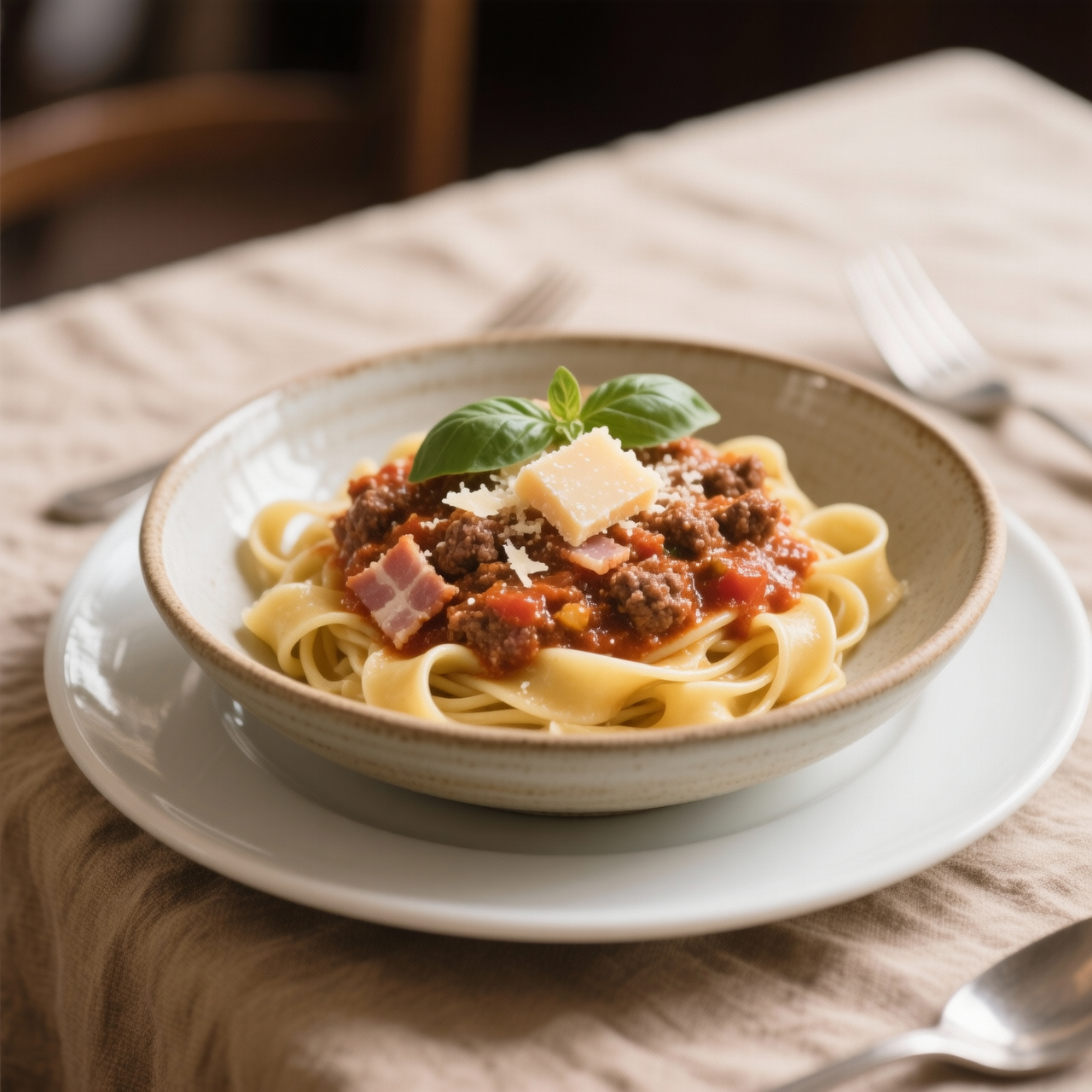
Ragù bolognese
I’ve always believed that ragù bolognese isn’t a sauce you make so much as a ritual you inhabit. Born in the kitchens of Emilia-Romagna, specifically the historic trattorias of Bologna, this meat-rich condiment was never meant to drown pasta, but to coat it in a velvety embrace. The official 1982 Accademia Italiana della Cucina recipe codified what generations of nonne already knew: patience, soffritto, and the slow coaxing of collagen from beef and pork into a deeply savory, almost sweet foundation. What makes a great version isn’t complexity; it’s restraint. You’re building layers, not throwing everything in at once. The most common pitfall I see is rushing the fond. If you don’t let the meat brown properly and the wine evaporate completely, you’ll end up with a boiled, watery mess rather than a glossy, concentrated ragù. Another mistake is over-relying on tomatoes. A true bolognese is meat-forward, with tomato playing a supporting role to add brightness, not bulk. Whether you’re using a jarred shortcut to get dinner on the table or grinding your own chuck and pancetta for a weekend project, the goal remains identical: a harmonious, long-simmered meld of fat, acid, and umami. This recipe scales beautifully, which is why I consider it a freezer champion. Make a double batch, portion it out, and you’ve secured a month of effortless, deeply comforting dinners. The only rule that truly matters here is time. Give it, and it will return the favor tenfold.
Nutrition
| Per serving | Calories | Protein | Carbs | Fat | Sat fat | Fibre | Sugar | Sodium |
|---|---|---|---|---|---|---|---|---|
| beginner | 490kcal | 26g | 14g | 36g | 15g | 3g | 8g | 780mg |
| intermediate | 510kcal | 29g | 12g | 35g | 13g | 4g | 7g | 710mg |
| expert | 500kcal | 31g | 11g | 34g | 12g | 5g | 8g | 650mg |
Per serving · Ava-estimated — a guide, not a clinical figure.
- 300 gbeef chuck— finely diced or ground, 15-20% fat
- 150 gpork shoulder— finely diced or ground
- 80 gpancetta— cured, finely diced
- 1 mediumonion— yellow, finely minced
- 1 mediumcarrot— finely minced
- 1 stalkcelery stalk— finely minced
- 40 gunsalted butter— cold, for finishing
- 2 tbspolive oil— extra virgin
- 120 mlwhole milk— full fat for best emulsion
- 150 mldry red wine— Sangiovese or similar dry varietal
- 200 gtomato passata— smooth, unseasoned
- 30 gtomato paste— concentrated
- 250 mlbeef broth— low sodium preferred
- 5 gkosher salt— adjust to taste
- 2 gblack pepper— freshly cracked
This version is designed for your first confident attempt, prioritizing clarity and forgiving margins over rigid tradition. We lean on practical shortcuts like pre-minced aromatics and store-bought broth to eliminate tedious prep without sacrificing the core flavor profile. The focus here is entirely on the sequence of heat and timing: browning the meat thoroughly before adding liquids, scraping up every bit of fond, and letting the sauce simmer gently while you handle other tasks. You will watch for the moment the mixture stops looking watery and begins to pull away from the sides of the pan, a clear visual cue that the flavors have concentrated properly. Don’t worry if the wine sputters or the milk splits slightly; this is a resilient recipe that rewards patience more than precision. Keep your heat strictly at a low-medium bubble once everything is combined, and resist the urge to stir constantly. A proper ragù needs quiet time to marry its components, and by sticking to a straightforward timeline, you’ll achieve a rich, cohesive sauce that coats pasta beautifully. It’s an ideal entry point that builds muscle memory for the more demanding techniques you’ll encounter later, proving that even simplified methods can yield deeply satisfying results when executed with care.
Equipment
- Heavy-bottomed pan— non-stick is fine here
- Wooden spoon— for gentle stirring
- Measuring cups(optional)— standard set
Method
- 1
Heat olive oil in a heavy pan over medium heat.
Pan should sizzle when meat touches surface.
sautéing~ 1 min - 2
Add the beef, pork, and pancetta, breaking it apart with a wooden spoon.
Don't rush the browning phase.
browning~ 8 minTricky bit - 3
Stir in the minced onion, carrot, and celery.
Cook until softened and translucent.
sweating~ 6 min - 4
Pour in the red wine and simmer until the liquid is reduced by half.
Scrape the bottom to release stuck bits.
deglazing~ 5 min - 5
Add tomato passata, tomato paste, and beef broth, stirring to combine.
Bring to a gentle bubble, then lower heat.
simmering~ 2 min - 6
Cover and cook on low heat, stirring occasionally, until thickened.
Adjust salt and pepper to taste.
reducing~ 30 min - 7
Remove from heat and stir in whole milk.
Let rest for five minutes before serving.
finishing~ 5 min
Cooking from frozen
Defrost overnight in the fridge, then reheat gently over low heat until piping hot.
Storage times are a guide — always use your judgement and store food safely.